




Terahertz (THz) Radar: A Solution For Degraded Visibility Environments (DVE)
Operating at higher frequencies than other types of radar produces tighter beams and finer resolution.
An accurate view of the physical world is frequently vital. For example, rotary wing aircraft pilots must have knowledge of the terrain in order to safely fly their aircraft. Therefore, systems capable of generating images of the environment of sufficient quality to facilitate the decision process are necessary. The product of such a system is illustrated in Figure 1.

Radar systems are often employed to provide an accurate image; however, the performance of radar systems in a given environment is dependent upon the frequencies at which they operate. Since objects appear different when using different observation systems, development of new approaches for viewing the world would offer new information that could prove critical in situations where currently standard techniques are inadequate. One such situation occurs in Degraded Visual Environments (DVE), such as the brownout illustrated in Figure 2. In this type of situation, the observation system must be capable of overcoming the visual obscurants and providing high resolution images of the environment in order to facilitate the decision process.
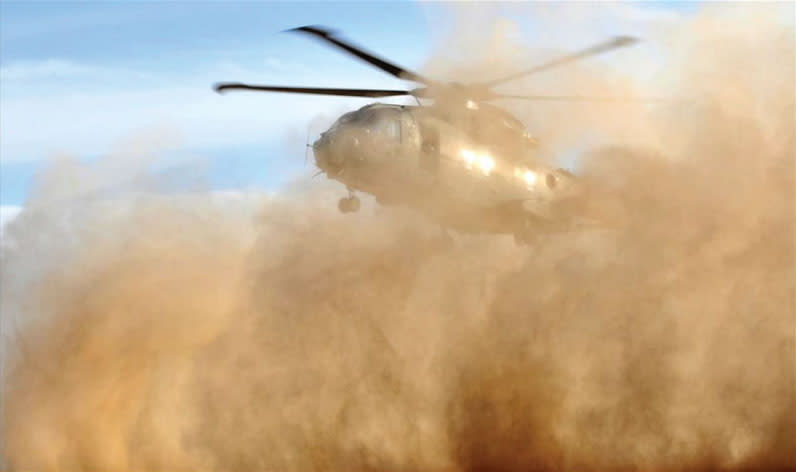
Currently, lidar, a radar-like system that utilizes frequencies in the visual spectrum and millimeter wave (MMW) radar are the most common solutions to DVE. However, while lidar can produce useful images at reasonable Size, Weight, and Power (SWaP), lidar's relatively lower obscurant penetration produces problems in several types of DVE. On the other hand, MMW radars must have a high SWaP in order to produce similar quality images, resulting in degradation of image quality in order to meet the limits of the platform on which the radar will be used.
To overcome the limitations of lidar and MMW solutions, a Terahertz (THz) radar was developed as a potential solution for DVE imaging. Although the THz band is not thoroughly explored, it offers several advantages for an imaging solution. To test the potential of a THz imager, the Active Covert Terahertz Imager (ACTI) was designed and built by Mustang Technology, now a subsidiary of L3, Inc. Operating at 300 to 330 gigahertz (GHz), the ACTI is among the world's highest frequency radars (lidar excluded). By operating at higher frequencies relative to MMWs, the ACTI can employ higher gain antennas at reasonable SWaP, thereby producing tighter beams and finer resolution. The higher frequencies also offer easy utilization of higher bandwidth components, allowing for finer range resolution. The increase in frequency and corresponding decrease in wavelength also decreases the minimum size required for an object to be detectable. In addition, while the frequency is high for a true radar, the frequency is sufficiently low for the radiation to penetrate obscurants, such as dust storms.
The ACTI is a Frequency-Modulated Continuous-Wave Radar (FMCW). The beam is mechanically steered by a rotating mirror, thus providing real beam imaging and an imaging time in single-digit seconds. The beam width is 0.5 degrees (°), and the field of view is 45° horizontal by 30° vertical. With its output power of 5 milliwatts (mW) and antenna gain of 50 decibels relative to isotropic (dBi), the ACTI is safe for imaging humans even at a range as close as 1 meter.
This work was done by Henry O. Everitt, Willie D. Caraway, and Jonathan T. Richard of the Army Research, Development, and Engineering Command. ARL-0200
This Brief includes a Technical Support Package (TSP).
TERAHERTZ (THZ) RADAR: A SOLUTION FOR DEGRADED VISIBILITY ENVIRONMENTS (DVE)
(reference ARL-0200) is currently available for download from the TSP library.
Don't have an account?
More From SAE Media Group
RF & Microwave Technology
System Could Detect Concealed Person-Borne Bombs at a Distance
Aerospace & Defense Tech Briefs
Digital Radar Warning Receiver
Tech Briefs
Toroidal Radiation Pattern Patch Antenna
Photonics & Imaging Technology
Terahertz Energy Focused by Credit Card-Sized Device to Generate High-Resolution Images
Aerospace & Defense Tech Briefs
Pathfinder Radar ISR and SAR Systems: Tactical Eyes for the Warfighter
Aerospace & Defense Tech Briefs
Co-Prime Frequency and Aperture Design for HF Surveillance, Wideband Radar Imaging, and Nonstationary Array Processing
Tech Briefs
Niobium Titanium Nitride Thin Film Coating
Aerospace & Defense Tech Briefs
Synthetic Aperture Radar for Helicopter Landing in Degraded Visual Environments
Tech Briefs
Products of Tomorrow
Aerospace & Defense Tech Briefs
Calibrated Long-Wave Infrared (LWIR) Thermal and Polarimetric Imagery of Small Unmanned Aerial Vehicles (UAVs) and Birds
Aerospace & Defense Tech Briefs
Development of an Optically Modulated Scatterer Probe for a Near-Field Measurement System
Imaging Technology
Metrology Camera System Using Two-Color Interferometry
Aerospace & Defense Tech Briefs
Detecting Drones with Doppler-Based Radar
Aerospace & Defense Tech Briefs
Airborne Antenna Considerations for C-Band Telemetry Systems
Aerospace & Defense Tech Briefs
Directed-Energy System to Defeat Small Unmanned Aircraft System Swarms
Aerospace & Defense Tech Briefs
SAE International Extends Call for Abstracts, Seeks Submissions for AeroTech Conference
Tech Briefs
Radio Signals Image Hidden and Speeding Objects
Aerospace & Defense Tech Briefs
Next-Generation Phased Radar Systems Lead to Hardware Improvements
Autonomous Vehicle Engineering
Imaging Radar Is the Next Big Thing
Aerospace & Defense Tech Briefs
New, Portable Antenna Could Help Restore Communication After Disasters
Tech Briefs
Electric Nanoscale Device Sees Through Walls
Photonics & Imaging Technology
T-Ray Camera Speed Boosted a Hundred Times Over
Aerospace & Defense Tech Briefs
Development of a 94 GHz Radar System for Dedicated Bird Detection at Airports and Airfields
Automotive Engineering
Single-chip digital imaging radar heads for 2022 production
Tech Briefs
Nuclear Radiation-Detecting Device
Aerospace & Defense Tech Briefs
A New Concept for Improving the Performance of Electrically Small Antennas


Overview
The technical report titled "Terahertz (THz) Radar: A Solution For Degraded Visibility Environments (DVE)" discusses the development and testing of an experimental radar system that operates at terahertz frequencies. Authored by Henry O. Everitt, Willie D. Caraway, and Jonathan T. Richard, the report highlights the importance of accurate imaging in environments where visibility is compromised, such as during brownout conditions encountered by rotary wing aircraft pilots.
The introduction emphasizes the necessity for systems that can generate high-quality images of the environment to aid decision-making in critical situations. Traditional radar systems have limitations based on the frequencies they operate at, which can affect their performance in various environments. The report suggests that new approaches, particularly those utilizing THz frequencies, could provide enhanced imaging capabilities that are crucial in Degraded Visual Environments (DVE).
The report outlines the current approaches to radar technology and introduces the concept of using THz waves for improved imaging. It details the experimentation phase, where the imaging capabilities of the THz radar system were tested. Preliminary results indicate that the system can produce high-resolution images and can adjust its frequency to adapt to different environmental conditions, thereby overcoming some of the challenges posed by visual obscurants.
The results section presents encouraging findings that validate the system's effectiveness in generating actionable images in DVE scenarios. The report concludes with a discussion on future efforts, suggesting that further research and development could enhance the capabilities of THz radar systems, making them a viable solution for various applications where visibility is a concern.
Overall, the report underscores the potential of THz radar technology to significantly improve situational awareness and safety in environments where traditional imaging techniques fall short. It serves as a foundation for ongoing research in radar technology, aiming to address the challenges posed by degraded visibility and enhance operational effectiveness in critical missions.
Top Stories
INSIDERManufacturing & Prototyping
 How Airbus is Using w-DED to 3D Print Larger Titanium Airplane Parts
INSIDERManned Systems
 FAA to Replace Aging Network of Ground-Based Radars
NewsTransportation
 CES 2026: Bosch is Ready to Bring AI to Your (Likely ICE-powered) Vehicle
NewsSoftware
 Accelerating Down the Road to Autonomy
EditorialDesign
 DarkSky One Wants to Make the World a Darker Place
INSIDERMaterials
 Can This Self-Healing Composite Make Airplane and Spacecraft Components Last...
Webcasts
Defense
 How Sift's Unified Observability Platform Accelerates Drone Innovation
Automotive
 E/E Architecture Redefined: Building Smarter, Safer, and Scalable...
Power
 Hydrogen Engines Are Heating Up for Heavy Duty
Electronics & Computers
 Advantages of Smart Power Distribution Unit Design for Automotive...
Unmanned Systems
 Quiet, Please: NVH Improvement Opportunities in the Early Design...
