




Kestrel Wide-Area Sensor Upgrades
In late May, Logos Technologies delivered the first payload upgrade to the Kestrel wide-area sensor, employed on U.S. Navy and Army aerostats in Afghanistan. The new hardware will provide better image stability, increased system reliability, and easier maintenance of Kestrel units already in the field.
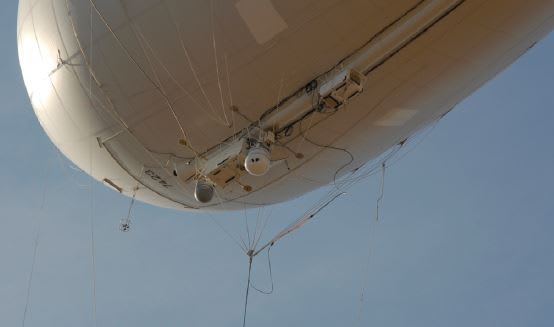
A critical intelligence, surveillance and reconnaissance (ISR) asset in safeguarding troops operating in and around forward operating bases, the operational, 360-degree persistent surveillance system is light enough to be mounted on an aerostat. The technology allows sensor operators to scan a city sized area, 24 hours a day, for weeks at a time.
Kestrel also allows operators to create “watch boxes” within the sensor’s larger field of view. The system will automatically monitor those areas and trigger an alarm if someone enters them. The sensor user can then investigate the area, cueing a hi-resolution MX camera to provide supporting imagery.
Besides force protection, Kestrel facilitates the intelligence collection process by recording events within its field of view, allowing analysts to identify actions that deviate from the normal pattern of life. Operators can run this DVR-like function in one window while tracking real-time activity in another.
In addition to recent payload improvements, Logos Technologies has been delivering software upgrades to the manned ground stations controlling the airborne sensor. The upgrades increase Kestrel’s processing power and storage, allowing for larger fields of view and a rewind capability that extends beyond 30 days. Finally, a new forensic bookmark database was added to boost pattern-of-life data exploitation.
Kestrel is an advanced version of Constant Hawk, first deployed in 2006 as part of a Quick Reaction Capability. Also developed by Logos Technologies, this early persistent surveillance system has flown on Shorts 360 and MC-12W Liberty aircraft in Iraq and Afghanistan, respectively. In late 2010, Army G2 and the U.S. Navy’s Naval Air Command engaged Logos Technologies to develop a Constant Hawk-like sensor for an aerostat, and within 12 months, an interim electro-optical solution was deployed to Afghanistan. This temporary system was later replaced by day/night sensors.
Currently, there are 10 day/night Kestrels, plus an equal number of spares, at forward operating bases in Afghanistan. Another 8 sensors and 8 backup systems were scheduled for delivery by October.
Logos Technologies
Fairfax, VA
703-584-5725
www.logos-technologies.com
For Free Info Click Here
More From SAE Media Group
Aerospace & Defense Tech Briefs
Surveillance Systems
Aerospace & Defense Tech Briefs
Unmanned Hover Plane
Aerospace & Defense Tech Briefs
Autonomous Collaborative Platform
Aerospace & Defense Tech Briefs
Nano-UAV Systems
Aerospace & Defense Tech Briefs
Video Encoders
Aerospace INSIDER
Bombardier to Start Building New Army HADES Prototype Spy Plane
Aerospace & Defense Tech Briefs
Counter UAS Defense System
Aerospace & Defense Tech Briefs
Enabling Off-the-Shelf Autonomous Naval Warfare

Aerospace INSIDER
Navy Completes 73-Hour Nonstop Flight of Solar-Powered UAS
Aerospace & Defense Tech Briefs
Counter-UAS Technology
Aerospace & Defense Tech Briefs
Insitu ScanEagle SUAS Boosts Coast Guard Mission Effectiveness
Automotive Engineering
Logos Technologies Redkite Airborne, Wide-Area Sensor Takes Flight in the Netherlands
Aerospace & Defense Tech Briefs
Unmanned Aircraft System Offers Superior Surveillance Imagery
Aerospace & Defense Tech Briefs
Mobile Counter Unmanned Aircraft System
Aerospace & Defense Tech Briefs
Unmanned Demonstrator Aircraft for Maritime Surveillance
Aerospace & Defense Tech Briefs
F/A-18 Infrared Search and Rescue System
Aerospace & Defense Tech Briefs
EO/IR Maritime Payload
Aerospace & Defense Tech Briefs
Predator Mission Aircrew Training Systems
Aerospace & Defense Tech Briefs
Maritime Unmanned Aircraft System
Aerospace & Defense Tech Briefs
Autonomous Helicopters
Aerospace & Defense Tech Briefs
Textron Systems, Textron Aviation Defense Demonstrate Simulated Manned-Unmanned Teaming Capability
Defense INSIDER
MQ-25, H-1 Test Next-Gen Satellite Communications
Aerospace & Defense Tech Briefs
Effectiveness of Inter-Vehicle Communications and On-Board Processing for Close Unmanned Autonomous Vehicle Flight Formations
Aerospace & Defense Tech Briefs
Remotely Piloted Air Systems
Aerospace & Defense Tech Briefs
Preparing Germany’s New Surveillance Aircraft for Service
Aerospace & Defense Tech Briefs
Rugged Processors and Ethernet Switches
Aerospace & Defense Tech Briefs
Multi-Sensor Electro-Optic Platform
Aerospace & Defense Tech Briefs
Low-Impact CUAS System
Top Stories
INSIDERManufacturing & Prototyping
 How Airbus is Using w-DED to 3D Print Larger Titanium Airplane Parts
NewsAutomotive
 Microvision Aquires Luminar, Plans Relationship Restoration, Multi-industry Push
INSIDERAerospace
 A Next Generation Helmet System for Navy Pilots
INSIDERDesign
 New Raytheon and Lockheed Martin Agreements Expand Missile Defense Production
ArticlesAR/AI
 CES 2026: Bosch is Ready to Bring AI to Your (Likely ICE-powered) Vehicle
Road ReadyDesign

Webcasts
Semiconductors & ICs
 Advantages of Smart Power Distribution Unit Design for Automotive...
Unmanned Systems
 Quiet, Please: NVH Improvement Opportunities in the Early Design...
Electronics & Computers
 Cooling a New Generation of Aerospace and Defense Embedded...
Power
 Battery Abuse Testing: Pushing to Failure
AR/AI
 A FREE Two-Day Event Dedicated to Connected Mobility
