




Truck & Off-highway Engineering - August 2018
Inside this issue
Overview
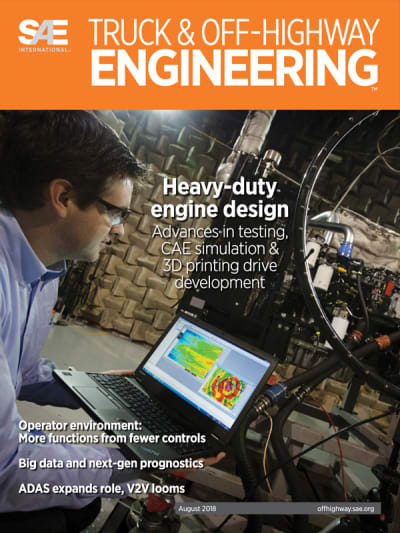
The August 2018 issue of Truck & Off-Highway Engineering presents a comprehensive overview of the latest advancements and trends in the commercial vehicle industry, focusing on efficiency, safety, and technological innovations. The editorial emphasizes the importance of intelligence in driving these improvements, highlighting discussions from a recent press workshop attended by leaders from global commercial vehicle manufacturers. The workshop addressed critical challenges such as electrification, autonomous operation, and connectivity, setting the stage for the upcoming IAA Commercial Vehicles trade show in Hannover, Germany.
Key Features and Innovations:
-
Active Safety and Connectivity: The issue explores the expanding role of Advanced Driver Assistance Systems (ADAS) and vehicle-to-vehicle (V2V) communication. These technologies are crucial for enhancing safety and operational efficiency in commercial vehicles. The integration of these systems is expected to significantly reduce accidents and improve traffic management.
-
Operator Comfort: A focus on operator comfort is evident with Denso's introduction of driver monitoring systems tailored for the commercial vehicle market. This innovation aims to enhance driver awareness and reduce fatigue, ultimately leading to safer driving conditions.
-
Chassis and Electrification: AxleTech's development of an electric independent suspension concept for vehicles with a gross combined weight rating (GCWR) of up to 58,000 pounds is a notable highlight. This advancement not only improves ride quality but also supports the electrification trend in heavy-duty vehicles, aligning with industry demands for cleaner and more efficient powertrains.
Design Tools: The issue discusses Mentor's design tool that simplifies the development of J1939, a communication protocol used in heavy-duty vehicles. This tool is essential for engineers looking to streamline the design process and ensure compliance with industry standards.
-
Heavy-Duty Engine Design: A feature article delves into the challenges of heavy-duty engine design, emphasizing the need for cleaner, more durable, and fuel-efficient engines. Developers are increasingly relying on computer-aided engineering (CAE) simulations, enhanced testing methods, and 3D printing technologies to meet stringent regulations and market demands.
-
Operator Environment: The evolution of operator controls, including switches, knobs, and touch panels, is discussed in the context of reducing operator fatigue. The design of these interfaces is critical for maintaining high levels of productivity and comfort in demanding work environments.
-
Predictive Maintenance: The issue highlights the importance of smart data-analyzing procedures that support predictive maintenance. These innovations are expected to significantly increase the uptime of heavy-duty vehicles, a topic that was addressed at the "Evolution of Big Data" symposium during the SAE COMVEC 2018 event.
-
Product Innovations: The magazine features a section on product briefs, spotlighting hydraulic components and other essential technologies that enhance the performance and reliability of commercial vehicles. This section serves as a valuable resource for industry professionals seeking the latest products and solutions.
-
Industry Insights: The Q&A segment features insights from Deutz, which is advancing its 'E' strategy with prototypes on the horizon. This reflects the industry's shift towards electrification and the development of sustainable technologies.
Conclusion: The August 2018 issue of Truck & Off-Highway Engineering serves as a vital resource for industry professionals, providing insights into the latest technological advancements and trends shaping the future of commercial vehicles. With a strong emphasis on safety, efficiency, and operator comfort, the magazine highlights the ongoing evolution of the industry in response to regulatory pressures and market demands. As the sector moves towards greater electrification and connectivity, the innovations discussed in this issue are poised to play a crucial role in enhancing the performance and sustainability of heavy-duty vehicles.
Features
Regulars
-
Technical Innovations
Mentor Design Tool Simplifies J1939 Development
ADAS Features Expand Role, V2V Looms
Denso Bringing Driver Monitoring to Commercial-Vehicle Market
Link Readies Semi-Active Cab Suspension for Intro on Select 2020 Models
AxleTech Develops Electric Independent Suspension Concept for Vehicles Up to 58,000-lb GCWR
-
Original Equipment
Volvo Trucks, FedEx Demonstrate 3-Truck Platoon on North Carolina Highway
Komatsu Targets Productivity, Operator Comfort With New WA480-8 Wheel Loader
Top Stories
NewsSensors/Data Acquisition
 Microvision Aquires Luminar, Plans Relationship Restoration, Multi-industry Push
INSIDERRF & Microwave Electronics
 A Next Generation Helmet System for Navy Pilots
INSIDERWeapons Systems
 New Raytheon and Lockheed Martin Agreements Expand Missile Defense Production
NewsAutomotive
 Ford Announces 48-Volt Architecture for Future Electric Truck
INSIDERAerospace
 Active Strake System Cuts Cruise Drag, Boosts Flight Efficiency
ArticlesTransportation

Webcasts
Aerospace
 Cooling a New Generation of Aerospace and Defense Embedded...
Energy
 Battery Abuse Testing: Pushing to Failure
Power
 A FREE Two-Day Event Dedicated to Connected Mobility
Automotive
 Quiet, Please: NVH Improvement Opportunities in the Early Design Cycle
Electronics & Computers
 Advantages of Smart Power Distribution Unit Design for Automotive &...
Unmanned Systems
 Sesame Solar's Nanogrid Tech Promises Major Gains in Drone Endurance