




Magnetic Random Access Memory Integrated Passive Components
Radiation-hard, nonvolatile memory used in strategic parts of electronic systems offers increased responsiveness and reduced power consumption.
An embedded magnetic memory technology was developed to be integrated into a Complementary Metal Oxide Semiconductor (CMOS) circuit fabrication process to provide radiation-hard logic elements and small random access memories. The goal was not to provide large scale, bulk memory, but latches and flip-flops that serve as state and data registers for sequential logic, and configuration registers for configurable logic. The benefits include the ability to power down a subsystem while retaining system state, thus saving energy until the subsystem is required. The subsystem can then be powered up and begin operating in milliseconds.
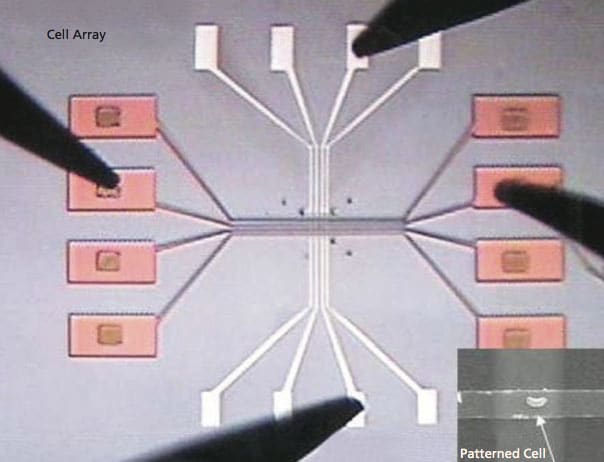
The second thrust of this research was to develop new families of on-chip passive components, particularly inductors and programmable resistors. Today’s CMOS processing technologies are highly optimized for making small, high-performance active components, or transistors. Options for on-chip passive components, including resistors, capacitors, inductors, and transformers, are limited. In particular, component values and quality of integrated passive components are very limited. Digital circuits are designed to work well without integrated passives, but analog circuits require quality passive components with a wide range of values. The ability to set passive component values electronically – to program them – would make possible a new kind of programmable analog circuit.
Radiation-hard, nonvolatile memory used in strategic parts of electronic systems offer increased responsiveness and reduced power consumption. A processor that uses nonvolatile memory for primary off-chip storage does not need to be “booted” after it is powered down; it can be powered back up in an “instanton” state, saving startup time and power. Nonvolatile magnetic tunneling junction memory can provide this “instanton” capability. The magnetic storage cells themselves consume no power when not being accessed, and are inherently radiation-hard.
The major elements of the project were to develop and optimize a functional magnetic storage cell; develop an optimized “free” layer, whose magnetic orientation can be easily switched by a magnetic field; develop a complete MTJ cell, incorporating the optimized free layer, whose resistance can be established by switching the magnetic polarity of the free layer; develop and model data storage circuits based on the MTJ cells; and integrate the MTJ cells into a CMOS process.
Two kinds of circuits were designed and simulated: a differential magnetic flip-flop and a magnetic shadow flip-flop. MTJs are placed between the P and N halves of a 4-transistor latch. The MTJs are programmed to opposite states. In case of a single-event upset, the flip-flop will restore the original state as follows: One of the signals, L or R, will fall faster than the other, due to the difference in MTJ resistance. Positive feedback will force the appropriate output, Q or QN, to be low. The MTJs provide resistor isolation for SEU immunity.
The specifications for the MTJ cells required for successful implementation of the magnetic latches are nominal resistance of 10 KΩ and a tunneling magnetic resistance (TMR) ratio of 15%. The preferred size and shape is an elongated PacMan, 1 μm in length. Integrating the MTJ cells onto a CMOS process proved elusive because of the difficulties in creating a metal surface smooth enough to accept the cells. This is necessary in order to carry out the next phases of the research, i.e., to develop accurate electronic circuit models, to implement the on-wire writing scheme, and finally, to integrate MTJ cells with CMOS electronics.
This work was done by Gregory W. Donohoe of the University of Idaho for the Air Force Research Laboratory. For more information, download the Technical Support Package (free white paper) at www.defensetechbriefs.com/tsp under the Electronics/Computers category. AFRL-0175
This Brief includes a Technical Support Package (TSP).
Magnetic Random Access Memory Integrated Passive Components
(reference AFRL-0175) is currently available for download from the TSP library.
Don't have an account?
More From SAE Media Group
Aerospace & Defense Tech Briefs
Magnetic Memory Devices for Embedded Computing
Tech Briefs
Magnetic Random-Access Memories
Tech Briefs
Minimal Power Latch for Single-Slope ADCs
Aerospace & Defense Tech Briefs
Improved Magnetic Sensor Based on Giant Magneto-Impedance
Tech Briefs
X-Band, 17-Watt Solid-State Power Amplifier
Aerospace & Defense Tech Briefs
Content Addressable Memory (CAM) Technologies for Big Data and Intelligent Electronics Enabled By Magneto-Electric Ternary CAM
Electronics & Sensors INSIDER
A New Magnetic Transistor for More Energy-Efficient Electronics
Tech Briefs
Watchdog Timer and Reset Control Circuit
Tech Briefs
Bounceless Switch/Monostable Multivibrator
Tech Briefs
Instrumentation System Diagnoses a Thermocouple
Motion Design INSIDER
Smart Microrobots Walk Autonomously

Tech Briefs
SEU-Tolerant Flip-Flops
Aerospace & Defense Tech Briefs
DC Power Converter for 200°C Containing SiC Transistors
Sensor Technology
Near-Zero-Power Temperature Sensor
Tech Briefs
Single Event Upset Suppression System (SEUSS)
Tech Briefs
164-GHz MMIC HEMT Frequency Doubler
Automotive Engineering
Clarios to Build Supercapacitor Plant in U.S.
Tech Briefs
Next-Generation Computer Chip Has Two Heads

Electronics Tech Briefs
High-Power-Density DC-to-DC Power-Converter Modules
Tech Briefs
Power-Amplifier Module for 145 to 165 GHz
Overview
The document titled "MAGNETIC RANDOM ACCESS MEMORY; INTEGRATED PASSIVE COMPONENTS" is a final report authored by Gregory W. Donohoe from the University of Idaho, published by the Air Force Research Laboratory in June 2010. It focuses on advancements in Magnetic Random Access Memory (MRAM) and integrated passive components, highlighting their innovations, benefits, and approaches.
The report begins with an executive summary that outlines the significance of MRAM technology, which is characterized by its non-volatile memory capabilities, allowing data retention without power. The introduction section elaborates on MRAM innovations, detailing its advantages over traditional memory technologies, such as faster speeds, lower power consumption, and greater endurance. The document emphasizes the potential of MRAM to revolutionize memory storage in various applications, including computing and telecommunications.
The report further explores the development of Magnetic Tunnel Junction (MTJ) cells, which are fundamental to MRAM technology. It discusses the optimization of soft magnetic elements and the design of complete MTJ cells, as well as the integration of these cells into storage circuits. Key topics include one-wire writing schemes and single-wire programming, which enhance the efficiency of memory operations. The integration of MRAM into Complementary Metal-Oxide-Semiconductor (CMOS) circuits is also examined, with results from integration studies presented to demonstrate the feasibility and performance of these technologies.
In addition to MRAM, the report addresses the development of integrated passive components, such as ferrite-clad inductors and programmable resistors. It highlights innovations in low-temperature ferrites and their applications in power circuits and digital loads, showcasing the benefits of integrating passive components into electronic systems.
The conclusion summarizes the findings and emphasizes the importance of continued research and development in both MRAM and integrated passive components to meet the growing demands of modern electronic devices. The report is intended for public release, making it accessible to a wide audience, including researchers, engineers, and policymakers interested in advancements in memory technology and integrated circuits.
Overall, this document serves as a comprehensive resource on MRAM and integrated passive components, providing insights into their development, benefits, and future potential in the field of electronics.
Top Stories
INSIDERDefense
 New Raytheon and Lockheed Martin Agreements Expand Missile Defense Production
NewsAutomotive
 Ford Announces 48-Volt Architecture for Future Electric Truck
INSIDERManufacturing & Prototyping
 Active Strake System Cuts Cruise Drag, Boosts Flight Efficiency
ArticlesTransportation
 Accelerating Down the Road to Autonomy
INSIDERMaterials
 How Airbus is Using w-DED to 3D Print Larger Titanium Airplane Parts
Road ReadyTransportation

Webcasts
Electronics & Computers
 Cooling a New Generation of Aerospace and Defense Embedded...
Power
 Battery Abuse Testing: Pushing to Failure
Connectivity
 A FREE Two-Day Event Dedicated to Connected Mobility
Automotive
 Quiet, Please: NVH Improvement Opportunities in the Early Design Cycle
Transportation
 Advantages of Smart Power Distribution Unit Design for Automotive &...
Aerospace
 Sesame Solar's Nanogrid Tech Promises Major Gains in Drone Endurance