




Cummins Mid-bore X10 Engine Raises the Performance Bar
Based on Cummins’ HELM platform, the latest X10 will replace the L-Series and X12 as Cummins medium-duty mule.
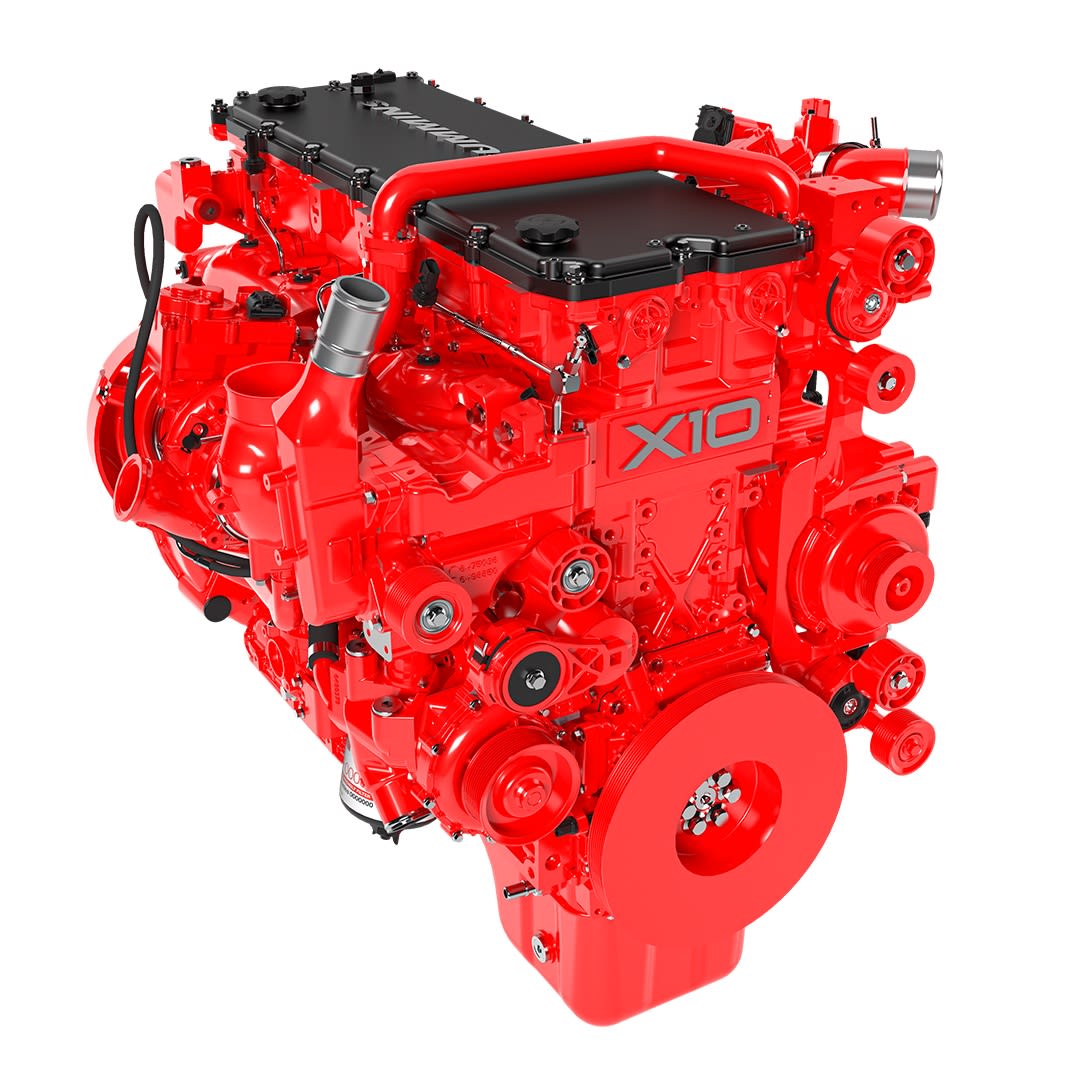
Cummins has continued to roll out new engine architectures under its fuel-agnostic HELM platform. The past year saw several introductions of new engines that are part of this new family, many of which are replacing multiple engines in the Cummins lineup.
While the large-bore X15 engine and unique B6.7 Octane gasoline engine garnered most of the attention, Cummins also introduced a medium-bore HELM variant last year. The X10 HELM engine replaces both the L9 and the X12 mills and reportedly delivers up to 450 hp (335 kW) and 1,650 lb-ft (2,237 Nm) of torque for heavy-duty applications. A medium-duty version with 380 hp (283 kW) and 1,250 lb-ft (1,695 Nm) is also available.
Cummins claims a fuel economy improvement of 2-4% compared to the outgoing engines. The X10 has been optimized for vocational applications ranging from local delivery, regional haul, transit bus and emergency response vehicles.
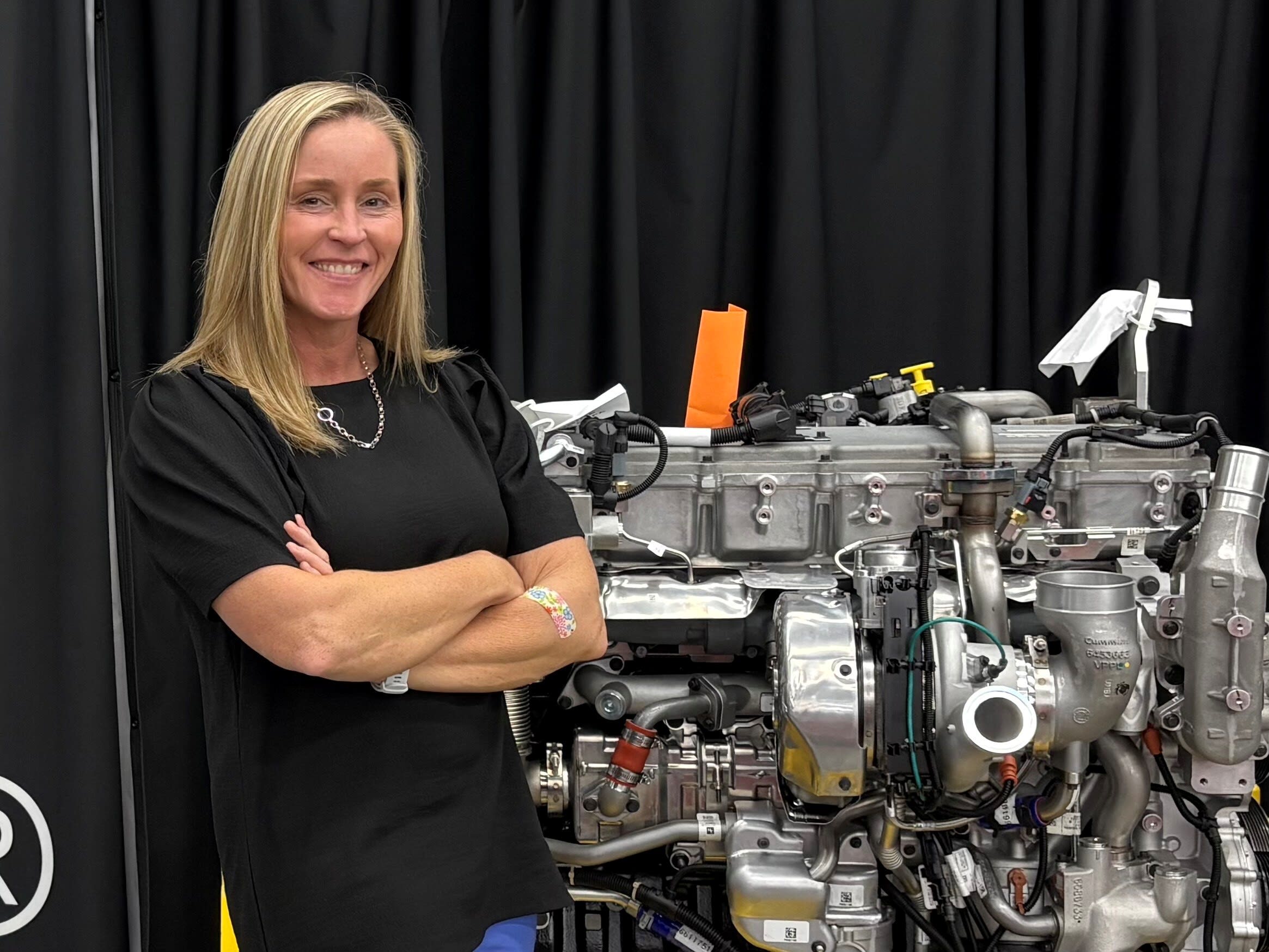
“The X10 brings robust capabilities, exceptional durability and unmatched versatility to customers looking for heavy-duty performance in a more compact, efficient package,” said Jose Samperio, VP North American on-highway engine business. “We’re confident the X10 will offer our customers the right engine to help them meet their operational goals.”
Limited production of the HELM X10 is expected in late 2026 with full series production to follow in 2027. The engine will be paired with transmission options including fully integrated powertrains from the Eaton and Cummins joint venture.
Heir to a legacy
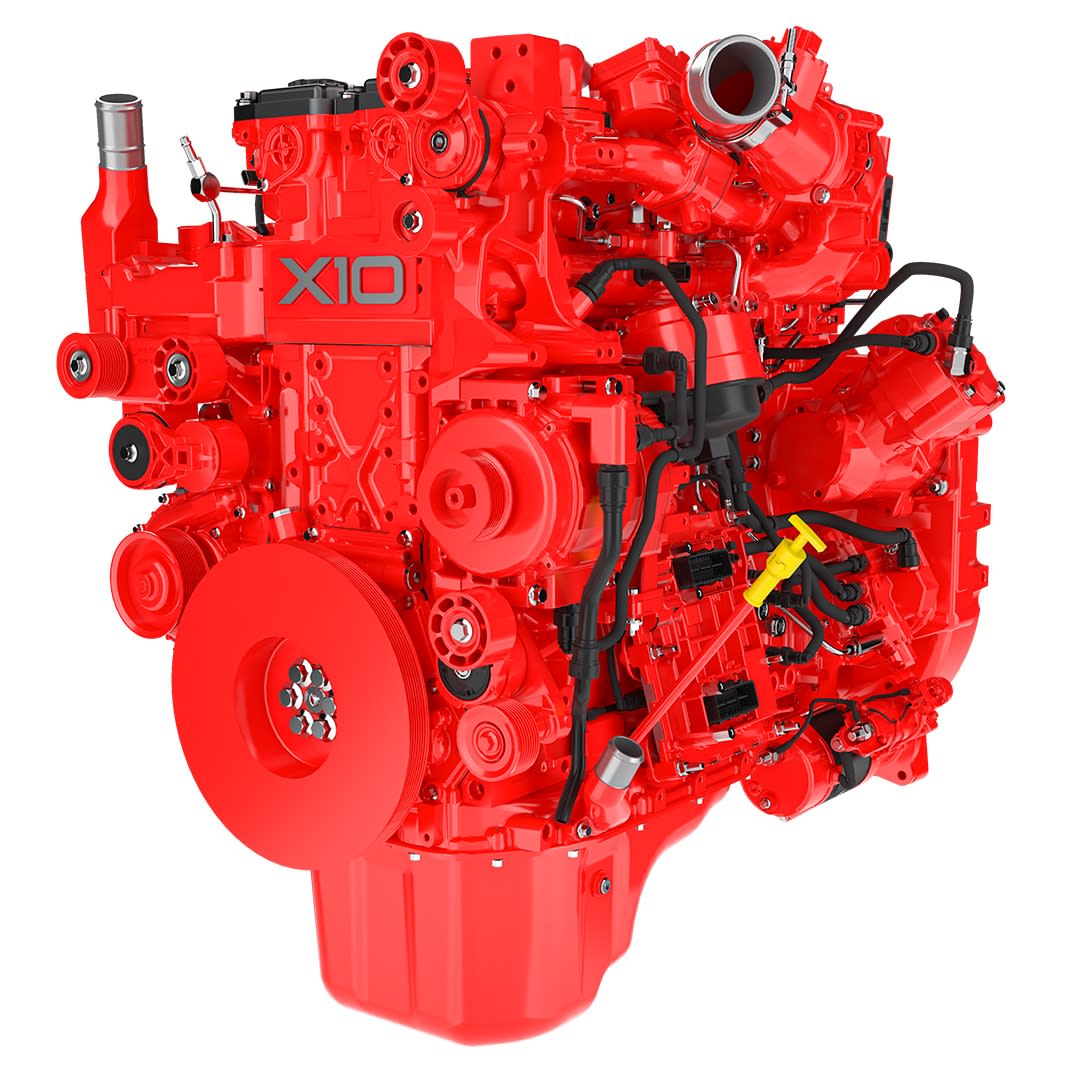
The X10 has some well-worn shoes to fill as the replacement for the venerable L9. The L-series has been in production since 1982 and has gained a loyal fanbase as a durable workhorse. Though many fleet owners may mourn the death of this dependable powerplant, Cummins is confident that the X10 will be a fitting successor to one of its most successful engines.
To that end, the X10 includes several durability-focused features like enhanced front and rear PTO capabilities that increase its flexibility for vocational equipment with up to 590 lb-ft (800 Nm) of continuous operation capacity and up to 664 lb-ft (900 Nm) intermittent. The engine also features a wet-sleeve cylinder design for better serviceability and long-term durability.
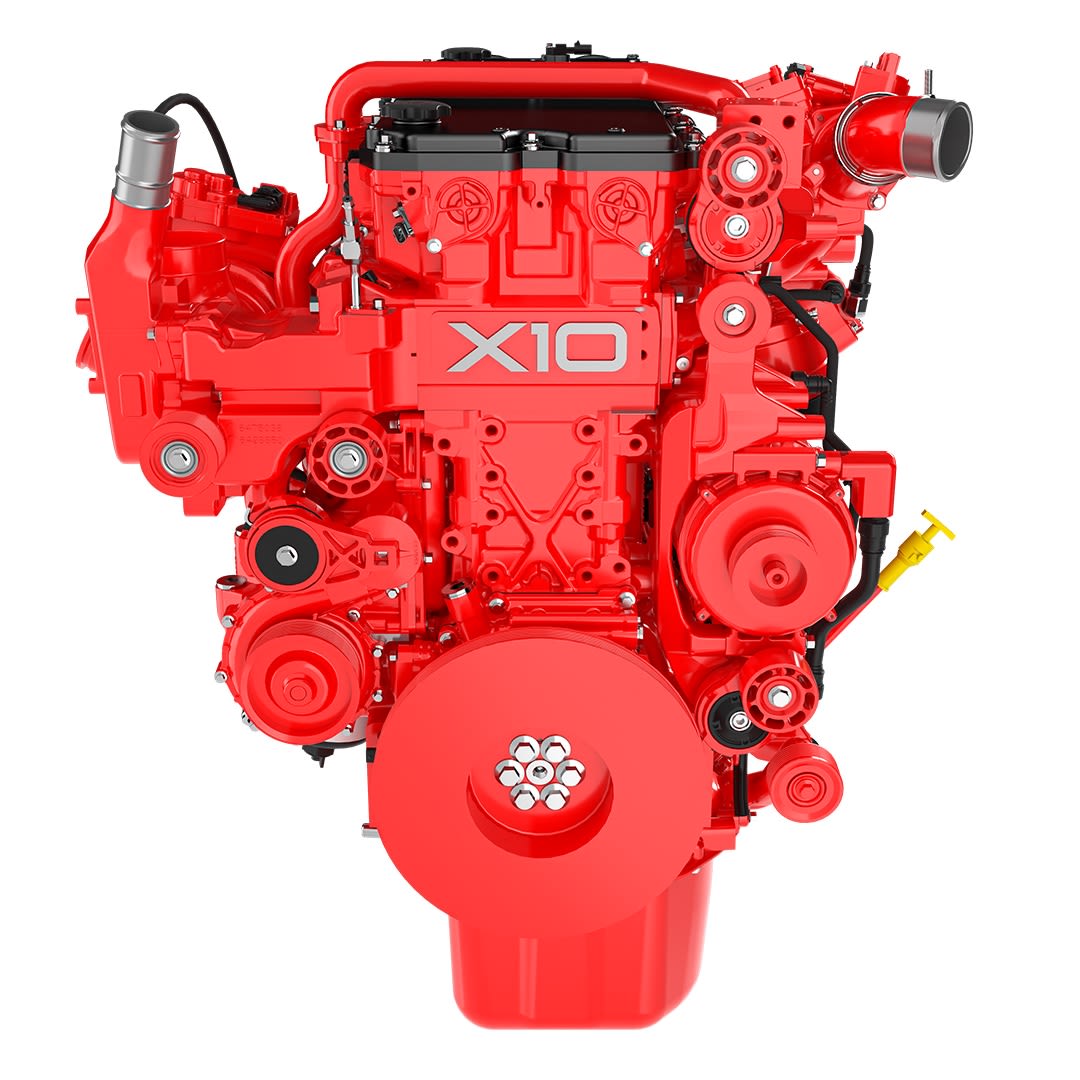
The X10 is capable of integrated braking power of up to 475 hp, helping drivers maintain control on steep grades and reducing wear on service brakes. A transmission-mounted braking system offering enhanced deceleration control is optional.
Compared to the X12, which was already one of the lightest engines in its class, the X10 is roughly 100 lb (45 kg) lighter. The outgoing X12 weighed in at 2,050 lb (930 kg) dry. Most of the weight loss comes from the X10’s sculpted block design that retains strength in necessary areas but optimizes material usage.
All in the family
The X10 HELM engine shares many of its features with its bigger displacement brother, the X15. These shared traits include Cummins’ seventh generation heavy-duty variable geometry turbocharger, an EGR cooler, new piston bowl design with a higher compression ratio and an upgraded fuel system that operates at 3,190 psi (2,200 bar).
The X10 also shares the X15’s dual thermostat design and other cooling system improvements that reduce parasitic losses, as well as a closed crankcase ventilation system that helps the X10 meet EPA 2027 standards.
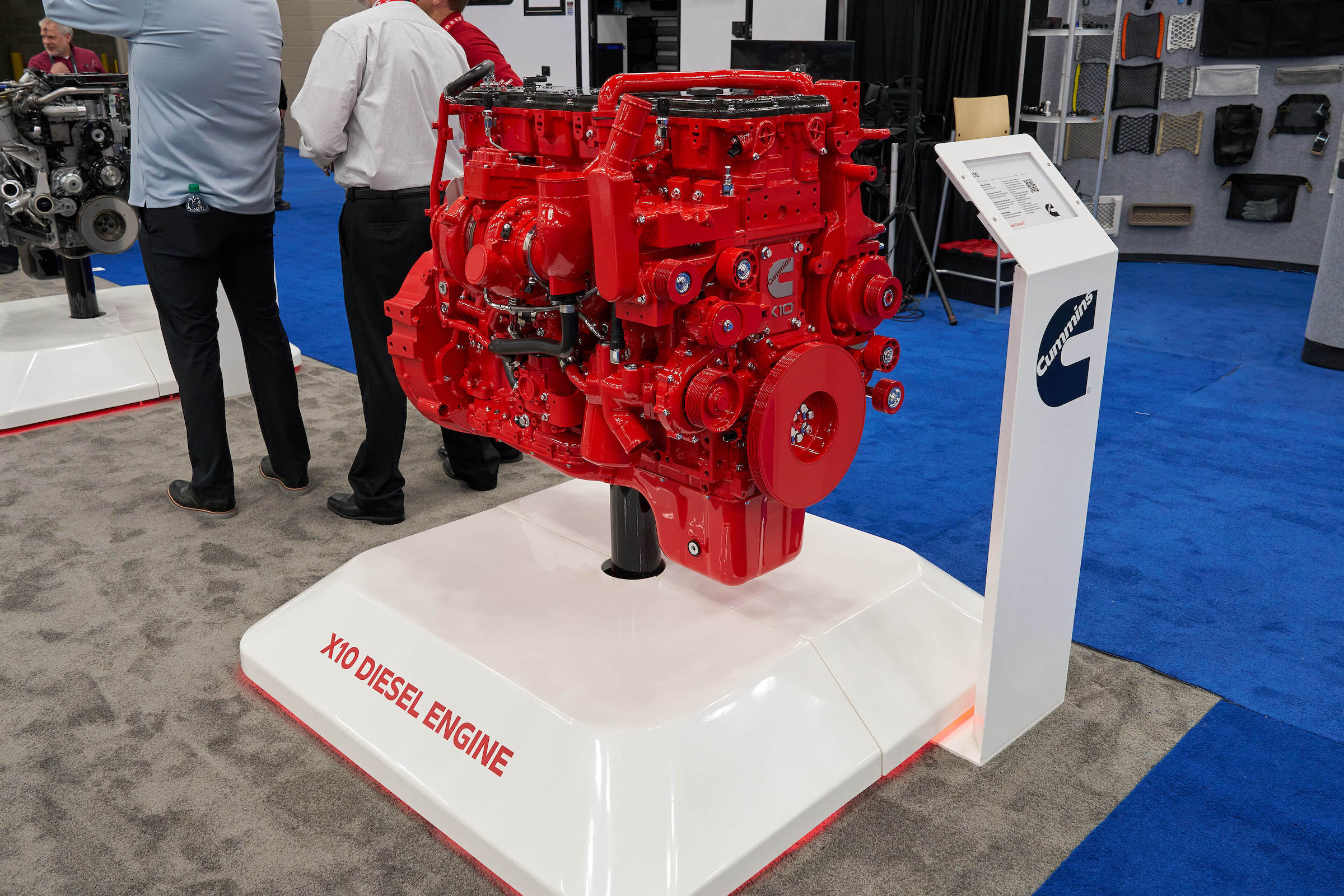
On the maintenance side, the X10 uses cartridge-style oil and fuel filters like the HELM X15, which reduce the cost of maintenance and environmental impact. Also shared with the X15 is the 48V alternator paired with a dedicated belt drive. Manual valve adjustments will also be part of the X10’s service regimen. According to Cummins, specific service intervals are still being finalized as development continues and will be communicated prior to the launch of formal service training.
While some long-time users of the L9 may be wary of all the new tech in the latest X10, Cummins is confident that they will take to the new offering quickly. “The L9 is in nearly every application Cummins’ on-highway segment serves,” said Tara Johnson, Cummins North America on-highway X10 product manager. “The X10 builds on that success with even greater versatility and capability for those customers.”
Kyle Richardson, X15 product manager at Cummins, also believes legacy customers will be impressed with the X10’s power and durability compared to the larger X12.
“The top X12 rating for refuse due to the speed governor is 380 horsepower and roughly 1,450 lb-ft of torque,” he said. “It’s the same for the mixers. They are using 430 hp and 1,400, 1,450 lb-ft [engines], so they will get the exact same torque curve [as the X12].”
“Drivability wise, the first thing [fleet owners] have been concerned about is, ‘Hey, is this going to drive like my X12?’ The answer is: absolutely,” Richardson said. “And then the question they come to next is, ‘Well, what about durability?’ The fun thing that we get to brag about is that a few of our lead engineers came straight from the X12 program, folding that valuable experience in with the full technical team’s expertise in developing the X10.”
Braking in new tech
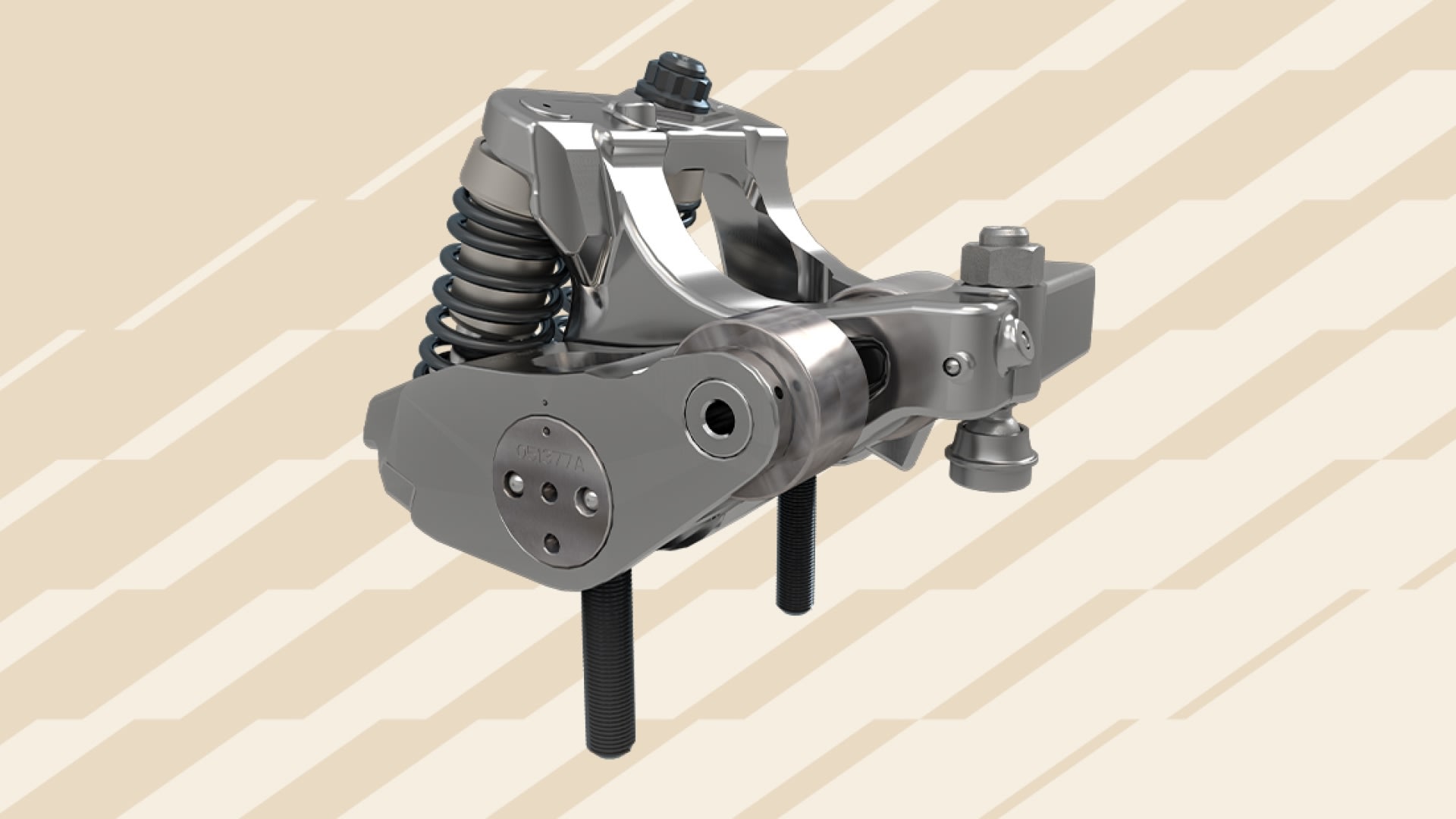
One of the features Cummins is boasting about for the new X10 is its High Power Density (HPD) engine brake system. Two-Stroke and 1.5-Stroke HPD engine brakes were announced in 2016 and 2018, respectively, by Jacobs Vehicle Systems, which was acquired by Cummins in 2022.
The 1.5-Stroke HPD engine brake reportedly provides small- and medium-displacement engines with large engine-displacement retarding power, generating up to 40 percent higher levels of supplemental braking force than traditional compression release braking at high engine speeds, and improvements of up to 100% at lower rpm cruising speeds.
According to Cummins, a conventional engine brake has one compression release and one brake gas recirculation event for each of the engine’s cam rotations. With 1.5-Stroke HPD, cylinder deactivation mechanisms are used to eliminate the main exhaust valve events, allowing two CR events per cam rotation.
A standard intake charge is used to power the first CR event; however, for the second CR event, the power is achieved through the recirculation of exhaust manifold gases, without drawing air from the intake.
Two HPD engine brakes, a three-cylinder and six-cylinder version, will be offered on the X10. The advanced brake offers up to 320 hp at 2,300 rpm for the three-cylinder option, and up to 475 hp at 2,300 rpm for the six-cylinder option.
“The HPD engine brake is both a unique and ideal braking solution for the wide displacement coverage of the new X10 engine, as well as the variety of duty cycles to be served,” said RaNae Isaak, program leader of the X10. “Feedback from both OEM and end-user customers who have test-driven the new X10 with the HPD engine brake attest to its ability to offer the braking power of up to a 13-liter truck, via a 10-liter displacement engine. Many comment that the HPD engine brake is the most powerful braking solution in a vehicle they have ever driven.”
Cummins states that the HPD is part of its Valvetrain Technologies’ common modular design frame, meaning other valvetrain technologies can be integrated, or removed, according to local market requirements. It is currently being developed in six other engine programs.
Courting customer feedback
The new X10s are currently undergoing field testing with a wide array of clients and vocations. Cummins has stated that it wants its various fleet customers to think carefully about their needs and available options when deciding which engine is right for their application.
The company believes that some previous L9 and X12 customers will be better suited to the new medium-duty B7.2 or heavy-duty X15, which meet the current EPA 2027 emissions regulations.
Consolidating two engine families and displacements to a single offering is a bold move for one of the few on-road medium-duty diesel engine suppliers left in North America. But Cummins has made it clear that it believes in its engineering team’s ability to deliver a product worthy of its logo.
More From SAE Media Group
Off-Highway Engineering
Cummins Unveils EPA-Compliant 2021 Heavy-Duty Diesels
Off-Highway Engineering
Detroit DD15 Gen 5 Showcases Durability of New Diesel Tech
Off-Highway Engineering
Navistar’s ‘Ground Up’ Approach to All-New Diesel Engine
Off-Highway Engineering
Mahle, Liebherr Develop Active Pre-Chamber for Hydrogen ICE
Off-Highway Engineering
Westport Awarded LNG Development Program
Off-Highway Engineering
Could This Infinitely Variable Compression Mechanism Be the Next Piston Engine Game-Changer?
Off-Highway Engineering
Cummins Spools up New Turbo Tech

Off-Highway Engineering
Cummins, Tula Test ‘Dynamic’ Cylinder Deactivation for Diesels
Automotive Engineering
Ford Revisits OHV Layout, Big Displacement for New Commercial-Truck V8
Automotive Engineering
Spawning an All-New Gasoline Engine, Stellantis’ Hurricane Is Coming
Off-Highway Engineering
Volvo Reveals New VNL with SuperTruck Influence
Off-Highway Engineering
Komatsu Logs a New Timber Machine
Off-Highway Engineering
Cummins Unveils New B7.2 Diesel Engine
Automotive Engineering
2020 Ford Super Duty Debuts All-New 7.3-Liter Pushrod V8, 10-Speed Automatic
Automotive Engineering
Advancing the OP Engine on Three Fronts
Off-Highway Engineering
Transmission Talk: Eaton Discusses Its Portfolio of Commercial Gearboxes
Automotive Engineering
More sting for the STINGRAY
Off-Highway Engineering
Cummins New X15 Engine Meets Upcoming Regs While Boosting Efficiency
Off-Highway Engineering
ZF Premieres AxTrax 2 Electric Axle Platform at ACT Expo
Automotive Engineering
NAIAS 2019: FCA Debuts New Ram Heavy Duty Pickups
Automotive Engineering
GM Adopts Advanced Cylinder Deactivation for 2019 Chevy Silverado V8s
Automotive Engineering
Nissan's 2020 Frontier Gets New Powertrain
Automotive Engineering
2016 Pentastar V6 Adds New VVT, Cooled EGR
Automotive Engineering
2022 Nissan Rogue Gets a VC Turbo Triple
Off-Highway Engineering
New Volvo D13 VGT Utilizes 24V Architecture
Off-Highway Engineering
Propane Powers Ahead for Medium Duty Sector
Automotive Engineering
Balancing GDI Fuel Economy and Emissions
Off-Highway Engineering
Navistar Updates A26 Engine, Improves FE by 4%
Off-Highway Engineering
Cummins Cylinder Deactivation Saves on Fuel and Emissions
Top Stories
INSIDERManufacturing & Prototyping
 How Airbus is Using w-DED to 3D Print Larger Titanium Airplane Parts
NewsUnmanned Systems
 Microvision Aquires Luminar, Plans Relationship Restoration, Multi-industry Push
INSIDERDesign
 A Next Generation Helmet System for Navy Pilots
ArticlesSoftware
 Accelerating Down the Road to Autonomy
INSIDERDesign
 New Raytheon and Lockheed Martin Agreements Expand Missile Defense Production
ArticlesTransportation
 CES 2026: Bosch is Ready to Bring AI to Your (Likely ICE-powered) Vehicle
Webcasts
Transportation
 Advantages of Smart Power Distribution Unit Design for Automotive...
Unmanned Systems
 Quiet, Please: NVH Improvement Opportunities in the Early Design...
Electronics & Computers
 Cooling a New Generation of Aerospace and Defense Embedded...
Automotive
 Battery Abuse Testing: Pushing to Failure
Communications
 A FREE Two-Day Event Dedicated to Connected Mobility
