




Vulcan Rocket Completes First National Security Launch for Space Force

United Launch Alliance's (ULA) Vulcan Centaur V rocket recently completed its first National Security Space Launch (NSSL) mission for the U.S. Space Force (USSF). On Aug. 12, the next generation rocket lifted off from Cape Canaveral Space Force Station, Florida, carrying the USSF-106 mission into geosynchronous Earth orbit (GEO).
Spacecraft separation, signaling mission success, occurred approximately seven hours after liftoff into geosynchronous Earth orbit (GEO).
The USSF is leveraging the newly certified Vulcan Centaur rocket to deliver demonstrations and experiments to geosynchronous orbit on behalf of Department of Defense (DoD) customers. The experiment flying on USSF-106, the Navigation Technology Satellite-3 (NTS-3), is an Air Force Vanguard project led by the Air Force Research Laboratory (AFRL) and built by L3Harris Technologies. It leverages a secondary payload adapter which demonstrates resilient satellite navigation through flexible reprogrammable signals, an electronically steerable antenna, and advanced timekeeping algorithms. NTS-3 is the first U.S. integrated navigation satellite experiment in nearly 50 years, since NTS-1 and NTS-2 paved the way for the current GPS constellation.
“It’s an exciting day for us as we launched the first NSSL flight of Vulcan, an outstanding achievement for United Launch Alliance and the nation’s strategic space lift capability. This is an important milestone for the Space Force and all involved,” said Col. Jim Horne, USSF-106 Mission Director. “After years of development, technical collaboration, and dedication by all involved, including our government mission partners and the entire ULA team, I’m proud to say the first Vulcan NSSL mission delivered its payloads safely into space.”
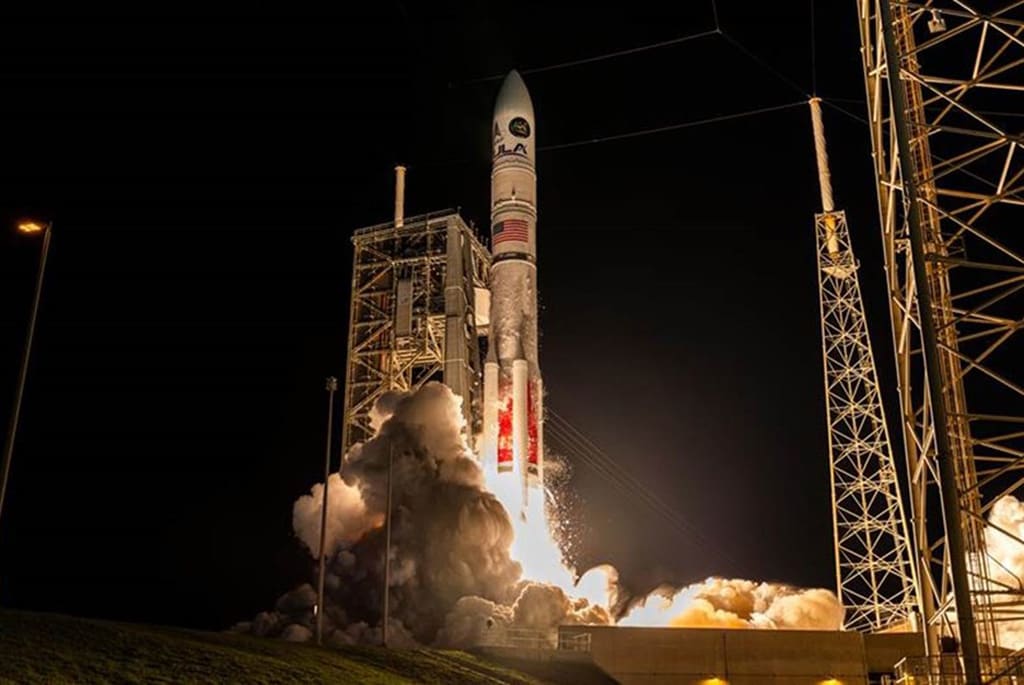
Standing at 202 feet tall and weighing 1.74 million pounds, the Vulcan configuration is enabled by the powerful Centaur V upper stage, which has 2.5 times the energy and 450 times the endurance of its predecessors, according to ULA. The company's Vulcan rocket is offered in four standard configurations, including zero, two, four and six solid rocket booster variants. Vulcan's main engine booster propulsion is powered by a pair of BE-4 engines, manufactured by Blue Origin, while Northrop Grumman supplies the Graphite Epoxy Motor (GEM) 63XL solid rocket boosters for Vulcan.
“Vulcan is a catalyst to supporting national defense in the strategic warfighting domain of space,” said Tory Bruno, ULA president and CEO. “Vulcan is the world’s most capable, high energy orbit rocket meeting the demand for expanding space competencies. Vulcan provides flexibility to our nation’s decision makers as we combat our adversaries attempts to disrupt the U.S. in space operations. This launch begins a new era in national space security.”
Since the company's founding in 2006, ULA has successfully launched nearly all of the 132 critical missions to orbit for the U.S. Space Force and National Reconnaissance Office, primarily using its Atlas V, Delta II and Delva IV rockets.
ULA’s next launch is the third Atlas mission for Amazon’s Project Kuiper, Kuiper 3, which will also be launched from Cape Canaveral Space Force Station, Florida.
More From SAE Media Group
Aerospace & Defense Tech Briefs
Vulcan Rocket Completes First National Security Launch for Space Force
Aerospace & Defense Tech Briefs
Northrop Grumman Wins $792M to Deliver Intermediate, Heavy Versions of OmegA Space Launch Vehicle
Aerospace & Defense Tech Briefs
Delta II’s Final Flight a Success
Aerospace & Defense Tech Briefs
Three Stages of Separation: Bidding Farewell to the Delta II Launch Vehicle
Aerospace & Defense Tech Briefs
Space Launch Providers Submit Proposals for National Security Space Launch Program
Aerospace INSIDER
Boeing to Develop New Space Force Nuclear Communications Satellites
Aerospace & Defense Tech Briefs
Canada’s RADARSAT Constellation Satellites Receive Thermal Blankets, Ready for Launch
Aerospace INSIDER
Three Companies to Build New Multi-Orbit Logistics Prototype Spacecraft
Aerospace & Defense Tech Briefs
Can the Air Force Reach a 24-Hour Launch Window?
Aerospace & Defense Tech Briefs
ULA’s Vulcan Centaur Will Launch Sierra Nevada Corporation’s Dream Chaser Spaceplane
Aerospace INSIDER
Boeing X-37B Latest Mission Tests Quantum Inertial Sensor in Space
Aerospace & Defense Tech Briefs
Lockheed Martin Ships AEHF Satellite in Advance of ULA Rocket Launch

Aerospace INSIDER
Boeing Starliner Launch Delayed to Test Helium Leak Repair
Aerospace & Defense Tech Briefs
Final Delta IV Heavy Rocket Launched
Aerospace & Defense Tech Briefs
In-Orbit Commercial Spacecraft Undocking
Aerospace INSIDER
Blue Origin Rocket Reaches Intended Orbit on First Launch
Aerospace & Defense Tech Briefs
Firefly Aerospace Is the Latest Addition to Florida’s “Space Coast”
Aerospace & Defense Tech Briefs
ULA Selects Blue Origin Advanced Booster Engine for Vulcan Centaur Rocket System
Aerospace & Defense Tech Briefs
NASA Demonstrates a First-of-Its-Kind Space Communications

Aerospace INSIDER
Firefly Alpha Rocket Loses Engine Nozzle During Launch
Aerospace & Defense Tech Briefs
OmegA Rocket Sustains Explosion During First Static Test, Northrop Grumman Maintains Test Was a Success
Aerospace & Defense Tech Briefs
NASA Invites Proposal from Space-Based Large-Scale 3D-Printing Company
Aerospace & Defense Tech Briefs
What Does NASA Do with a Space Station Originally Developed for a Now-Cancelled Mission?
Aerospace INSIDER
DARPA Teams With Industry to Create Spaceplane
Aerospace Manufacturing and Machining INSIDER
ULA, Blue Origin to Develop New American Rocket Engine
Tech Briefs
Building Technology to Clean Up Space
Aerospace & Defense Tech Briefs
Multi-Orbit Space Relay Communications
NASA Spinoff
Make Way for Satellites
Top Stories
NewsSensors/Data Acquisition
 Microvision Aquires Luminar, Plans Relationship Restoration, Multi-industry Push
INSIDERRF & Microwave Electronics
 A Next Generation Helmet System for Navy Pilots
INSIDERWeapons Systems
 New Raytheon and Lockheed Martin Agreements Expand Missile Defense Production
NewsAutomotive
 Ford Announces 48-Volt Architecture for Future Electric Truck
INSIDERAerospace
 Active Strake System Cuts Cruise Drag, Boosts Flight Efficiency
ArticlesTransportation

Webcasts
Aerospace
 Cooling a New Generation of Aerospace and Defense Embedded...
Energy
 Battery Abuse Testing: Pushing to Failure
Power
 A FREE Two-Day Event Dedicated to Connected Mobility
Automotive
 Quiet, Please: NVH Improvement Opportunities in the Early Design Cycle
Electronics & Computers
 Advantages of Smart Power Distribution Unit Design for Automotive &...
Unmanned Systems
 Sesame Solar's Nanogrid Tech Promises Major Gains in Drone Endurance