




Schaeffler Optimizes Rolling Bearings for Hydraulic and Axle Drives
The frictional torque generated by rolling bearings can be cut in half, enabling construction machinery to lower CO2 emissions without high development costs.
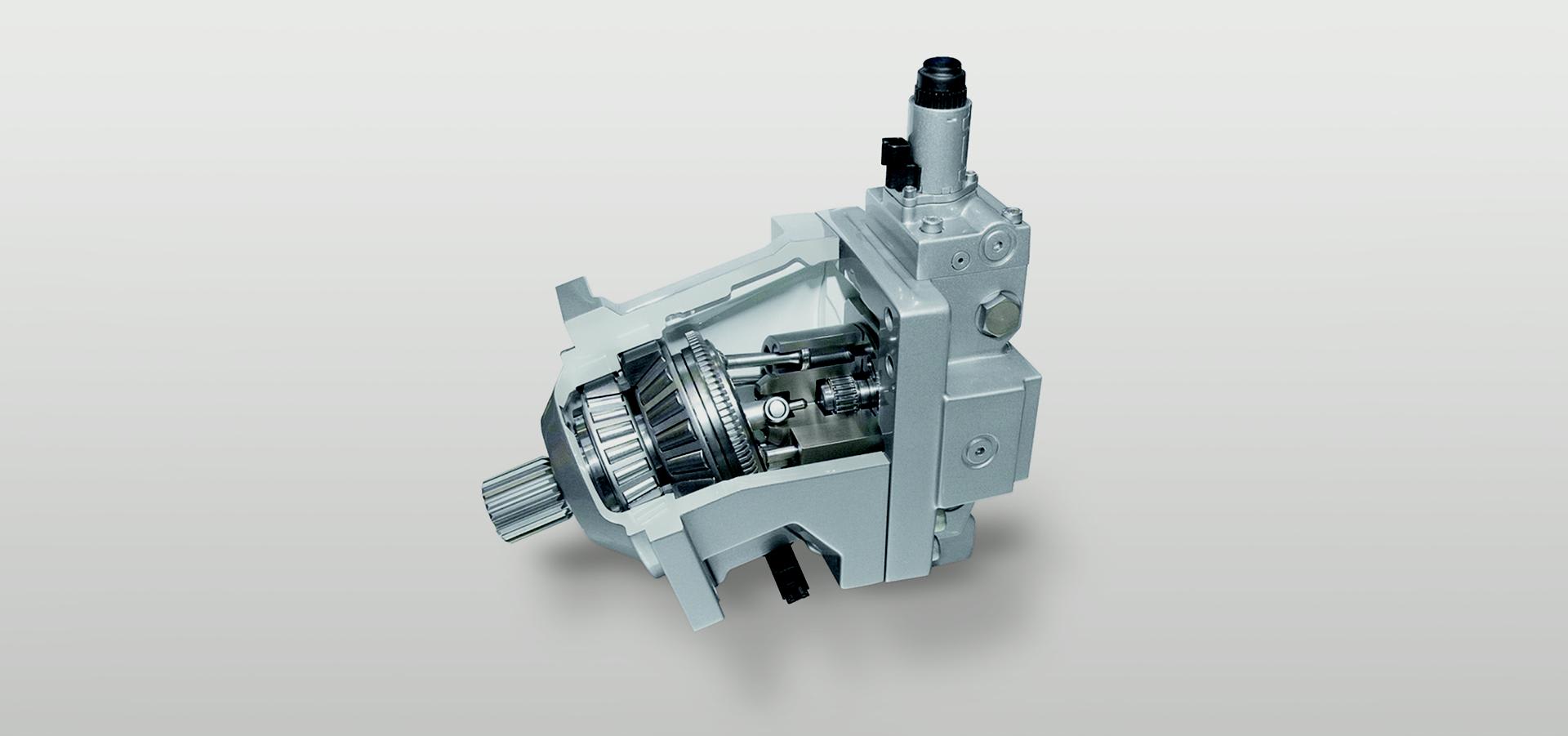
Rolling bearings with optimized friction and performance characteristics can have a significant influence on reducing the power loss, design envelope and weight of hydraulic motors and pumps, gearboxes and axles in construction machinery. If correctly designed, rolling bearings can make a significant contribution to reducing carbon dioxide emissions.
Most construction machinery is still operated conventionally, using diesel engines and hydraulic components. In the widely used adjustable axial piston pumps and motors, the input and output shaft are usually supported by two tapered roller bearings that are adjusted against each other. When designing the bearing support, it is advisable to reduce the preload to precisely the required minimum allowed by the load spectrum. The lower bearing preload leads to permanently lower axial forces between the tapered roller end face and inner ring rib and, therefore, to a corresponding reduction in frictional torque.

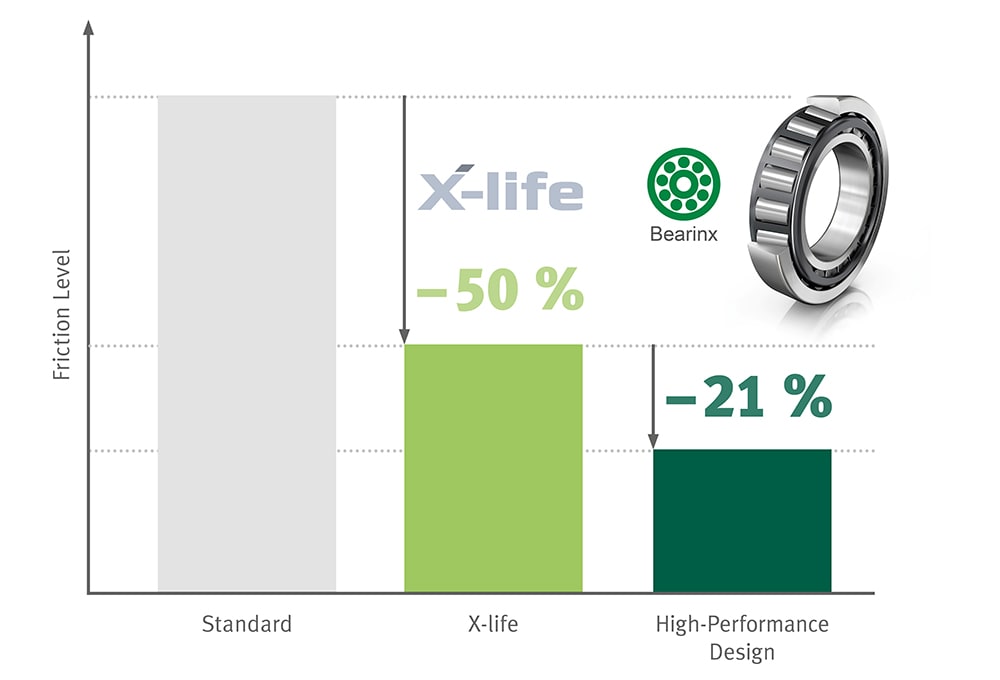
Schaeffler tapered roller bearings in X-life quality are another option for reducing friction without making a design change. Friction can be halved compared to conventional bearings through specially machined raceway and roller surfaces as well as optimized geometry in the contact between the end face of the rolling element and the inner ring rib. Even at low speeds during the startup process, an elastohydrodynamic lubricant film forms due to the improved surfaces and osculations, which reduces the wear and friction under the already very low-viscosity lubrication.
The optimizations to the internal design also led to a significant noise reduction along with approximately 25% higher dynamic load ratings as compared to standard tapered roller bearings from Schaeffler, resulting in a calculated rating life increase of more than 100%. Similar progress can be achieved by using cylindrical roller bearings in X-life quality. The high dynamic load ratings allow a changeover from full-complement cylindrical roller bearings to cage-guided cylindrical roller bearings with significantly less friction.
How friction is reduced
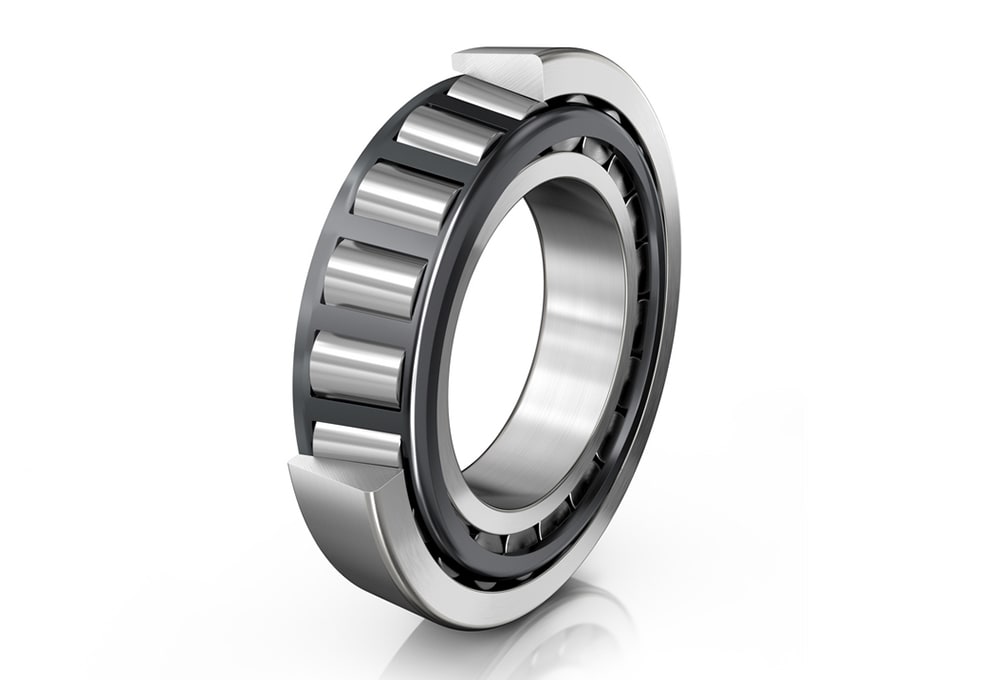
For rolling bearings and, in particular, for cylindrical roller bearings with radial and axial loads as well as tapered roller bearings, Schaeffler offers its proprietary friction-reducing coating Triondur C. This diamond-like carbon (DLC) coating is specifically optimized for loads in the rolling element contact and reduces the friction in a “dry steel-to-steel contact” by around 80%.
Downsizing or higher power density is not only associated with a lower consumption of materials and energy during manufacturing; it also leads to reduced friction in drive systems. As described above, rolling bearings in X-life quality offer the required reserves thanks to their load ratings. With high-performance rolling bearing steels, such as Schaeffler’s Cromadur, it is possible to unlock further potential for increasing the power density.
Using simulation software, engineers can achieve efficiency improvements as early as during the product-development phase. For example, with the aid of computational fluid dynamics (CFD) simulations, it is possible to reduce the churning losses in hydraulic units and gearboxes to a minimum.
Schaeffler’s Bearinx design and simulation software allows very efficient optimization of bearing supports. Bearinx’s “OptiKit” optimization module can compare various load case analyses or determine suitable parameters for specific target values so that, for example, the optimum bearing preload can be calculated.
Verifiable savings potential
By using X-life tapered roller bearings in combination with optimized preload, it was possible to increase the efficiency of hydraulic pumps and hydraulic motors by about 2% in efficiency projects. Accordingly, a wheel loader equipped with such an optimized hydraulic pump and two hydraulic motors could yield a 6% energy savings.
For a drive power of 140 kW, this corresponds to around 9 kW. Extrapolated to 1,000 wheel loaders working for eight hours per day, this results in an annual savings potential of around 26,000 MWh – which amounts to a savings of approximately 16,000 tons of carbon dioxide.
The solutions for not only hydraulic drives as described above, but also for gearboxes, differentials and axle drives, allow the frictional torque generated by rolling bearings to be reduced by half using standard catalog products. By exploiting all the possibilities, including a bearing design that is based on the load spectrum of the customer’s application, Schaeffler has verified a friction reduction of more than 71% as compared to conventional catalog bearings. These advancements are certain to resonate with the demands of the market.
Stefan Scharting is the application engineering manager for hydraulic and electric drives within the Power Transmission sector at Schaeffler’s Bearings & Industrial Solutions division in Schweinfurt, Germany.
More From SAE Media Group
Off-Highway Engineering
Liebherr Reveals ‘Hybrid’ CFRP Cylinders and Parallel-Pump Concept
Off-Highway Engineering
Rexroth Takes Aim at Electrification for Off-Highway Vehicles
Off-Highway Engineering
Volvo CE, Norrhydro Team to ‘Revolutionize’ Digital Hydraulics
Off-Highway Engineering
Electronic Torque Limiting Boosts Machine Productivity
Off-Highway Engineering
Pump and Motor Series
Off-Highway Engineering
Komatsu Logs a New Timber Machine
Off-Highway Engineering
Terzo Strives to Electrify Fluid Power
Off-Highway Engineering
New Power Steering Concept Uses Variable Displacement Pump
Motion Design
New Piston Design Features Soft, Flexible Materials
Off-Highway Engineering
Maintenance-Free Bearings
Off-Highway Engineering
Rexroth Releases New Flow-Sharing Valve for Mini Excavators
Off-Highway Engineering
Eaton Solves Nuisance Problems with Electrohydraulic Solutions
Off-Highway Engineering
Case Unveils Fully-Electric Backhoe Loader, Begins Delivery This Year
Off-Highway Engineering
Danfoss Targets Excavators with New Digital-Hydraulics System
Off-Highway Engineering
Increasing Connectivity, Leveraging Intelligence
Off-Highway Engineering
Garrett Two-Stage Turbos Ramp up Off-Highway
Automotive Engineering
Tackling the Lubrication Challenges of Electric Vehicles
Off-Highway Engineering
HD Hyundai Rolls out a Slew of New Machines
Off-Highway Engineering
Solving Problems and Seeking Big Ideas for Commercial Vehicles
Off-Highway Engineering
ASV Rolls out a Pair of New Loaders
Off-Highway Engineering
Detroit DD15 Gen 5 Showcases Durability of New Diesel Tech
Off-Highway Engineering
Advances in Virtual Powertrain Development
Off-Highway Engineering
Axial Piston Pumps
Tech Briefs
Chemically Driven Wheels “Morph” Into Gears
Off-Highway Engineering
Mecalac Targets Building Sites in Cities for Fully-Electric E12 Excavator
Off-Highway Engineering
Cummins New X15 Engine Meets Upcoming Regs While Boosting Efficiency
Motion Design
Chemically Driven Wheels “Morph” Into Gears
Motion Design
Torque Limiters 101: Benefits, Types, and Comparisons
Off-Highway Engineering
Hydraulic Fluids Evolve to Meet Critical Equipment-Design Trends
Off-Highway Engineering
Many ICE Paths Lead to Reduced Emissions
Top Stories
INSIDERRF & Microwave Electronics
 FAA to Replace Aging Network of Ground-Based Radars
PodcastsDefense
 A New Additive Manufacturing Accelerator for the U.S. Navy in Guam
NewsSoftware
 Rewriting the Engineer’s Playbook: What OEMs Must Do to Spin the AI Flywheel
Road ReadyPower
 2026 Toyota RAV4 Review: All Hybrid, All the Time
INSIDERDefense
 F-22 Pilot Controls Drone With Tablet
INSIDERRF & Microwave Electronics
 L3Harris Starts Low Rate Production Of New F-16 Viper Shield
Webcasts
Energy
 Hydrogen Engines Are Heating Up for Heavy Duty
Energy
 SAE Automotive Podcast: Solid-State Batteries
Power
 SAE Automotive Engineering Podcast: Additive Manufacturing
Aerospace
 A New Approach to Manufacturing Machine Connectivity for the Air Force
Software
 Optimizing Production Processes with the Virtual Twin
