




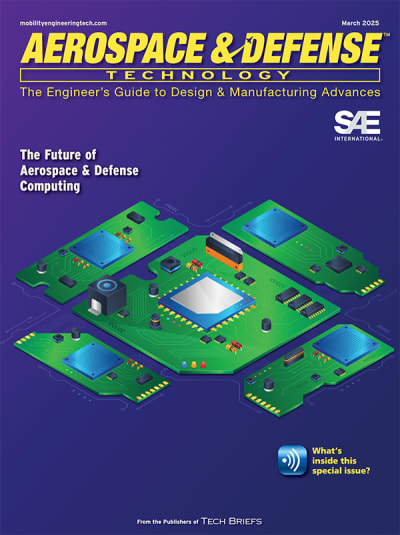
Aerospace & Defense Technology - March 2025
Inside this issue
Overview
The March 2025 issue of Aerospace & Defense Technology focuses on the evolving landscape of aerospace and defense, emphasizing the critical need for innovation, cost efficiency, and adaptability in response to rising global conflicts and geopolitical tensions. The issue highlights the importance of continuous investment in research and development to drive technological advancements that can enhance performance while reducing costs.
A key theme throughout the issue is the concept of "affordable mass," which refers to the aerospace industry's shift towards producing large quantities of effective and cost-efficient munitions and systems. This cultural transformation is essential for maximizing combat power and ensuring military readiness in modern warfare. The article by Adit Girdhari, Vice President of Business Development at Marotta Controls, underscores that the effectiveness of advanced military aircraft, such as 5th generation fighters and stealth bombers, is heavily reliant on the precision-guided munitions (PGMs) that support them. The industry must embrace new technologies and partnerships to meet the demands of the modern battlefield.
The issue also discusses the necessity of workforce investments, including employee training and development, to build the skills required for supporting affordable mass strategies across the aerospace enterprise. As the demand for rapid deployment and sustained military capacity increases, aerospace leaders are urged to rethink traditional manufacturing and supply chain management approaches. This rethinking is not merely optional; it is vital for ensuring that military forces are equipped to handle future challenges effectively.
In addition to the focus on military applications, the magazine features various companies and technologies that are shaping the future of aerospace and defense. Notable mentions include:
- 3-Dimensional Service Group - Highlighting advancements in 3D printing technologies that can revolutionize manufacturing processes in aerospace.
- Centorr Vacuum Industries - Discussing innovations in vacuum technology that enhance material processing for aerospace applications.
- COMSOL, Inc. - Showcasing simulation software that aids in the design and analysis of complex aerospace systems.
- Mercury Systems - Focusing on secure and high-performance computing solutions for defense applications.
- VORAGO Technologies - Presenting radiation-hardened technologies essential for space and military applications.
The issue also includes insights into the future of aerospace computing, emphasizing the integration of artificial intelligence (AI) and machine learning (ML) in defense systems. These technologies are expected to play a pivotal role in enhancing decision-making processes, improving operational efficiency, and enabling predictive maintenance for aircraft and systems.
Moreover, the magazine addresses the importance of collaboration between industry stakeholders, government agencies, and academic institutions to foster innovation and address the challenges facing the aerospace and defense sectors. This collaborative approach is seen as crucial for developing next-generation technologies that can meet the evolving needs of military and civilian applications.
The editorial section provides a comprehensive overview of the current state of the aerospace and defense industry, highlighting trends, challenges, and opportunities. It emphasizes the need for a proactive approach to address the complexities of modern warfare and the importance of maintaining a competitive edge in a rapidly changing global landscape.
In summary, the March 2025 issue of Aerospace & Defense Technology serves as a vital resource for industry professionals, offering insights into the latest trends, technologies, and strategies that are shaping the future of aerospace and defense. The emphasis on affordable mass production, workforce development, and the integration of advanced technologies underscores the industry's commitment to ensuring military readiness and resilience in the face of emerging challenges. As the landscape continues to evolve, the magazine remains a key platform for sharing knowledge and fostering collaboration among stakeholders in the aerospace and defense sectors.
Features
-
Articles
4 Advancing Embedded Systems with VITA 93: A New Era in Modular I/O for Aerospace and Defense
10 Centralized Computing in Next-Generation Army Vehicles
16 Affordable Mass: Embracing a New Strategy for Advancing Defense Capabilities
20 Next Level Rugged Fiber Optic Interconnects: A New Era of High-Speed Data Transmission in Defense
24 5 Startups Developing AI for Defense Application
27 How Will TSN Ethernet Impact the Future of Embedded Computing?
30 A Supercomputer for Aerospace and Defense Systems Modeling and Simulation
34 The Unusual Machines Approach to Low-Cost Drones and Drone Components
37 Fully Rugged Mobile PCs Provide an Edge on the Battlefield and Beyond
Top Stories
NewsRF & Microwave Electronics
 Microvision Aquires Luminar, Plans Relationship Restoration, Multi-industry Push
INSIDERAerospace
 A Next Generation Helmet System for Navy Pilots
INSIDERDesign
 New Raytheon and Lockheed Martin Agreements Expand Missile Defense Production
INSIDERMaterials
 How Airbus is Using w-DED to 3D Print Larger Titanium Airplane Parts
NewsPower
 Ford Announces 48-Volt Architecture for Future Electric Truck
ArticlesAR/AI

Webcasts
Electronics & Computers
 Cooling a New Generation of Aerospace and Defense Embedded...
Automotive
 Battery Abuse Testing: Pushing to Failure
Power
 A FREE Two-Day Event Dedicated to Connected Mobility
Unmanned Systems
 Quiet, Please: NVH Improvement Opportunities in the Early Design Cycle
Automotive
 Advantages of Smart Power Distribution Unit Design for Automotive &...
Energy
 Sesame Solar's Nanogrid Tech Promises Major Gains in Drone Endurance