




Ultraviolet Camera System for Small Satellites Could Advance Space Weather Studies

Virginia Tech researchers are collaborating with NASA's Jet Propulsion Laboratory to gain new insights on space weather and Earth's upper atmosphere.
“The idea was to design a highly capable ultraviolet instrument for a small satellite,” said Leon Harding, Principal Investigator and former research associate professor with the Virginia Tech National Security Institute. “We have achieved this by leveraging the extraordinary sensitivities of the electron multiplying charged coupling device, which is capable of operating in space and obtaining extremely faint signals in challenging imaging environments.”
Moving into the final phase of a three-year project, the work builds on Virginia Tech’s expertise in the field of heliophysics, using ground-based, balloon-based, and rocket-based experiments to probe the atmosphere to understand various transport mechanisms. Specifically, the project is investigating nitric oxides downward movement in the atmosphere and impact of the ozone layer.
"We're working to measure nitric oxide in the polar night,” said Samantha Kenyon, Research Assistant Professor in the Kevin T. Crofton Department of Aerospace and Ocean Engineering and affiliate faculty with the Virginia Tech National Security Institute. “Throughout the winter on the poles, there's no sunlight that enters the atmosphere. This causes a type of oxygen-nitrogen element to build up in those areas.”
With the third phase of the current project wrapping up, the team hopes to move forward to secure funding for the full satellite build. Researchers also believe the technology could play a role in near future NASA missions, involving the Habitable Worlds Observatory, which is the next scheduled astronomy flagship mission.
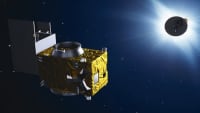
Part of NASA's Heliophysics Technology and Instrument Development for Science program, the project aims to develop this cutting-edge ultraviolet camera system for miniaturized satellites called CubeSats. This will allow researchers to measure nitric oxide levels more accurately and at a lower cost compared to larger, more expensive space missions.
The heart of the CubeSat is the electron multiplying charged coupling device, which will make it possible to detect nitric oxide with a really low level of light, which is crucial given the small telescope size.
“What we want are more measurements to give us more information,” said Scott Bailey, Professor in the Bradley Department of Electrical and Computer Engineering and Director of the Virginia Tech Center for Space Science and Engineering Research. “We're learning a way to take measurements with the CubeSat at a much lower cost and in a more efficient way than the methods we’ve used before. Ultimately, we want to fly a satellite that contains an instrument like this every day.”
The Heliophysics Technology and Instrument Development for Science program is part of the NASA Research Opportunities in Space and Earth Science. One charter of the program is education and workforce development.
“We planned for a significant amount of student support so the next generation of scientists and engineers can learn,” Harding said. "The project allowed us to teach students to think through the implications of their design choices. At its core it is very interdisciplinary, which gives the students the opportunity to wear many hats, depending on the day, or on the problem."
More From SAE Media Group
Aerospace & Defense Tech Briefs
CubeSat Spacecraft
NASA Spinoff
Tiny Star Trackers Help Spacecraft Find Their Place
NASA Spinoff
Unfurling Antennas Let Tiny Satellites Do Big Things
Photonics & Imaging Technology INSIDER
NASA Targets 2026 for Launch of Israel's First Space Telescope
Aerospace & Defense Tech Briefs
Automated Atmospheric Correction of Nanosatellites Using Coincident Ocean Color Radiometer Data
NASA Spinoff
Ballooning Business for Shrinking Cameras

NASA Spinoff
A Huge Development for Tiny Satellites
NASA Spinoff
Keeping the Connection

Aerospace INSIDER
Blue Ghost Arrives in Lunar Orbit, Prepares for Landing
Aerospace INSIDER
Boeing's New Approach to 3D Printing Solar Arrays for Satellites
NASA Spinoff
Make Way for Satellites
Aerospace & Defense Tech Briefs
NASA Invests in Aerospace Start-Up, University Projects on CubeSat Platform
Aerospace & Defense Tech Briefs
In-Space Upgrade Satellite System
Aerospace & Defense Tech Briefs
NASA Demonstrates a First-of-Its-Kind Space Communications
Aerospace & Defense Tech Briefs
In-Orbit Testing of Autonomous ‘Swarm’ Satellites
Tech Briefs
Lunar Surface Navigation System
NASA Spinoff
Cloud Software for Above the Clouds
Tech Briefs
Getting NASA Data to the Ground with Lasers

Aerospace INSIDER
Aitech’s New Palm-Sized Satellite Enables Space-Based AI Processing
Aerospace Manufacturing and Machining INSIDER
Ball Aerospace Starts Final Assembly of Space Force's Next Generation Operational Weather Satellite
NASA Spinoff
CubeSats Take a Bus into Space
Top Stories
INSIDERDefense
 New Raytheon and Lockheed Martin Agreements Expand Missile Defense Production
NewsAutomotive
 Ford Announces 48-Volt Architecture for Future Electric Truck
INSIDERManufacturing & Prototyping
 Active Strake System Cuts Cruise Drag, Boosts Flight Efficiency
ArticlesTransportation
 Accelerating Down the Road to Autonomy
INSIDERMaterials
 How Airbus is Using w-DED to 3D Print Larger Titanium Airplane Parts
Road ReadyTransportation

Webcasts
Electronics & Computers
 Cooling a New Generation of Aerospace and Defense Embedded...
Power
 Battery Abuse Testing: Pushing to Failure
Connectivity
 A FREE Two-Day Event Dedicated to Connected Mobility
Automotive
 Quiet, Please: NVH Improvement Opportunities in the Early Design Cycle
Transportation
 Advantages of Smart Power Distribution Unit Design for Automotive &...
Aerospace
 Sesame Solar's Nanogrid Tech Promises Major Gains in Drone Endurance