




Rheinmetall, HDT to Develop Army's Small Multipurpose Equipment Transport Prototypes

On Sept. 24, the U.S. Army announced the award of two Other Transaction Authority Engineering and Manufacturing Design contracts to American Rheinmetall Vehicles, LLC, and HDT Expeditionary Systems, Inc., totaling a combined $22 million to provide eight prototypes each of the Small Multipurpose Equipment Transport Increment II.
The S-MET was originally developed as a Directed Requirement meant to identify opportunities for the Army to quickly field existing platforms to improve the fighting force’s capability. The S-MET Increment I is a single radio-controlled, eight-wheeled platform designed to carry payload, generate power for organic electronic systems, and conduct unconstrained movement. In its first increment, the S-MET is capable of carrying 1,000 lbs. of equipment and provides enhanced capability primarily in Infantry Brigade Combat Teams, Explosive Ordnance Disposal, and Security Force Assistance Brigades.
The second increment seeks to double that payload capacity while adding several improvements identified by Solders during evaluation and operation. Those improvements include:
- Higher exportable power to enable modern mission payloads like Unmanned Air Systems and communications equipment
- Improved audio signature reduction
- A dismounted wireless mesh communication network
- Increased reliability
- Worldwide grid charging
- Modular and open architecture allowing for easier and more cost-effective upgrades.
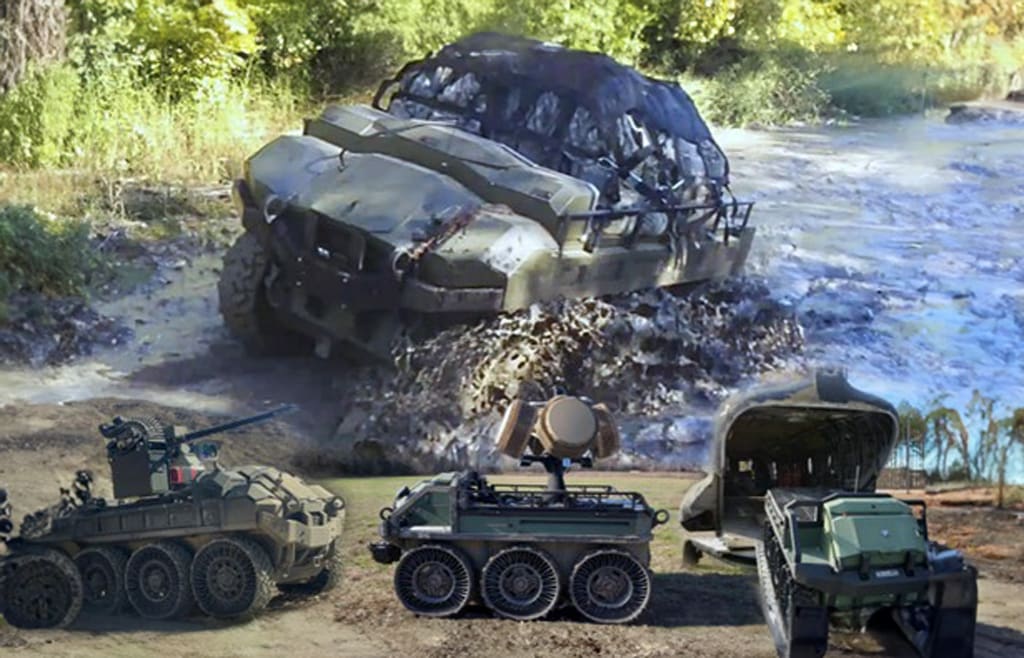
“S-MET Increment II addresses capability gaps associated with excessive physical burdens, recharging batteries during continuous operations, and reducing sustainment burden for semi-independent operations. The S-MET reduces Soldier load and enhances small unit combat effectiveness by reducing fatigue and injury caused by excessive physical loads, shifting the burden to the robotic platform,” said Kyle Bruner, the Army’s Project Manager for Force Projection, Program Executive Office Combat Support & Combat Service Support, headquartered here.
“S-MET supports the Army’s mission to implement robotic and autonomous system capabilities with urgency to lessen risk to Soldiers in multi-domain operations,” he added.
Successful S-MET Increment II developmental testing will lead to a production contract slated for late Fiscal Year 2027 for an Army Acquisition Objective of up to 2,195 systems.
More From SAE Media Group

Aerospace Manufacturing and Machining INSIDER
Army to Advance Prototype Competition for Future Electric Light Reconnaissance Vehicle
Defense INSIDER
Army Green Lights Infantry Squad Vehicle Upgrade Production
Defense INSIDER
Army Receives New Robot Combat Vehicle Prototypes
Aerospace Manufacturing and Machining INSIDER
Army Unveils New Prototype M1E3 Abrams Tank


Aerospace & Defense Tech Briefs
Mobile Howitzer
Defense INSIDER
Army Tests Newest 120mm Abrams Main Battle Tank Round
Defense INSIDER
Marines Select Prototypes for Light Armored Vehicle Replacement
Aerospace INSIDER
New Anduril, Skydio Drones Start Field Testing in Romania
Aerospace & Defense Tech Briefs
Electric Hybrid Propulsion System
Defense INSIDER
Four New Military Ground Vehicles Unveiled at DSEI 2025
Aerospace & Defense Tech Briefs
U.S. Army Tests Innovative Autonomous Tactical Vehicle Prototype
Aerospace & Defense Tech Briefs
Army Issues Prototyping Contracts for Common Tactical Truck Replacement
Aerospace & Defense Tech Briefs
Reconnaissance Vehicle Sensor Suite Upgrade
Tech Briefs
Magazine Archives


Aerospace INSIDER
Army Starts Testing Prototype Modular Turreted Mortar System
Defense INSIDER
Japanese Army to Test First Unmanned Ground Vehicles
Aerospace & Defense Tech Briefs
Autonomous Navigation Kits
Defense INSIDER
DEVCOM Tests Airdrop System for Rapid Deployment in the Field
Defense INSIDER
Mounted Troops to Get High-Tech Situational Awareness Tools
Defense INSIDER
3D-Printed Temporary Use Parts Reduce Downtime for Army Vehicles
Top Stories
INSIDERManufacturing & Prototyping
 How Airbus is Using w-DED to 3D Print Larger Titanium Airplane Parts
INSIDERManned Systems
 FAA to Replace Aging Network of Ground-Based Radars
NewsTransportation
 CES 2026: Bosch is Ready to Bring AI to Your (Likely ICE-powered) Vehicle
NewsSoftware
 Accelerating Down the Road to Autonomy
EditorialDesign
 DarkSky One Wants to Make the World a Darker Place
INSIDERMaterials
 Can This Self-Healing Composite Make Airplane and Spacecraft Components Last...
Webcasts
Defense
 How Sift's Unified Observability Platform Accelerates Drone Innovation
Automotive
 E/E Architecture Redefined: Building Smarter, Safer, and Scalable...
Power
 Hydrogen Engines Are Heating Up for Heavy Duty
Electronics & Computers
 Advantages of Smart Power Distribution Unit Design for Automotive...
Unmanned Systems
 Quiet, Please: NVH Improvement Opportunities in the Early Design...
