




Lightweighting: WHAT’S NEXT?
Experts weigh in on the challenges and future enablers in the battle to reduce vehicle mass.

Are there any automakers who haven’t yet put at least one new model through the weight-reduction wringer? Vehicle mass efficiency has joined the vanguard of product development where every gram lost is heralded. And it’s no passing fad — escalating global fuel economy and safety regulations ensure that lightweighting, as a product-development tenet, is here to stay.
The list of 2016 vehicles that are lighter than their predecessors continues to grow. It includes such notables as the Nissan Altima, which dropped 80 lb (36 kg). Acura’s TLX is lighter by 55 lb (25 kg). The Chevrolet Malibu, part of GM’s mass reduction crusade, shed a whopping 300 lb (136 kg) versus the previous car. Experts say a 100-kg (220-lb) reduction in vehicle weight typically brings a 3%-5% reduction in CO2 emissions, depending on vehicle size and powertrain solutions.
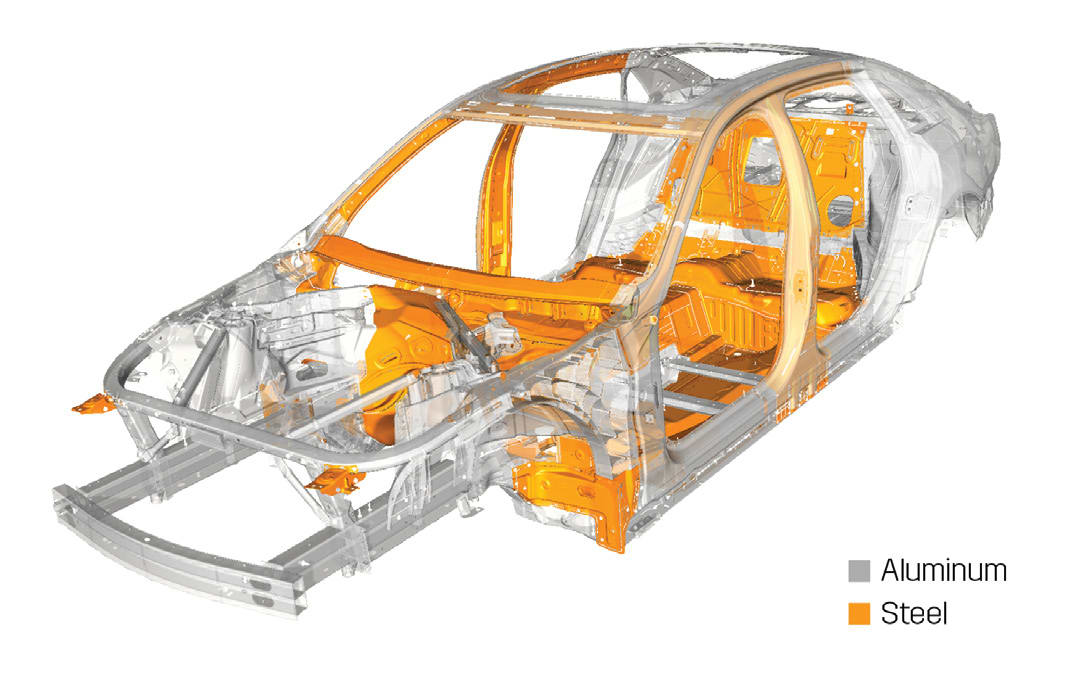
Mazda’s new CX-9, a 3-seat unibody SUV, is a shining example of lightweighting driven by holistic design and analysis. Aiming for the quietest cabin in its class, the CX-9 team engineered a thicker-gauge floor pan, added 53 lb (24 kg) of NVH mastics and blankets, more robust door seals and acoustic-laminated glass. But while the pounds were piling on to create the quietest Mazda ever, the powertrain team squeezed 132 lb (60 kg) from the new engine, 56 lb (25 kg) from the all-wheel-drive system and about 100 lb (45 kg) more in other areas. These reductions more than off-set the NVH countermeasures, leaving the new CX-9 about 250 lb (113 kg) leaner than the 2015 car.
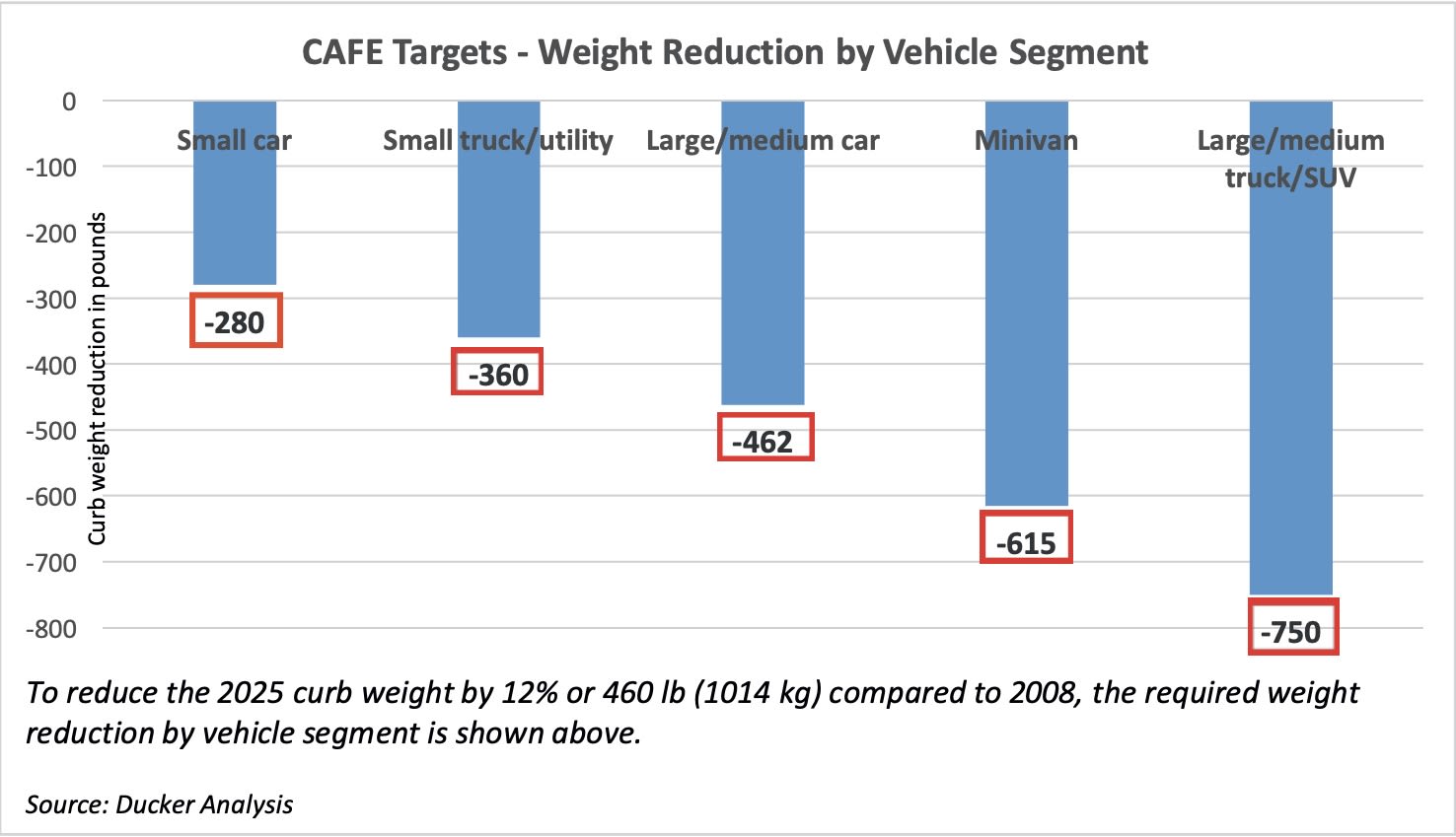
“The industry has become more aggressive in its lightweighting actions and its rate of introducing the technology is accelerating,” observed Jay Baron, Ph.D, President and CEO of the Center for Automotive Research (CAR). “The data we’ve been collecting shows it’s gone from an average of about 3% per year to 5% per year, depending on how you want to measure it.”
Dr. Baron and other experts note that the supply base has become fully engaged. “The industry’s doors are open wider than ever before — if you’re a supplier and have a lightweight technology solution, the car companies want to hear about it,” Dr. Baron noted.
Vehicle lightweighting “is arguably no less of an important consideration as powertrain selection nowadays,” asserted Andrew Fulbrook, IHS Automotive Director of Global Powertrain Forecasting. Both technology domains have the ability to provide efficiency gain while maintaining or improving performance and drivability, he said, with lightweighting also offering potential reductions in road load.
Overcoming ‘mass creep’
In a recent survey published by CAR on future vehicle-lightweighting trends, industry decision-makers indicated that mixed-materials solutions will predominate over aluminum-intensive programs going forward — a practical strategy driven by cost and by manufacturing considerations such as part formability, dissimilar-material joining and paint-shop capability, commented Dr. Baron.
The CAR respondents echo the views of nearly 20 experts interviewed for this article. Both groups highlighted the nagging challenge facing every light-weighting initiative: How to overcome what Chevy Malibu Chief Engineer Jesse Ortega calls “mass creep” — the weight of added safety, emissions and feature content that can offset the weight saved during base vehicle development. For many vehicle program managers, simply attaining curb-weight parity with the outgoing vehicle is a triumph.
The CAR survey asked, “Between now and 2025 do you feel you need to add weight to the car? And what’s forcing you to add it?” Respondents replied that they expect a 5% overall mass gain, split 50-50 (about 2.5% each) between added mass for performance and for safety.
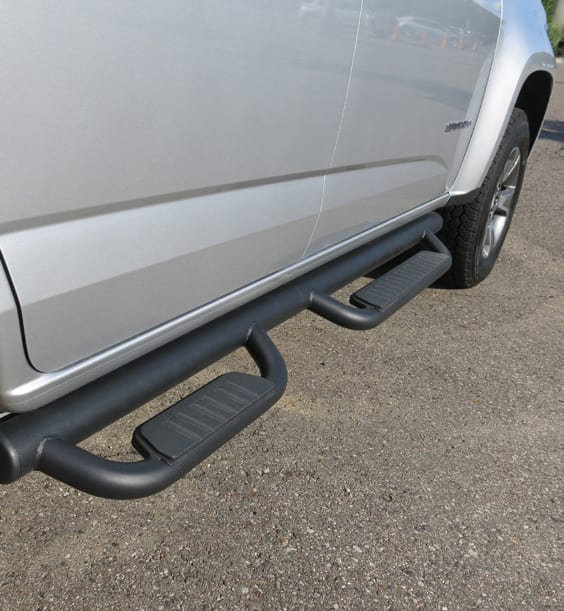
“You can’t sell cars that are almost as good as last year’s,” Dr. Baron explained. “Customers want the better performance that comes from increased body stiffness, for example, which may come at a price of structural reinforcements and mass. Same with lower NVH — it’s a big issue because light materials tend to transmit vibrations more.”
His advice: “If you’re planning for a vehicle to be 10% lighter, you’ve got to reduce mass by 15%.”
Product planners tell Automotive Engineering they’re concerned about the capital cost of premium materials — new higher-strength steel and aluminum alloys, carbon-fiber-reinforced plastics (CFRP) and magnesium — and how rising cost will impact vehicle retail price. Veteran industry analyst Mike Robinet, Managing Director at IHS Automotive, talks of an impending “cost cliff” driven by a combination of lightweighting, vehicle electrification, increased demand for advanced driver-assistance systems (ADAS) and connectivity content. And faster product cadences will likely affect cost amortization.
Recent vehicle programs reflect the cost-prudent approach that is expected going forward. GM chose a metals mix for the 2017 Chevrolet Bolt EV. According to Chief Engineer Josh Tavel, the car’s underbody consists of 95% high-strength steel or advanced high-strength steel, including some new alloys making their auto-industry debut. Bolt’s upper body is 80% HSS.
“The team saved about 50 pounds by using aluminum for the closures,” Tavel reports. Another 200-mi (321-km)-range EV with a heavy battery pack, Tesla’s “affordable” 2017 Model 3, reportedly also uses mixed-materials construction — the company’s first non-aluminum-intensive vehicle.
Lightweighting the pickup

Experts believe steel and aluminum will continue to dominate vehicle structures and chassis systems beyond the 2025 timeframe. Stronger and more formable alloys aimed at making lighter components and subassemblies are in the pipeline. Meanwhile structural composites, engineering plastics, and specialty light metals including magnesium will find greater opportunity.
A conversation with Paul Belanger, Director of R&D, Body in White at Gestamp North America, revealed the impact of new alloys and forming technologies. “We worked with Honda R&D on the new [2016] Civic, employing hot-formed ultra-high-strength steel (UHSS) for the rear rails. The material properties enabled Honda to reduce complexity of the car’s rear structure, improve its kinematics and achieve a 20% weight saving vs. the previous Civic.
He said Gestamp is currently involved with development of a super-strong 2-gigapascal UHSS grade “which will allow even further down-gauging.” Industry newcomer NanoSteel and partner AK Steel are prototyping a new automotive UHSS grade designed to simplify production, enabling the stamping and forming of parts at room temperature, reported CEO Dave Paratore.
The aluminum industry is firing back with new high-strength 7000-series alloys designed to challenge steel’s hegemony in impact-critical areas such as B pillars. “We’re out to make inroads in those exact areas with higher-strength grades now in development,” said Duane Bendzinski, Global Director of Technology, Automotive, at Novelis.
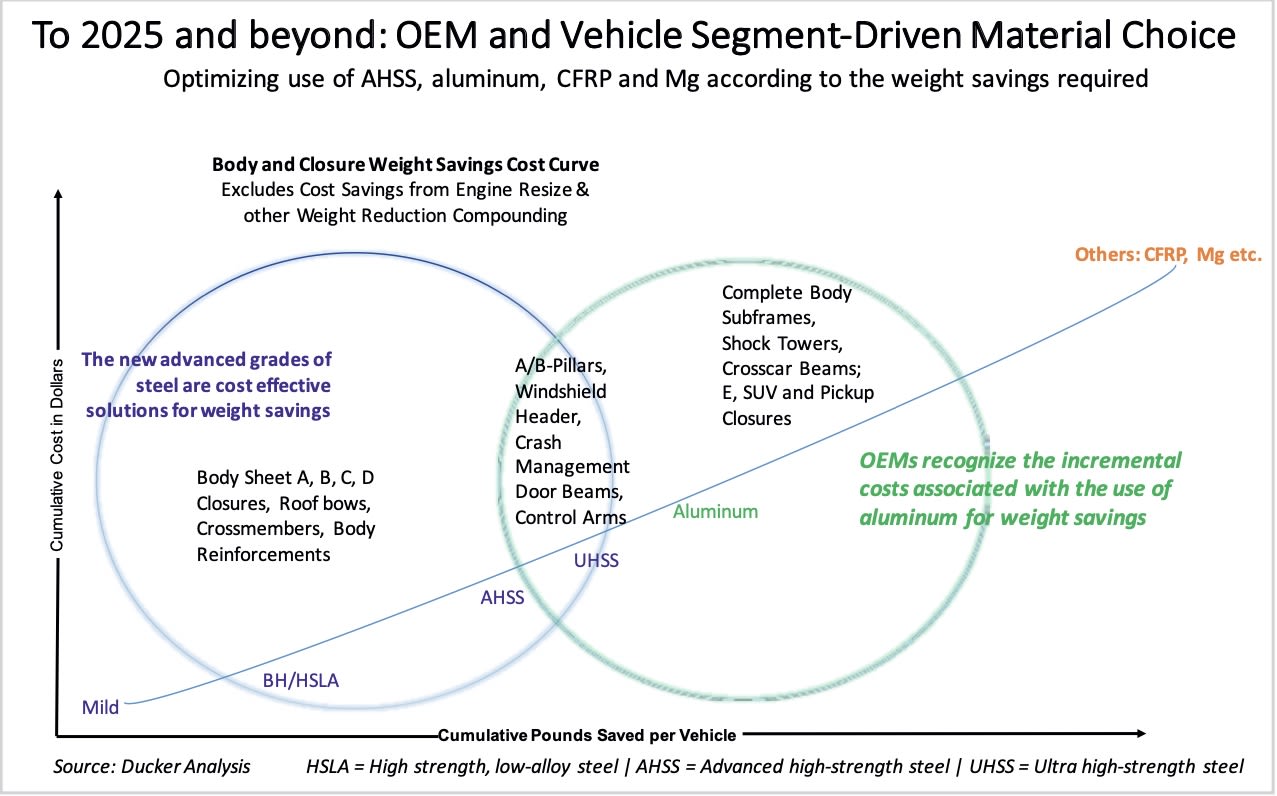
Bendzinski notes that the OEMs’ urgency to reduce vehicle mass is pushing suppliers to shorten their own development processes. “We’re validating new products and getting them into customer evaluation faster for incorporation into new vehicle designs in the upcoming 3-to-6-year window,” he said.
The heavy steel ladder frames underpinning most pickup trucks are even a target market for aluminum as future CO2-driven regulations get tougher. “We think it’s more of a design question than a materials one,” Bendzinski asserted. “In the not-too-distant future there will be opportunities to take weight out of those heavy ladder frames. It’s a primary area for the extrusion folks and it’s an opportunity to use roll-formed (aluminum) sheet in large quantities.”
Composites’ opportunities
BMW’s pioneering use of CFRP for the “black bodies” of its electrified i3 and i8 models signaled a serious commitment to bring lightweight composites, long proven in aircraft and racecar structures, into the automotive mainstream, albeit at comparatively low volumes. Carbon fiber’s main attraction is its strength-to-weight ratio and the potential for net vehicle weight reductions up to 60% via mass de-compounding, according to ORNL.
CAR’s Dr. Baron believes the structural composites industry “has a whole world of opportunity waiting for it in automotive — but it’s going to have to learn to work together in the steel industry model,” he said. “Lack of a robust supply chain will continue to hold them back.” He cautioned that the sector’s reliance on unique solutions delivered company by company is an impediment.
“If I’m an OEM looking for a new materials solution, I want to be able to buy it from four companies — not just from one,” Dr. Baron observed. Steel’s commodity-focused product model enables standardized specifications and testing and in some cases, a more rapid entrée into production. There is no analog to DP700 [a dual-phase steel] in the composites world, he opined.
New technology relationships are spreading among the auto industry, government agencies and academia. Ford Motor Co. and DowAksa recently formed a joint development agreement to create new families of more cost-effective thermoset and thermoplastic CFRP components and take them to the proof-of-concept level. The new JDA is part of the U.S. Dept. of Energy-sponsored Institute for Advanced Composites Manufacturing Innovation (IACMI) which aims to commercialize CFRP-related processes.
Another composite, polycarbonate, has long been expected to replace conventional automotive glazing with less mass and other benefits. Ford claims Corning’s new ‘Gorilla Glass’ (a thin polycarbonate laminate widely used in mobile devices) used first on the 2017 GT supercar is 30% lighter than conventional glass and is stronger, more durable and optically clearer. Is polycarbonate glazing a light-weight candidate for volume vehicle programs after 2020? Perhaps.
Coatings technologies that offer collateral lightweighting benefits as well as friction reduction and NVH attenuation are receiving greater attention by suppliers. A proven example is the liquid acrylic sound-deadening coating (LASD) produced by Henkel that’s replacing relatively heavy bitumen acoustic mats in critical areas. Henkel claims mass reductions up to 30% for its incumbent low-density LASD which weighs 0.9 to 1.1 g/cm3.
New processes drive future actions
Robust processes to enable lightweight solutions in high-volume automotive manufacturing are at least as important as the materials, most experts agree. “The development of creative, low-cost methods to assemble and join multi-material solutions on existing assembly lines is an imperative,” said Dick Schultz, a former Alcoa executive and long-time materials analyst at Ducker Worldwide.
A process “enabler” with huge future potential is the ability to weld steel with aluminum. GM and Honda are both using new multi-patented innovations in this area, which engineers believe are vital for greater mixed-material construction. GM’s spot-welding process is currently underway for the rear seat-back frame of the Cadillac CT6 and is expected to be expanded to the CT6 hood assembly — then to higher-volume applications.
Honda has used Friction Stir Welding since 2012 to join steel to aluminum in vehicle subframe production. This was followed by another welding method for joining aluminum outer skins with steel door subframes, first implemented in series production on the 2014 Acura RLX. Using a hem-like double seam filled with adhesive enables the two metal surfaces to be welded with minimal thermal deformation. Honda engineers claim the new welding process helps to reduce door-panel weight by approximately 17% compared to standard steel doors.
Weld bonding pairs spot welding with structural adhesives to increase stiffness and improve crash-worthiness, while reducing the number of spot welds. It’s a key to future mixed-material vehicle construction. Adhesive suppliers Aderis Technologies, Ashland, Atlas Copco, Dow Automotive Systems, Henkel, PPG and 3M are in the thick of developing new adhesive-joining solutions. Dow engineer and marketing director Peter Cate noted that parts consolidation through design offers significant weight reduction using CFRP components bonded within “hybrid-material” subassemblies.
Despite the billion-dollar investment by BMW and its material partner SGL Group to develop CFRP for series production, new innovations are still needed to mitigate the cost of the material’s process-intensive fabrication. CFRP composites currently cost about three times more to produce than the $5/pound the auto industry seeks. Oak Ridge National Laboratory and Knoxville, TN-based RMX Technologies recently launched co-development of a cold-plasma-based processing technology that has the potential to significantly cut the time and energy required to make affordable CFRP fiber.
The ORNL/RMX technology aims to improve the oxidation stage of carbon-fiber’s conversion process. The oxidation process offers a 20% cost reduction versus current commercial methods — but more cost needs to come out. The team is working with German acrylic textile maker Dralon on a high-strength fiber that is projected to deliver another 20% cost reduction.
Such progress is good news to Dale Brosius, chief commercialization officer at the Institute for Advanced Composites Manufacturing Innovation, an industry-government partnership. In a recent interview with this magazine, he said IACMI’s goal is to drive a 25%-50% reduction in CFRP costs within 10 years, while reducing by up to 75% the energy required to produce the material. Brosius conceded that cost and energy-intensive manufacturing are CFRP’s chief drawbacks. “We (the CFRP industry) can’t be doing things at aerospace rates — we’ve got to get to automotive rates,” he asserted.
Magnesium (Mg) alloy is 30% less dense than aluminum, but its applications tend to be aimed at large components such as cross-car beams and recently the liftgates of the Lincoln MKT and Chrysler Pacifica. GM is among many OEMs looking for Mg cost-reduction solutions. It has been operating a new vertical squeeze-casting (VCS) machine at its China Advanced Technical Center that is designed to more affordably produce magnesium castings.
Designed by teams in Shanghai and Detroit, GM’s VSC machine uses high squeeze pressure to improve casting integrity by eliminating oxide inclusions. GM engineers believe the new process will allow magnesium castings to displace certain forged components, reducing a part’s overall cost. The machine is sited to leverage the material’s availability — China accounts for about 80% of the global magnesium output.
Shultz, the Ducker Worldwide veteran, acknowledged magnesium’s potential but underscored its current shortcomings. He said the $2.50/lb of weight saved with Mg die castings and supply uncertainties “are considered a deal-breaker for most OEMs.” However, for OEMs to attain the final 20% of the 500-odd pounds the average vehicle needs to shed to meet 2025 regulations will require “a 3-5% penetration from a combination of magnesium and carbon-fiber reinforced epoxy and SMC composites.”
If the OEMs do not do this, “it will be because they are not willing to spend the necessary money on the new plant and equipment to make it happen — not because the materials needed to save a significant amount of weight are unavailable, unproven or too expensive,” Schultz said.
The foundry industry has also heeded the lightweighting call. In Europe, 24 steel and forging-industry companies have formed the Lightweight Forging Initiative to demonstrate the potential of forged parts to enable lightweight designs versus competing production processes and materials. Phase I studies conducted in 2013-14 determined that advanced steels and forging technologies could reduce light-vehicle mass by up to 42 kg (93 lb), mainly applied to powertrain and chassis components.
Grede, a U.S.-based producer of cast-iron automotive components, is using its experience with thin-wall lost-foam casting as a member of LIFT, a public-private partnership operated by the American Lightweight Materials Manufacturing Innovation Institute (ALMMII) that is developing and deploying advanced lightweight solutions. According to Jay Solomond, Vice President, Engineering & Technology, Grede “has completed optimizing the design and chemistry which has resulted in 40% weight reduction and 50% thickness reduction.” Trials on differential-case parts created as part of LIFT have begun.
Solomond told Automotive Engineering that through the LIFT process Grede has been using existing production lines and advanced molding techniques. “This means we can make improvements entirely with existing capital and it doesn’t require any new equipment,” he noted.
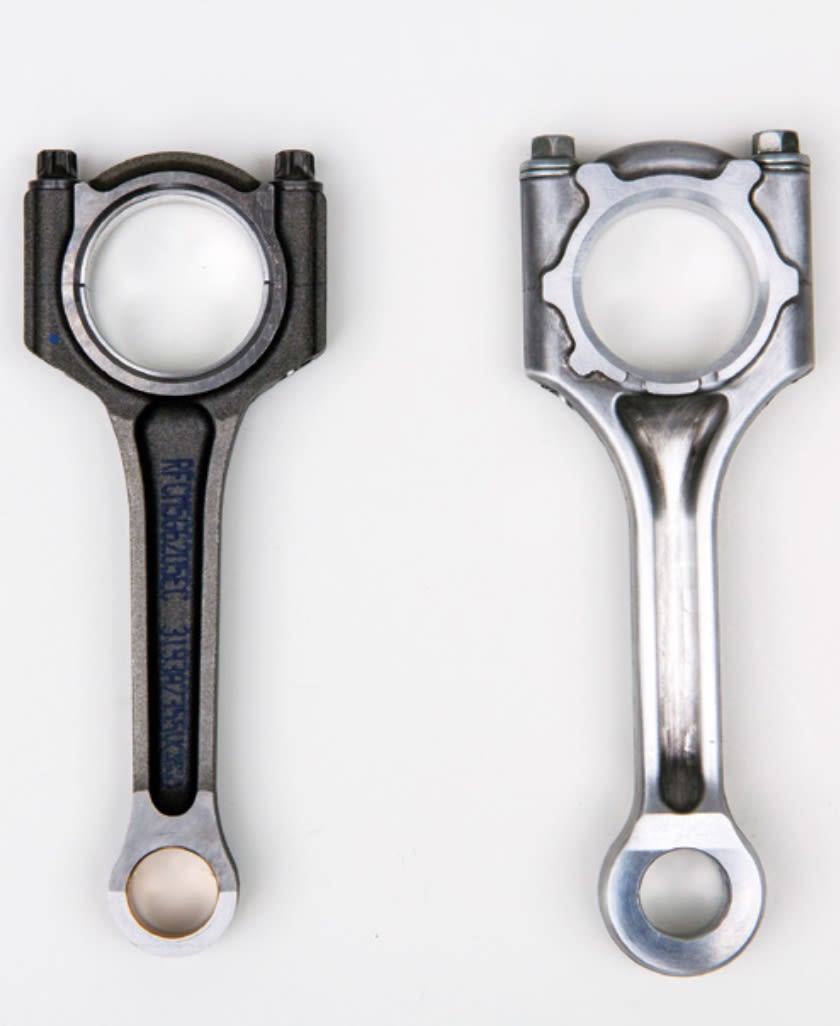
How extensive will lightweighting be? Forged aluminum connecting rods investigated by Ford and Honda would offer a 30% weight saving on reciprocating and rotating mass per engine versus today’s cast iron or steel rods. Long-term durability remains an issue in automotive use, engineers say.
With all the possibilities offered by lightweighting technologies, what will the construction of post-2025 passenger vehicles consist of? Experts we spoke with pointed to today’s BMW i3 and i8, Cadillac CT6, Ford F-Series, Tesla Model S and even the Chevrolet Corvette as directional inspirations for the cars and trucks to come. Opinions were divided on how widespread aluminum-intensive vehicles will be in the 2025-30 timeframe. Most predicted that cost will continue to make mixed-material solutions — incorporating a greater percentage of composites — the reigning choice. Whatever the details, “lightweighting” appears certain to remain a product-development mantra.
More From SAE Media Group
Automotive Engineering
Aluminum: Toward 50% Body Content
Tech Briefs
Pros & Cons of Advanced Lightweighting Materials
Automotive Engineering
2015 F-150: Ford Drops an Aluminum Blockbuster
Automotive Engineering
Altair Honors Weight-Saving Innovations
Off-Highway Engineering
Liebherr Reveals ‘Hybrid’ CFRP Cylinders and Parallel-Pump Concept
Automotive Engineering
Engineering the 2022 Toyota Tundra
Automotive Engineering
2015 Mustang's Glovebox-Integrated Knee Airbag, Other Plastics Innovations Recognized by SPE
Tech Briefs
Executive Roundtable: Additive Manufacturing
Automotive Engineering
ZF's CEO Talks About Lightweight Vehicle Applications
Automotive Engineering
Steel Stands Tall
Automotive Engineering
Recaro Pioneers Seating Shells Made with CF Recyclate
Automotive Engineering
Altair Honors Innovations in Sustainability and Lightweighting
Automotive Engineering
Innovations for Lightweighting: Magna and Ford test carbon-fiber subframes
Automotive Engineering
Hyundai, Ford Pursue Structural Composites Despite Challenges
Automotive Engineering
Mass-Reducing Innovations Honored by Altair
Automotive Engineering
Novelis Creates First Aluminum Sheet Battery Enclosure for Mass Electric Vehicle Production
Automotive Engineering
Top Mass-Cutting Innovations Receive Altair Enlighten Awards
Automotive Engineering
Innovation More Than Skin Deep
Automotive Engineering
In Search of the Lightweight, Multi-Material Car
Automotive Engineering
Multi-material Structures Move mpg Upward
Automotive Engineering
Cadillac Pursues Aluminum/steel Mix for New CT6 Luxury Sedan
Automotive Engineering
Rethinking Aluminum for NVH Abatement
Automotive Engineering
2019’s Best Automotive Plastics Innovations
Automotive Manufacturing and Machining
Aluminum’s Rising Star
Automotive Engineering
Advanced Steels Making Inroads
Medical Design Briefs
Top 10 Reasons Stainless Steel Is Right for Healthcare Design

Tech Briefs
Magazine Archives
Aerospace & Defense Tech Briefs
Lockheed Martin and Arconic Collaborate on 3D Printing and Advanced Aerospace Materials
Battery & Electrification Technology
Battle for the Box
Top Stories
INSIDERManufacturing & Prototyping
 How Airbus is Using w-DED to 3D Print Larger Titanium Airplane Parts
INSIDERManned Systems
 FAA to Replace Aging Network of Ground-Based Radars
NewsTransportation
 CES 2026: Bosch is Ready to Bring AI to Your (Likely ICE-powered) Vehicle
NewsSoftware
 Accelerating Down the Road to Autonomy
EditorialDesign
 DarkSky One Wants to Make the World a Darker Place
INSIDERMaterials
 Can This Self-Healing Composite Make Airplane and Spacecraft Components Last...
Webcasts
Defense
 How Sift's Unified Observability Platform Accelerates Drone Innovation
Automotive
 E/E Architecture Redefined: Building Smarter, Safer, and Scalable...
Power
 Hydrogen Engines Are Heating Up for Heavy Duty
Electronics & Computers
 Advantages of Smart Power Distribution Unit Design for Automotive...
Unmanned Systems
 Quiet, Please: NVH Improvement Opportunities in the Early Design...
