




Blockchain Unchained!
The weird world of cryptocurrency exists because of the intense mathematics of blockchain technology. The mobility sector is looking beyond Bitcoin to put blockchain to work in potentially game-changing ways.
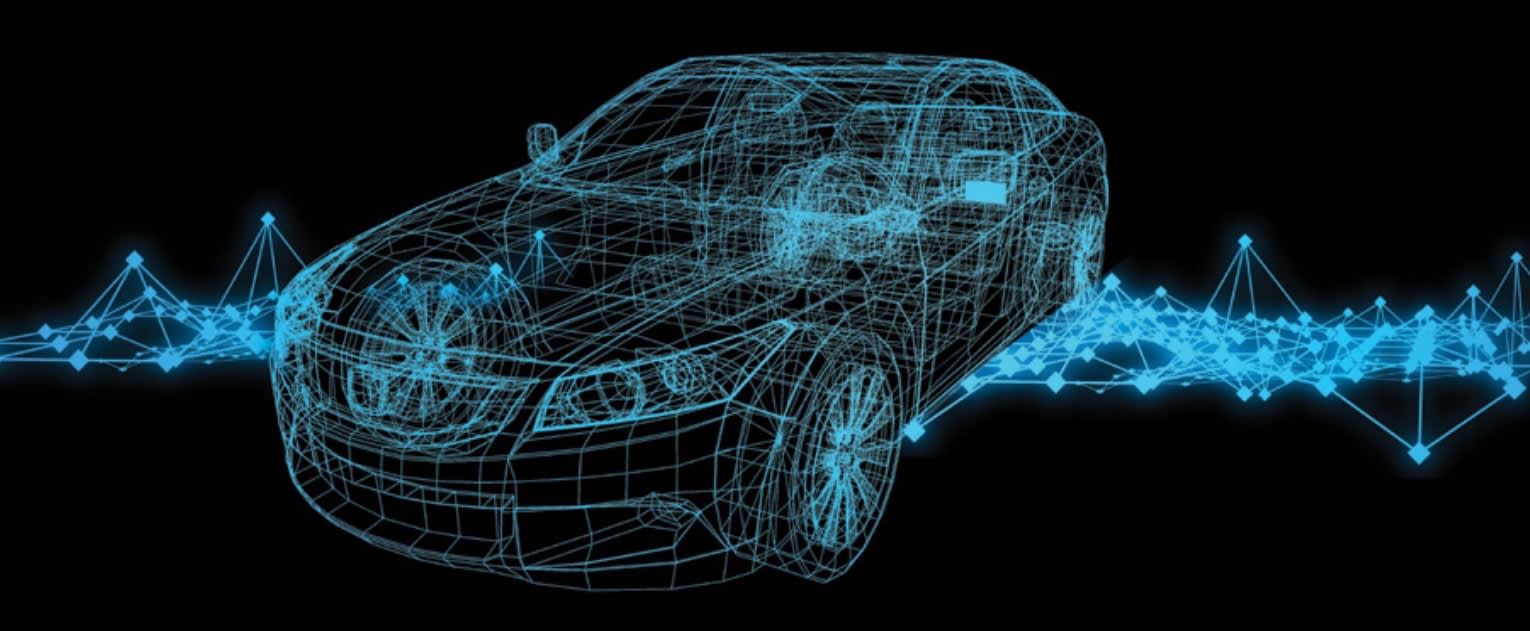
Would you like to get your data back?
What if you could only reveal what you wanted, when you decreed, and it could never be altered without your knowledge? What if all transaction data was securely controlled, automatically, even when you roll thru a drive-through and your connected vehicle makes a purchase without you touching your wallet?
If you can reconcile this vision of personal-data utopia with the fairly shadowy perception of Bitcoin cryptocurrency, welcome to blockchain. Some insist blockchain will change everything in the same fashion as the Internet. And ironically, if it really lives up to the hype, you’ll never even know blockchain was there.
Just tell me what it does

Albert Einstein often is credited with saying, “If you can’t describe it simply, you don’t understand it well enough.” This may be true, but even “simple” explanations of blockchain are likely to leave many puzzled.
Blockchain is a decentralized ledger database for recording transactions (blocks) using numerous computer “nodes” that retain exact copies of each block. Subsequent related transactions (transferring credit to another party, for example) creates a new data entry as a new block added to the chain. The validity of the transaction must be verified by every node tracking the block.
The multiple redundancies and authentications for every coded transaction (all anonymous) makes blockchain transactions nearly impossible to hack or otherwise disrupt. Key to this is decentralization. The data does not reside on a third-party server or with any single database. You relinquish only the data you choose, based on the single block transaction you’ve agreed to make. Since this all happens in a decentralized, peer-to-peer encrypted environment, no one is ever “holding” your data. You’ve never transmitted data that can be linked to you by anyone outside the transaction.
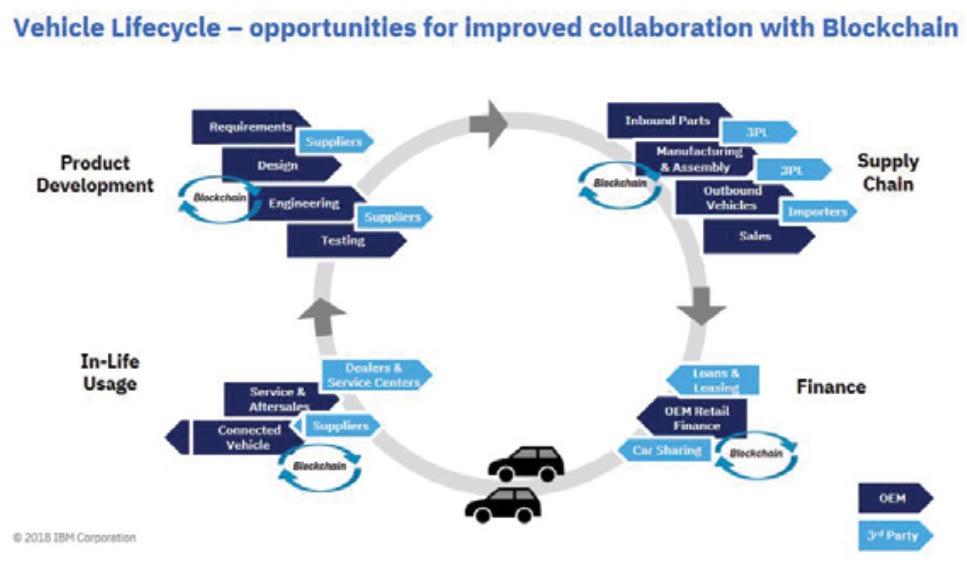
As you might guess, math and financial experts came up with blockchain — and certainly seem to understand it best. Blockchain was first deployed in 2009 as the underlying data technology for the cryptocurrency Bitcoin and the two are invariably linked, said Philipp Schartau, a director in EY’s Strategy and Mobility Innovation teams.
“A lot of people confuse blockchain with Bitcoin,” he told Autonomous Vehicle Engineering in a recent interview. “Bitcoin is (just) the most famous application of blockchain.”
Others — particularly the financial sector — soon took notice of blockchain’s potential.
“The whole (blockchain) movement really started with banks and financial services. They were sort of the first ones to realize the disruptive potential,” said Chris Ballinger, CEO of the Mobility Open Blockchain Initiative (MOBI), a global alliance of automakers and consumer-facing mobility companies attempting to promote standards and accelerate the adoption of blockchain and related technologies (see sidebar).
Secure and efficient
Schartau also is Ernst & Young’s global lead for Tesseract, a blockchain technology pilot platform developed by the firm to enable new ownership models for fractional ownership and crowdfunding of fleets, facilitate data- and transaction-sharing for EV owners and “disaggregate” EV major-component assets to optimize their economic lifecycle and to settle mobilty as a service (MaaS) transactions in multi-modal mobility. He thinks blockchain’s intrinsic security and ability to accommodate “smart contracts” are immense attractions for new mobility models.

“The security aspect really comes from the distribution of information, because to hack the blockchain, you would need to hack not just one node, but more than 50 percent of nodes because if they don’t agree then it’s not going to be considered a valid transaction. It makes it extremely difficult to tamper with the data simply because everyone has a copy of it. You’d need to hack everybody.
“You can apply the same idea of perfect synchronization, perfect record keeping to a whole bunch of other things. And then you’ve got an additional element now that is not just the distributed ledger,
but a programmable ledger.
“You’ve got something called smart contracts, a codified version of traditional contracts between parties that self-execute on the blockchain when certain events happen or certain data comes in. You can rely on those being executed correctly.”
Eliminating a “middle man” holding sensitive data is an important reason why blockchain holds such promise – all manner of transactions can be simple “one and done” dealings that have the anonymity of cash but with an immutable data trail that nobody is able to alter. And without the usual “back office” accounting resources typically required for record-keeping or parts-tracking through the supply chain, blockchain’s automation has potential to considerably cut the “frictional” costs of record-keeping.
What it portends for automated driving is multifarious. Blockchain means your vehicle can be the initiator of transactions — no more parking-lot stubs to remember or tollbooth gadgets to affix to the windshield. And blockchain has the potential to provide certain aspects of cybersecurity for vehicle-to-vehicle (V2V) and vehicle-to-infrastructure (V2X) communications and data exchange. The strategy of “swarm” V2V information to enhance road safety could benefit from blockchain by enabling massive amounts of shared vehicle information virtually free from threat of hacking or mischief.
But wherever blockchain goes for the consumer, most experts agree the technology will and should be essentially transparent, no less so than today when a credit card is inserted into a payment reader. Consumers simply want to trust it works.
“I think where we will get to in the next few years is that people won’t need to understand how the technology works to be able to interact with it,” said Schartau.
“People want to lower the friction of doing something, the time and effort,” echoed MOBI’s Ballinger.“They don’t want complexity.”
Improved safety and services
Vehicle owners reputedly will benefit from blockchain’s potential to enhance safety and security in ways that doubtless will be obscure to many consumers. One is the ability to more accurately align recall actions with the vehicles and consumers who are affected. A 2016 study from Alix Partners determined that recalls in the U.S. that year hit a new record that exceeded 53 million, costing automakers an aggregate $22 billion.
A considerable portion of the cost of recalls is waste attributed to the current system of tracking owners, but also identifying the actual parts or components necessitating the recall. Blockchain presumably would enable a decidedly more acute system for tracing parts from their origin manufacturing plants — right down to individual assembly lines — helping pinpoint only the affected components. Or imagining massive recalls that apply to many models over several years, blockchain could vastly improve the industry’s ability to accurately isolate only the vehicles using the defective part.
As the auto sector ponders the staggering scope of some recent recalls, it’s nearly universally agreed that injecting blockchain’s promise into the supply chain can significantly reduce the ultimate cost of recalls.
In a similar vein, consumers should benefit from essentially the same kind of sleuthing blockchain can bring to tracking of repair-industry parts. In a system tormented by counterfeit, illegitimate parts, blockchain can be used to help assure the provenance and authenticity of replacement components.
According to an early-2018 story in The New York Times, the first quarter of 2018 saw more than a half-billion dollars of venture capital investment in some 75 separate blockchain projects; not all were automotive-related, but that plump three-month figure provides some idea of the investment community’s view of blockchain’s scope.
“I think the biggest game changer—that people aren’t talking about very much yet — is the smart contract, which basically means you’re building process automation into the blockchain,” said Schartau. “You know the moment a transaction happens anywhere in the system that can trigger other actions across the entire blockchain. I think that’s going to be very, very powerful as that matures.”
Early adopters
You won’t yet find many everyday touches with blockchain technology. But that’s soon to change.
This summer, German mega-supplier ZF spun off the eWallet automated-payment service it developed with partners IBM and UBS. The service initially targets automated valet parking and other emerging transportation-related services such as electric-vehicle charging and automated toll collection. The eWallet system is one of the auto industry’s first users of blockchain.
Porsche recently announced a collaboration with startup technology company XAIN to test blockchain-enabled features such as vehicle locking via smartphone apps and permitting temporary access to a vehicle. Porsche claims it’s the first car manufacturer to implement and successfully test blockchain in cars.
And E&Y’s Schartau said the Tesseract project is proceeding steadily to a test phase planned to begin sometime this year. Where on the globe that happens is one of the wild cards.
“We’re in (Tesseract) generation three, a prototype that is experiment-ready. So that means we’ve security tested it,” he explained. “It’s easily scalable to new servers. We are currently talking to a number of different players from across the sectors.
“We’re talking to OEMs. We’re talking to retailers, to leasing organizations, to insurers and to cities, to battery manufacturers, to energy companies and we’re trying to pull together a first live, in-market experiment with those players. So, it’s not decided yet specifically which geography and specifically what use case, but we expect that we’ll get to a live experiment this year.”
More From SAE Media Group
Off-Highway Engineering
Connections Dig Deeper

Automotive Engineering
BMW, Classiq Find Better Architectures Through Quantum Computing
Autonomous Vehicle Engineering
Are Blockchain and ‘Smart Contracts’ the Secure Future?
Off-Highway Engineering
Digital Transformation of the Construction Jobsite
Off-Highway Engineering
The Role of a Cloud-based Server in Service Workshops
Motion Design INSIDER
Leading the Way to Cyber Safety on Roads and Highways
Tech Briefs
Executive Forum: Sensors & the IoT
Automotive Engineering
Manufacturers Must Take the Wheel to Scale SDV Success
Autonomous Vehicle Engineering
Lockered and Loaded
Autonomous Vehicle Engineering
Wired for Autonomy
Automotive Engineering
New SAE President Focused on Big Data
Automotive Engineering
Accelerating Down the Road to Autonomy
Tech Briefs
EVs Are Growing Up—and Getting Practical
Tech Briefs
Product of the Month
Tech Briefs
Rising Star Awards 2025 Judges
Automotive Engineering
Sharper Testing Delivers Better AV Performance
Power Electronics INSIDER
Highway Segment Charges Electric Vehicles
Off-Highway Engineering
Reshaping the Mobile-hydraulic Ecosystem
Automotive Engineering
CES 2026: Qualcomm Expands Partnerships For More Snapdragons



Motion Design INSIDER
Physics-Aware Neural Networks Improve Camera-Based Machines

Top Stories
INSIDERManufacturing & Prototyping
 How Airbus is Using w-DED to 3D Print Larger Titanium Airplane Parts
NewsAutomotive
 Microvision Aquires Luminar, Plans Relationship Restoration, Multi-industry Push
INSIDERAerospace
 A Next Generation Helmet System for Navy Pilots
INSIDERDesign
 New Raytheon and Lockheed Martin Agreements Expand Missile Defense Production
ArticlesAR/AI
 CES 2026: Bosch is Ready to Bring AI to Your (Likely ICE-powered) Vehicle
Road ReadyDesign

Webcasts
Semiconductors & ICs
 Advantages of Smart Power Distribution Unit Design for Automotive...
Unmanned Systems
 Quiet, Please: NVH Improvement Opportunities in the Early Design...
Electronics & Computers
 Cooling a New Generation of Aerospace and Defense Embedded...
Power
 Battery Abuse Testing: Pushing to Failure
AR/AI
 A FREE Two-Day Event Dedicated to Connected Mobility
