




New SAE President Focused on Big Data
Mircea Gradu, senior VP and quality chief at lidar specialist Velodyne, targets data analytics, electrification and connectivity, and STEM initiatives during his 2018 term.
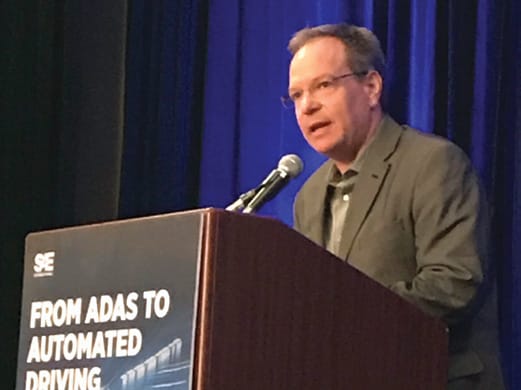
Well-known in the mobility industry for his expertise in mechatronics and propulsion-system engineering, Mircea Gradu, Ph.D. begins his one-year term as SAE International President amid technology shifts that are rocking the automotive status quo. Gradu, the Senior Vice President of Validation/Chief Quality Officer at Velodyne LiDAR Inc., is eager to get going.
“I started my involvement with SAE 25 years ago, while I was still working and studying in Stuttgart, Germany,” noted the Bucharest native who was SAE Vice-President-Automotive during 2010-2012. “Becoming the president of an organization that I have always valued and strongly supported is the culmination of the various honors I received during my career.” He pledges to serve SAE’s global membership “to the best of my abilities.”
Dr. Gradu discussed his vision for SAE in a wide-ranging interview, an edited version of which follows.
What are your goals as SAE President?

Consistent with the objectives I announced during the selection process, I would like to strongly focus on ADAS (advanced driver-assistance systems) and Autonomous Vehicle technologies, given the significant Safety benefits they provide. In addition, I would like to support initiatives in Big Data Analytics and Vehicle Electrification and Connectivity, all enablers for higher levels of vehicle automation. This will be done in conjunction with increased attention to the more traditional areas of automotive engineering, subjected also to an accelerated rate of development.
Again, the engineering education, the application of the STEM model (science, technology, engineering and mathematics) represents a priority for me and a continuation of the impressive work at SAE by several previous presidents.
What are some of your most valuable talents and character traits?
I learned early in my career to listen to the various inputs I received from my talented colleagues, and try to factor them into my decisions and actions. I am always on the lookout for creative ideas and concepts and work diligently to materialize them into innovative new products and processes.
Few people have as many patents and publications as you do. How important is “drive” to success?
I have pursued innovation throughout my entire career, and I am particularly proud of awarded patents that make their way into the market place as mature products, while the rest are merely records of novel approaches. My motivation comes from a tremendous respect for engineers and for the invaluable contributions they bring to our world.
I would feel extremely rewarded if my presidential mandate continues to raise the interest level of new generations for the engineering profession and in general for STEM-based education. In my current position at Velodyne, I have the honor and privilege to work with CEO David Hall, who represents for me the living proof that even in today’s ultra-competitive environments, persistence in innovation, doubled by technical and business leadership, generates success and a life-time of accomplishments.
What should SAE do to be more relevant to mobility engineers of the 2020s?
We’re living in exciting times, with the automotive industry situated at the confluence of four major trends with extremely broad influence, beyond the boundaries of classic transportation: Greenhouse gas emissions reduction over the entire lifecycle of the vehicle, promoting the case for alternative energy powertrains; Vehicle Connectivity; increased levels of vehicle Autonomous Driving capability, and Shared Mobility.
One of the common denominators of all these trends is the increased need and opportunity for Big Data Collection and Analysis, which they create at an unprecedented rate. The Big Data benefits also the quality, safety, cybersecurity, and delivery process of the vehicle. The related tools and skills required to materialize these strategies are a blend of established and emerging disciplines. SAE must provide maximum support to its members in these areas, along with maintaining focus on the more traditional mobility engineering needs.
Has SAE been more valuable to you personally or professionally?
I would say SAE helped me both personally, by introducing me to people that I admire and value as friends today, as well as professionally, through the networking and continuous education opportunities.
In general, through my entire career, I have witnessed compelling cases where SAE has provided tremendous support to mobility industries, regulatory organizations, and providers of engineering education. In recent years, when the auto industry became concerned with cybersecurity and the framework for autonomous vehicles, SAE stepped up and created the initial set of concepts/standards, like the J3061 Cybersecurity Guidebook for Cyber-Physical Vehicle Systems and J3016 to define the levels of Driving Automation for On-Road Motor Vehicles, both embraced by key regulatory organizations.
Your advice for SAE members?
As mobility engineers, we have chosen an incredible career path that is going through an unprecedented era of change with the application of autonomous and sensing technologies. The field of automotive engineering has an opportunity to expand its reach, not just to more people around the world but also in terms of the development of technical expertise not previously associated with the automotive industry.
Everything from ‘edge computing’ to advanced cybersecurity will be incorporated into the autonomous vehicles of the near future, allowing them to become possibly the most advanced pieces of hardware made to this point. The fact that these technological advancements will be driven by automotive engineers is extremely exciting to me, and I hope inspiring to younger and aspiring engineers.
More From SAE Media Group
Autonomous Vehicle Engineering
LiDAR Giant
Autonomous Vehicle Engineering
Standards Play a Vital Role
Sensor Technology
RTK and Sensor Fusion for Autonomous Vehicle Navigation & Guidance

Autonomous Vehicle Engineering
The ‘Buzz’ in Driverless Shuttling
Autonomous Vehicle Engineering
Hopeful but Closer Scrutiny for SAE Level 4 Automation
Autonomous Vehicle Engineering
Safety, Standards Crucial to AVs’ Advance
Off-Highway Engineering
Realizing Software-Defined Commercial Vehicles
Off-Highway Engineering
WCX 2019: IAMTS Association Will Establish Standardization and Testing for Connected Vehicles
Autonomous Vehicle Engineering
ADAS Over the Horizon
Automotive Engineering
Sharper Testing Delivers Better AV Performance
Autonomous Vehicle Engineering
Ensuring No Child Left Inside
Off-Highway Engineering
Sensing Changes in Autonomous Trucks
Motion Design INSIDER
Physics-Aware Neural Networks Improve Camera-Based Machines
Autonomous Vehicle Engineering
Navigating the Language of Vehicle Autonomy

Automotive Engineering
Nvidia’s New Level 2+ Autonomy Platform Is Making Cars Safer Today
Automotive Engineering
Mobileye Ready to Meet FMVSS 127 with Vision-Only System



Automotive Engineering
Manufacturers Must Take the Wheel to Scale SDV Success
Autonomous Vehicle Engineering
AV Powers Bring May Flowers
Autonomous Vehicle Engineering
‘Software, Start Your Engines’
Automotive Engineering
The Future of “Core” Vehicle Systems
Autonomous Vehicle Engineering
New Roles for Lidar in Autonomy’s Lower Levels
Automotive Engineering
Valeo Debuts New Lidars, EV Tech at CES 2022
Motion Design INSIDER
Autonomous Bus Sounds: It’s All About When, Not How

Top Stories
NewsSensors/Data Acquisition
 Microvision Aquires Luminar, Plans Relationship Restoration, Multi-industry Push
INSIDERRF & Microwave Electronics
 A Next Generation Helmet System for Navy Pilots
INSIDERWeapons Systems
 New Raytheon and Lockheed Martin Agreements Expand Missile Defense Production
NewsAutomotive
 Ford Announces 48-Volt Architecture for Future Electric Truck
INSIDERAerospace
 Active Strake System Cuts Cruise Drag, Boosts Flight Efficiency
ArticlesTransportation

Webcasts
Aerospace
 Cooling a New Generation of Aerospace and Defense Embedded...
Energy
 Battery Abuse Testing: Pushing to Failure
Power
 A FREE Two-Day Event Dedicated to Connected Mobility
Automotive
 Quiet, Please: NVH Improvement Opportunities in the Early Design Cycle
Electronics & Computers
 Advantages of Smart Power Distribution Unit Design for Automotive &...
Unmanned Systems
 Sesame Solar's Nanogrid Tech Promises Major Gains in Drone Endurance