




Engineering the Motivo Way
Broad capabilities, unparalleled project diversity and an innovative culture have put this thriving California “idea factory” in high demand.
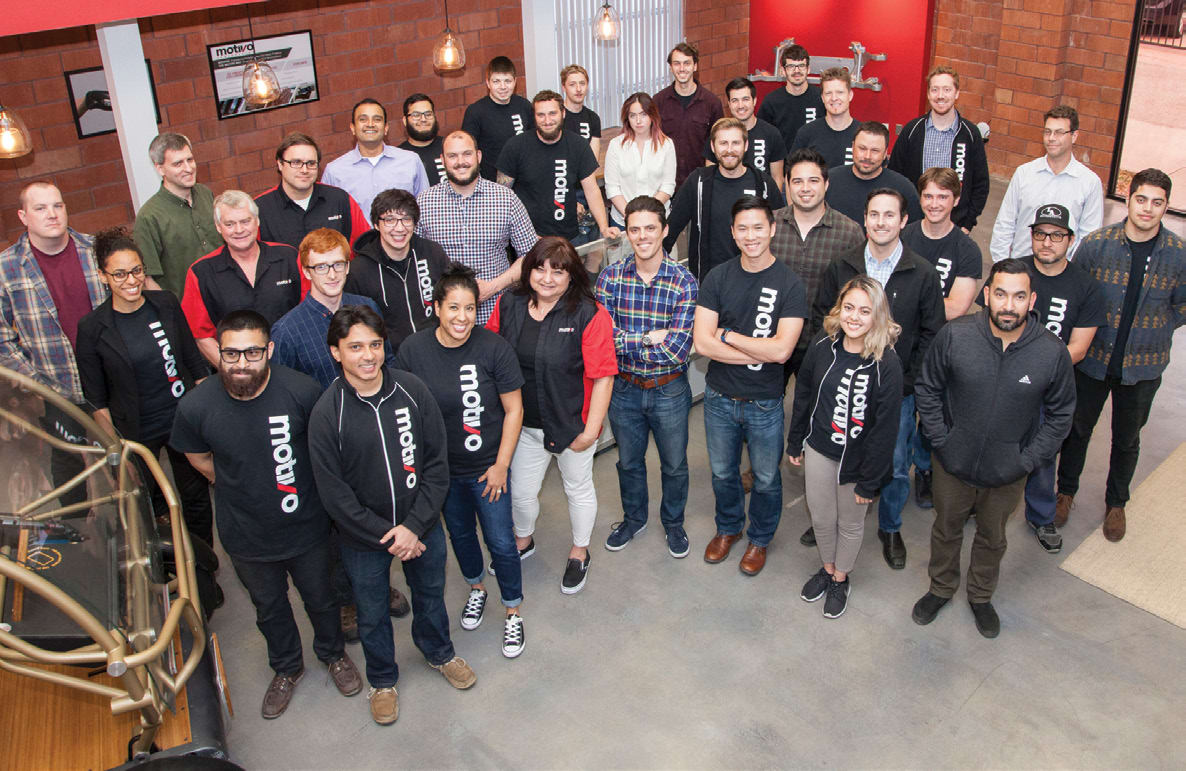
“When we hire new engineers, I’m usually the last guy to talk with the candidate during the interview process," said Praveen Penmetsa, CEO and founder of Motivo Engineering. “And that’s when I to try to convince them NOT to join the company.
”I tell them it’s going to be a crazy job,” he asserted. “You have to put your ego aside because our client’s vision may not line up with your vision. I tell them the designs they’ve developed and are proud of will likely change during the course of a project — are they OK with throwing that away? And after all this, why do they want to work at Motivo?

“The right kind of people love that kind of challenge,” Penmetsa noted with a smile. “The people who show up here and those who we recruit are looking for fulfillment. The ones who succeed here are highly motivated, intellectually curious people who enjoy our project diversity—and who like to get things done.”

Engineers who make the grade find themselves in one of the most project-diverse product development environments of any industry sector. Motivo clearly would not be a good fit, professionally, for those with a singular focus. The company currently serves three market “pillars”—Mobility and Energy, Agtech (agricultural technology), and Aerospace. A glance through the mind-blowing portfolio of nearly 400 projects completed by Motivo since its 2010 founding is like peering into the future. Autonomous vehicle systems. A virtual-reality parachute simulator. Robotic automation for harvesting vegetables as delicately as a human hand can pick them. Battery systems. Drone aircraft propulsion and controls. Biz-jet cabins and aircraft seating solutions. Power grids. Advanced gearboxes. An electric multi-purpose tractor. Audio headphones and wearables!

The growing client base served by Motivo’s two California facilities (Los Angeles and San Francisco Bay area) ranges from tech start-ups to global automotive, aerospace and consumer products giants including Airbus, Hyundai, Designworks, Panasonic, Foster Farms, and Nissan, to name a few who have made public their engagements with Motivo.

“Very often the ‘large incumbents’ come to us wanting some outside thinking,” he noted. “Their advanced R&D says, ‘Our engineering group says X is not possible — what do you guys think?’ We then take a different perspective to it and feed that information back to them. Start-ups, on the other hand, will seek help because they lack band-width, resources. A lot of them have raised a ‘seed round’ or a Series A round [early stage capitalizations] and are still in ‘stealth mode’. They look to us as a resource to help them better define their product before the next round of financing.”
And sometimes the ‘start ups’ are semi-independent entities set up inside the big incumbents to promote innovation while trying to avoid traditional big-company pitfalls.
Innovation is optimal “if you can marry it, in a balanced way, with experience,” he explained. “Too much of either will squash the other! Too much innovation won’t make it to market; you see this a lot with the start-ups.”
Deep involvement in both the ‘wheels’ and ‘wings’ worlds has helped cross-pollinate future programs across Motivo’s business. “Our Aerospace clients love it that we bring experience from both the automotive and consumer-electronics worlds. And the Automotive guys like that we bring Aerospace experience,” Penmetsa reported.

Scott Parazynski’s young company, Fluidity Technologies, develops controls for drone aircraft in Houston, Texas. He and his three-person executive team “had looked far and wide for the right expertise in robotic flight controls. We needed a special combination of electrical and mechanical engineering, with a good deal of robotics and human-factors experience,” he told Automotive Engineering.
Motivo has several engineers with aerospace backgrounds who delivered “lots of ideation and active engagement” in helping the Fluidity team develop three flying prototypes and their single-handed control systems. “They were a good fit for us,” he said.

Aerospace seating and first-class-level cabins have been a Motivo specialty for some of the big players in the commercial-aircraft market segment. Learnings from these projects are being applied to autonomous-vehicle projects. Notes Penmetsa: “The space inside the fully-autonomous automotive cabin has much more in common with seating inside a commercial aircraft or biz jet than it does with a traditional car. From a pure business perspective you’re selling a space along with the mobility from Point A to Point B—exactly what the airlines do,” he said.
Rapid innovation and agility

Penmetsa, a co-founder degreed in aerodynamics and aerospace engineering, was previously director of commercial and automotive products at SoCal technology innovator MillenWorks prior to its acquisition by Textron. A student of innovation history and how it impacted icons such as Bell Labs, he notes that Motivo engineers are part of an exclusive group.
“We will never have more than 49 core people because a small team is important,” he said. “There is a strong need across markets for an organization that understands the huge convergence of technologies, of propulsion, sensors, and the abstract layers in between. We also understand the increasingly fragmented use cases — customers want solutions customized. Unless you have all that expertise — from software to controls to the nitty-gritty mechanical devices like electric motors and gearboxes — in a small team, you really cannot innovate.”
Motivo is organized flexibly to tackle the only type of projects Penmetsa will accept — those that are complex, challenging and professionally rewarding for his staff. There are generalists, specialists and special project teams dubbed ‘Seal Teams’ that operate on the premise that innovation typically is ambiguous. To innovate successfully you must be nimble and move quickly. Sometimes the teams must pivot, with the urgency of Navy Seals, depending on the situation.
Customers herald Motivo’s ability to solve problems rapidly, a key element of what Penmetsa calls the Motivo Way.
“We won’t take on projects that lack complexity or aren’t challenging. We don’t do product cost-optimization projects. If the vision is not audacious, you don’t need Motivo,” he pledged. “Most clients who approach us with projects come to Motivo because they were told that whatever they want to achieve is impossible. We’re an ‘idea factory.’ Our approach is always ‘how do we solve this problem’ rather than, ‘let’s research this thing to death.’”
He noted that a racecar-engineering mentality burning inside the company constantly keeps the team focused on high-value use cases for each project first, rather than starting with the technology problem. Big- company clients come to Motivo for innovation — for the fact that a small team of fewer than 50 can do complete projects from the ground up, quickly.
Penmetsa sees Motivo as a ‘bolt-on start-up’ for both larger customers as well as entrepreneurs.
“They made the difference for us in finalizing our suspension linkage design,” noted Joe Wilcox, founder and CEO of San Francisco-based SWAY Motorsports, developers of an electric motorcycle with unique articulated, three-wheeled chassis that allows the rider to lean into turns like a motorcycle.
“When we began our product design there was not a lot of background engineering information, said Wilcox, who was formerly with IDEO. “Motivo brought deep expertise in Systems Engineering and mechanical engineering. Their team had crazy linkages know-how, with the ability to rapidly iterate on the shop floor. Their agility also EKO allows them to tailor their resources to individual projects.
“They’re a really great partner for smaller companies like mine. We were just starting out, so we had to be resourceful. Motivo worked with us to tailor the project to fit our budget.” Wilcox explained.
A new HARVEST
The diversity of Motivo’s client base and development work is clearly evident during a walk through the company’s Gardena engineering spaces with Penmetsa as tour guide. In one area a Class-8 semi-tractor is being retrofitted for automated/autonomous operation. In another engineers are prototyping a device for harvesting onions—its robotic jaws caress a plump Vidalia as a technician adjusts the vision system controls. Various white boards provide visual updates on the status of programs for major automotive OEMs. At a long work bench, an engineer assembles a prototype wiring harness while colleagues tweak control software on laptops nearby.
Penmetsa has keen interest in all of this company’s work, but he’s especially proud of HARVEST — the Hybrid Agriculture/Road Vehicles with Electricity Storage and Transformation. This small red electric tractor shown on the magazine’s cover is conceived as a “Swiss Army knife” platform for a range of agricultural mechanization and power-related challenges facing farmers in Africa and Asia, and rural populations in other regions. Penmetsa himself hails from an Indian farming family so knows the challenges intimately.
HARVEST was developed as part of a competition hosted by the United States Agency for International Development (USAID), in collaboration with private partners, to develop innovative technical solutions for mobile power and agricultural duty, to assist global humanitarian and economic development efforts. Called “Powering Agriculture: An Energy Grand Challenge for Development,” the competition attracted 450 companies and entrepreneurs. Motivo’s entry was among a dozen finalists who were granted funding to bring their ideas to reality.
Motivo’s HARVEST tractor brings 21st century capabilities. It can use multiple energy sources including solar panels and micro-wind-turbines, or the grid, to power not only implements but also serve as a mobile communications platform for farmers and those who live in remote communities.
According to Penmetsa, two prototypes have been field tested and he is optimistic that a large pilot fleet will provide further, more detailed evaluation of this clever, do-it-all unit.
Currently around 60% of Motivo’s business is on the mobility side including aerospace. Within the other 20-30%, robotics/automation and Agtech projects are growing fast. Penmetsa expects Mobility to become a smaller slice of the pie.
“We apply our insights to line up with where the technologies will be five years from now,” he said. “If you’re too early, you end up too expensive and too niche. But if you’re too late, the competition will engulf you. And your competition these days may not even exist yet.”
More From SAE Media Group
NASA Spinoff
Bringing Hybrid Power to the Rescue
Off-Highway Engineering
Reshaping the Mobile-hydraulic Ecosystem
Tech Briefs
EVs Are Growing Up—and Getting Practical
Tech Briefs
A Self-Powered Trailer
Power Electronics INSIDER
Highway Segment Charges Electric Vehicles
Tech Briefs
2025 Award Finalists
Power Electronics INSIDER
New Smart Charger May Pave the Way for More EVs


Off-Highway Engineering
Off-highway Innovators to Demo Digital Prowess at CES 2026
Off-Highway Engineering
Komatsu Augments Intelligent Machine Control in New Excavator
NASA Spinoff
Swinging the HAMR
Tech Briefs
High-Power Direct Borohydride Fuel Cells
Autonomous Vehicle Engineering
Lockered and Loaded
Power Electronics INSIDER
Highly Conductive Aluminum Can Equal Copper
Off-Highway Engineering
Sensing Changes in Autonomous Trucks
Automotive Engineering
Riding Along With Mercedes and Its in-city Driver Assistance System
Tech Briefs
SAE WCX™ Digital Summit Preview
Tech Briefs
Are In-Wheel Motor Systems Catching On?
Battery Technology
New SAE Wireless Charging Standard is EV Game-Changer




Autonomous Vehicle Engineering
The Road to Automobility
Off-Highway Engineering
CV Autonomy: Picking the 'Low-Hanging Fruit'

Automotive Engineering
Manufacturers Must Take the Wheel to Scale SDV Success
Off-Highway Engineering
ZM Trucks Starts Production in Fontana, California
Top Stories
INSIDERManufacturing & Prototyping
 How Airbus is Using w-DED to 3D Print Larger Titanium Airplane Parts
NewsAutomotive
 Microvision Aquires Luminar, Plans Relationship Restoration, Multi-industry Push
INSIDERAerospace
 A Next Generation Helmet System for Navy Pilots
INSIDERDesign
 New Raytheon and Lockheed Martin Agreements Expand Missile Defense Production
ArticlesAR/AI
 CES 2026: Bosch is Ready to Bring AI to Your (Likely ICE-powered) Vehicle
Road ReadyDesign

Webcasts
Semiconductors & ICs
 Advantages of Smart Power Distribution Unit Design for Automotive...
Unmanned Systems
 Quiet, Please: NVH Improvement Opportunities in the Early Design...
Electronics & Computers
 Cooling a New Generation of Aerospace and Defense Embedded...
Power
 Battery Abuse Testing: Pushing to Failure
AR/AI
 A FREE Two-Day Event Dedicated to Connected Mobility
