




New Technique for Environmentally Friendly Battery Recycling
The method allows recovery of 100 percent of the aluminum and 98 percent of the lithium in EV batteries.
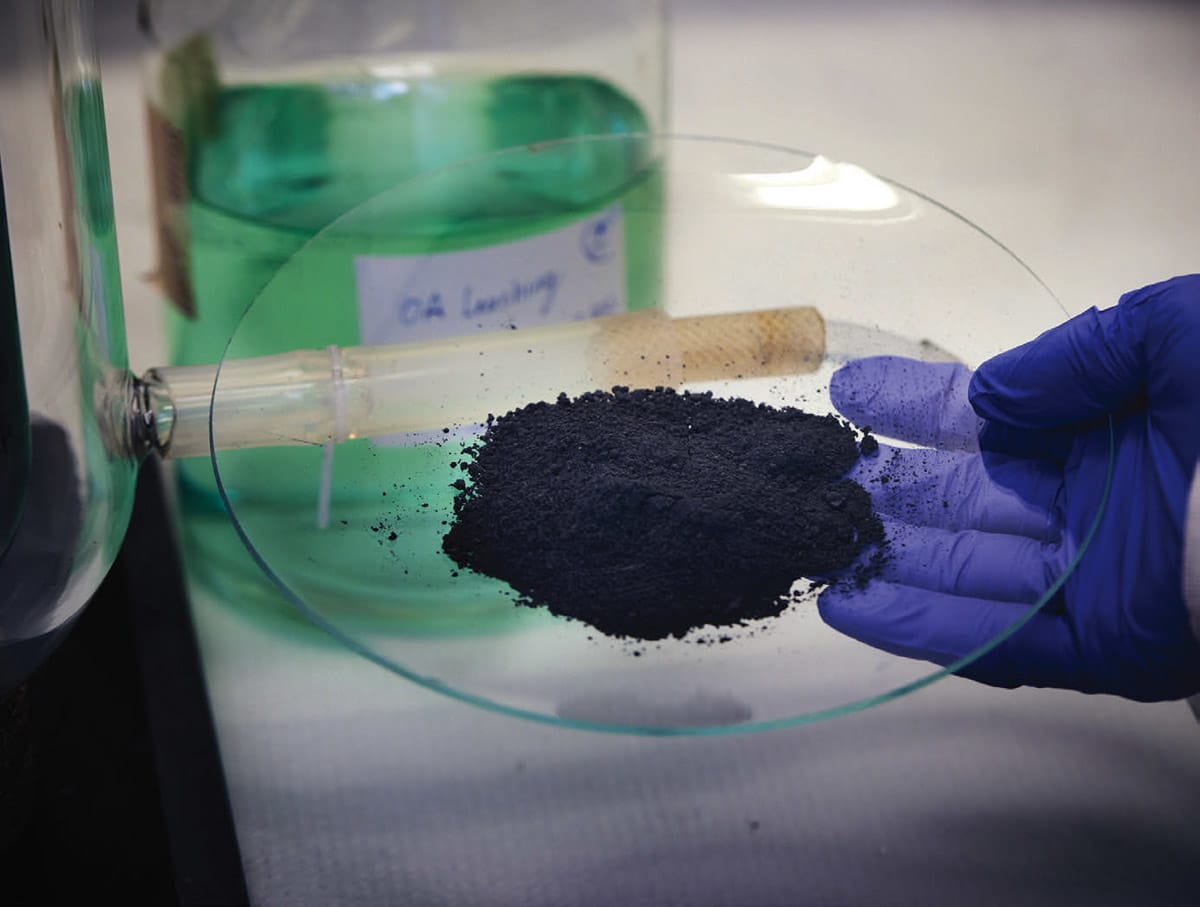
Researchers at Chalmers University of Technology, Sweden, have created a new and efficient way to recycle metals from spent electric vehicle (EV) batteries. The method allows recovery of 100 percent of the aluminum and 98 percent of the lithium in EV batteries. At the same time, the loss of valuable raw materials such as nickel, cobalt, and manganese is minimized. No expensive or harmful chemicals are required in the process because the researchers use oxalic acid – an organic acid that can be found in the plant kingdom.
“So far, no one has managed to find exactly the right conditions for separating this much lithium using oxalic acid, whilst also removing all the aluminum. Since all batteries contain aluminum, we need to be able to remove it without losing the other metals,” said Léa Rouquette, PhD student at the Department of Chemistry and Chemical Engineering at Chalmers.
In Chalmers’ battery recycling lab, Rouquette and research leader Martina Petranikova have shown how the new method works. The lab has spent car battery cells and, in the fume cupboard, their pulverized contents. This takes the form of a finely ground black powder dissolved in a transparent liquid –oxalic acid.
Rouquette produced both the powder and the liquid in something reminiscent of a kitchen mixer. Although it looks as easy as brewing coffee, the exact procedure is a unique and recently published scientific breakthrough. By fine-tuning temperature, concentration and time, the researchers have come up with a remarkable new recipe for using oxalic acid – an environmentally friendly ingredient that can be found in plants such as rhubarb and spinach.
“We need alternatives to inorganic chemicals. One of the biggest bottlenecks in today’s processes is removing residual materials like aluminum. This is an innovative method that can offer the recycling industry new alternatives and help solve problems that hinder development,” said Martina Petranikova, Associate Professor at the Department of Chemistry and Chemical Engineering at Chalmers.
The aqueous-based recycling method is called hydrometallurgy. In traditional hydro metallurgy, all the metals in an EV battery cell are dissolved in an inorganic acid. Then, you remove the “impurities” such as aluminum and copper. Lastly, you can separately recover valuable metals such as cobalt, nickel, manganese, and lithium.
Even though the amount of residual aluminum and copper is small, it requires several purification steps and each step in this process can cause lithium loss. With the new method, the researchers reverse the order and recover the lithium and aluminum first. Thus, they can reduce the waste of valuable metals needed to make new batteries.
The latter part of the process, in which the black mixture is filtered, is also reminiscent of brewing coffee. While aluminum and lithium end up in the liquid, the other metals are left in the “solids.” The next step in the process is to separate aluminum and lithium.
“Since the metals have very different properties, we don’t think it’ll be hard to separate them. Our method is a promising new route for battery recycling – a route that definitely warrants further exploration,” said Rouquette. “As the method can be scaled up, we hope it can be used in industry in future years,” said Petranikova.
For more information, contact Karin Wik at
More From SAE Media Group


Battery & Electrification Technology
Designing Safer, Higher-Performance Lithium Batteries
Battery & Electrification Technology
Cobalt-Free Electrodes Achieved with Nickel Ions
Battery & Electrification Technology
Cobalt-Free Batteries Could Power EVs of the Future
Tech Briefs
Developing Fast-Charging Lithium-Metal Batteries
Battery & Electrification Technology
Developing a Better Way to Recycle Lithium-Ion Batteries
Battery & Electrification Technology
New Cathode Material for Sodium-Ion Batteries
Tech Briefs
Method Turns Fruit Peels into New Batteries

Battery & Electrification Technology
New Priming Method for Improving Battery Lifecycle
Battery & Electrification Technology
Control Valves: Essential Components for EV Battery Manufacturing and Recycling
Automotive Engineering
In Search of Higher-Energy-Content Batteries
Automotive Engineering
Closing the Loop on EV Battery Recycling
Battery & Electrification Technology
Niobium: Magic Metal for Battery Anodes?
Battery & Electrification Technology
Developing Safer Batteries with Solid-State Polymer Electrolytes
Battery & Electrification Technology
Iron Could Be Key to Less Expensive, Greener Lithium-Ion Batteries
Battery Technology
Doubling Battery Performance with Lithium Metal
Automotive Engineering
Nissan's Innovative Solid-State Gambit
Automotive Engineering
Constellium Develops New Alloys for EV Battery Enclosures
Automotive Engineering
Batteries & Recycling: The Next Frontier

Battery & Electrification Technology
A New Way to Enhance Durability of Lithium Batteries
Battery Technology
Ultrasound Device Improves Charge Time and Run Time in Lithium Batteries
Tech Briefs
Coating Extends Lithium Metal Battery Life

Battery & Electrification Technology
Improving and Increasing Energy Density of Batteries
Top Stories
INSIDERManufacturing & Prototyping
 How Airbus is Using w-DED to 3D Print Larger Titanium Airplane Parts
NewsAutomotive
 Microvision Aquires Luminar, Plans Relationship Restoration, Multi-industry Push
INSIDERAerospace
 A Next Generation Helmet System for Navy Pilots
INSIDERDesign
 New Raytheon and Lockheed Martin Agreements Expand Missile Defense Production
ArticlesAR/AI
 CES 2026: Bosch is Ready to Bring AI to Your (Likely ICE-powered) Vehicle
Road ReadyDesign

Webcasts
Semiconductors & ICs
 Advantages of Smart Power Distribution Unit Design for Automotive...
Unmanned Systems
 Quiet, Please: NVH Improvement Opportunities in the Early Design...
Electronics & Computers
 Cooling a New Generation of Aerospace and Defense Embedded...
Power
 Battery Abuse Testing: Pushing to Failure
AR/AI
 A FREE Two-Day Event Dedicated to Connected Mobility
