




Evaluation of Performance of WL Fe-Based Spin-LEDs
Unlike prior spin-LEDs, these spin-LEDs function reliably at room temperature.
A study was performed to evaluate the performance of a recently developed type of Fe-based spin-light-emitting diodes (spin-LEDs) that incorporate wetting layers (WLs). [The term "wetting layer" has two slightly different meanings as explained below.] Light beams emitted by the WL Febased spin-LEDs were found to exhibit the same high degree of circular polarization as do those of previously developed Fe-based spin-LEDs, but differ in one very important aspect: they are an order of magnitude brighter than those emitted by their previously developed counterparts. As a consequence, the WL Fe-based spin-LEDs function reliably at room temperature, whereas their previously developed counterparts do not.

In a typical previously developed spin-LED, electron-hole recombination takes place in either a GaAs quantum well (QW) or an InAs quantum dot (QD). The growth of an InAs QD proceeds as follows: InAs is deposited on GaAs and initially forms a two-dimensional layer that is highly strained because of the large mismatch between the GaAs and InAs crystal lattices. This layer, which is what has previously been meant by "wetting layer," has a critical thickness of 1.7 monolayers. The InAs QDs are grown on the WL using an indium flash procedure. Optical-pumping experiments have led to the finding that the WL results in strong (30 percent) circular polarization that remains constant across the temperature range of 5 to 100 K. This degree of polarization corresponds to a ratio τR/τS ≈ 1, where τR is the radiative relaxation time and τS is the spin relaxation time. This finding prompted the development and study of the present WL Fe-based spin-LEDs, which differ from prior Fe-based InAs-QD spin LEDs in that they incorporate WLs but not InAs QDs.
The layers now denoted as WLs in the present WL Fe-based spin-LEDs differ from the WLs of the prior Fe-based InAs-QD spin LEDs. The layers now denoted as WLs could be characterized more accurately as quantum wells. They have thicknesses between 3 and 4 nm and compositions of InxGa1-xAs, where 0.25 ≤ × ≤ 0.35.
The figure presents the energy-band diagram of a specific WL Fe-based spin-LED, considered in the study reported here, that incorporates three WLs constituting thinner, deeper quantum wells at the middle of a thicker (40-nm-thick), shallower GaAs quantum well. The Al0.1Ga0.9As barrier to the left of the WLs is n-doped, while the A0.3Ga0.7As barrier to the right of the WLs is p-doped. The leftmost 15 nm of the Al0.1Ga0.9As is doped heavily (to a number density 1019 cm-3) to form a Schottky barrier with a 10-nm-thick Fe contact.
The principle of operation is as follows: A magnetic field oriented through the thickness (along a horizontal line in the figure) is applied by an external magnet to saturate the out-of-plane magnetization of the Fe contact. Under this condition, spin-polarized electrons (predominantly in the spin-down state) from the Fe contact tunnel through the reverse-biased Fe/Al0.1Ga0.9As Schottky barrier, while unpolarized holes are injected from a p-doped GaAs buffer layer. Electrons and holes are captured by the WL QWs. The recombination of electrons and holes in the WL QWs results in emission of photons with a degree of circular polarization corresponding to the degree of polarization of the electrons.
In experiments, intensities of electroluminescence from WL Fe-based spin-LEDs was found to be typically an order of magnitude greater than the corresponding intensities of prior spin-LEDs in which recombination takes place in quantum wells that do not contain narrower, deeper WL quantum sub-wells. Moreover, even though only a small fraction of prior spin-LEDs were found to emit at room temperature, all WL spin-LEDs were found to emit at room temperature.
This work was done by Athos Petrou of the Research Foundation of the State University of New York for the Office of Naval Research.
ONR-0008
This Brief includes a Technical Support Package (TSP).
Evaluation of Performance of WL Fe-Based Spin-LEDs
(reference ONR-0008) is currently available for download from the TSP library.
Don't have an account?
More From SAE Media Group

Tech Briefs
Material Increases Efficiency of LED Devices
Tech Briefs
Turning Diamond into Metal
Photonics Tech Briefs
Semiconductor Quantum Dots as Radiation-Hard Light Emitters
Tech Briefs
Quantum Switch Turns Metals into Insulators
Tech Briefs
Materials Move in Response to Light
Photonics & Imaging Technology
Using Magnets to Toggle Nanolasers Leads to Better Photonics


Photonics & Imaging Technology INSIDER
Researchers Discover Breakthrough Materials to Enhance Light-Based Computers
Photonics Tech Briefs
DFM Your Device? Simulation Is the Answer
Aerospace & Defense Tech Briefs
Compact Megawatt Infrared Free-Electron Laser Amplifier
Photonics & Imaging Technology INSIDER
Paving the Way to Electrically Pumped Lasers from Colloidal-Quantum-Dots
Photonics & Imaging Technology
Nanoscale Machines Convert Light into Work
Photonics & Imaging Technology INSIDER
Using Light to Put a Twist on Electrons
Aerospace & Defense Tech Briefs
BC VCSELs for RF/Photonic Links
Tech Briefs
Nanoscale 3D Structure to Control Light
Photonics & Imaging Technology
Researchers Create World’s Smallest LED And Holographic Microscope
Aerospace & Defense Tech Briefs
Frequency Agile Plasmonic Antennas and Sensors
Photonics & Imaging Technology
A New Optical Metamaterial Makes True One-Way Glass Possible
Tech Briefs
Turning Thermal Energy into Electricity
Photonics & Imaging Technology
Spiral Ladder-Inspired Tool That Allows Precision Control of Light Direction and Polarization
Electronics & Sensors INSIDER
World's First Petahertz-Speed Phototransistor in Ambient Conditions

Tech Briefs
Composite Glass Produces Unbreakable Screens
Tech Briefs
Nanoscale LED Also Functions as a Laser
Tech Briefs
Combined Optical Transmitter and Receiver
Aerospace & Defense Tech Briefs
Continuous-Wave Atom Laser
Photonics & Imaging Technology
Manufacturing OLED Lighting
Overview
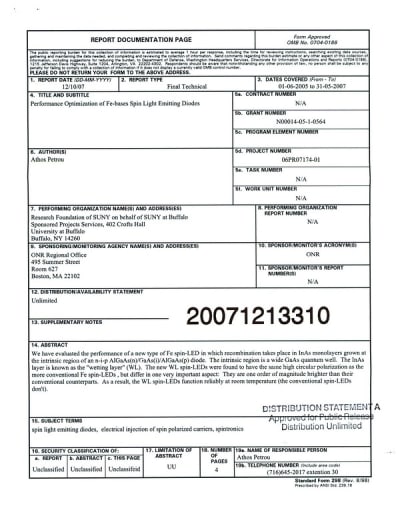
The document presents a final progress report on the performance optimization of a new type of Fe-based spin light-emitting diodes (spin-LEDs), developed through collaboration with Dr. Athos Petrou and his research group at the Naval Research Laboratory (NRL). The focus of the research is on the use of InAs monolayers, specifically the "wetting layer" (WL), which is crucial for enhancing the performance of these devices.
The report outlines the growth process of InAs quantum dots (QDs) on GaAs substrates, where InAs initially forms a strained two-dimensional wetting layer due to the lattice mismatch with GaAs. This wetting layer is integral to the operation of the spin-LEDs, as it serves as the region where electron-hole recombination occurs. The study highlights that the new WL spin-LEDs exhibit high circular polarization, comparable to conventional Fe spin-LEDs, but with a significant advantage: they are one order of magnitude brighter. This increased brightness allows the WL spin-LEDs to function reliably at room temperature, a notable improvement over traditional spin-LEDs, which struggle to operate effectively at such temperatures.
The document also details the results of the research, which have been disseminated through various conferences and a journal publication. Notable presentations include "Electrical Spin Injection into InAs Wetting Layer" at the 52nd Conference on Magnetism and Magnetic Materials in 2007 and the 2008 March Meeting of the American Physical Society. Additionally, a paper titled "Electrical Spin Injection into the InAs/GaAs Wetting Layer" has been accepted for publication in Applied Physics Letters.
The findings indicate that the WL spin-LEDs not only maintain high polarization levels but also demonstrate a strong performance in terms of brightness and operational reliability. This research contributes to the field of spintronics, which seeks to exploit the intrinsic spin of electrons for advanced electronic applications.
Overall, the report emphasizes the potential of WL spin-LEDs in practical applications, particularly in the development of more efficient and reliable light-emitting devices that leverage spin-polarized carriers. The work represents a significant step forward in the optimization of spin-LED technology, with implications for future advancements in the field.
Top Stories
INSIDERDesign
 How Airbus is Using w-DED to 3D Print Larger Titanium Airplane Parts
NewsSensors/Data Acquisition
 Microvision Aquires Luminar, Plans Relationship Restoration, Multi-industry Push
INSIDERManned Systems
 A Next Generation Helmet System for Navy Pilots
NewsAR/AI
 Accelerating Down the Road to Autonomy
INSIDERDefense
 New Raytheon and Lockheed Martin Agreements Expand Missile Defense Production
ArticlesAR/AI
 CES 2026: Bosch is Ready to Bring AI to Your (Likely ICE-powered) Vehicle
Webcasts
Semiconductors & ICs
 Advantages of Smart Power Distribution Unit Design for Automotive...
Unmanned Systems
 Quiet, Please: NVH Improvement Opportunities in the Early Design...
Electronics & Computers
 Cooling a New Generation of Aerospace and Defense Embedded...
Automotive
 Battery Abuse Testing: Pushing to Failure
Transportation
 A FREE Two-Day Event Dedicated to Connected Mobility
