




Continuous-Wave Atom Laser
Continuous injection and propagation of a cold atomic beam has been demonstrated.
Progress has been made toward realization of a continuous-wave, phase-andamplitude- stable atom laser based on magnetic guiding, magnetic compression, and continuous distributed evaporative cooling of a sparse cloud of 87Rb atoms. This apparatus is intended to serve as a prototype of sources of coherent matter waves for future atom-interferometric field and motion sensors.
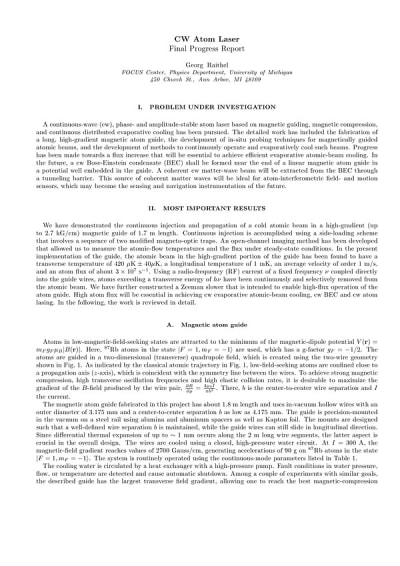
A major part of the apparatus is a magnetic guide comprising two hollow, watercooled, 3.175-mm-diameter wires (see figure) about 1.7 m long in a vacuum chamber in which the 87Rb atoms are manipulated. In operation, the wires are excited with parallel direct currents of 300 A, thereby generating a two-dimensional quadrupole magnetic field having a minimum magnitude along the central longitudinal axis of the guide with large lateral gradient. The 87Rb atoms used in this apparatus are prepared in the ⎜F = 1, mF = -1〉 quantum state in which the atoms have magnetic moments that cause them to be attracted to the locus of minimum magnitude of the magnetic field — that is, to the central longitudinal axis.

At the input end, 87Rb atoms are injected continuously into the guide in a side-loading scheme that involves a sequence of two modified magneto-optical traps. An open-channel imaging method enables measurement of temperatures and flux of the beam of atoms in the guide under steady-state conditions. At the stage of development at this writing, the beam in the high-gradient portion of the guide has been found to have a transverse temperature of 420 ±40 μK, a longitudinal temperature of 1 mK, an average speed of order 1 m/s, and an atom flux of about 3×10⁷.
It is planned to incorporate a potential well into the guide near the output end, for the purpose of forming a continuous-wave (CW) Bose-Einstein condensate in the well. It is further planned to utilize quantum-mechanical tunneling to extract a coherent CW matter wave from the BEC. A Zeeman slower (a device that utilizes laser cooling and the Zeeman effect to reduce speeds of atoms) has been constructed, with the intent to eventually use it to enable highflux operation of the guide. High flux is essential to further progress toward achieving CW evaporative cooling of the beam, a CW BEC, and CW atom lasing.
This work was done by Georg Raithel of the Army Research Laboratory. For more information, download the Technical Support Package (free white paper) at www.defensetechbriefs.com/tsp under the Photonics category. ARL-0003
This Brief includes a Technical Support Package (TSP).
Continuous-Wave Atom Laser
(reference ARL-0003) is currently available for download from the TSP library.
Don't have an account?
More From SAE Media Group
Photonics Tech Briefs
Dual-Beam Atom Laser Driven by Spinor Dynamics
Photonics & Imaging Technology
Using Magnets to Toggle Nanolasers Leads to Better Photonics
Photonics & Imaging Technology
Researchers Generate Terahertz Laser with Laughing Gas
Photonics & Imaging Technology
R&D Effort Produces Magnetic Devices to Enable More Powerful X-ray Lasers
Photonics Tech Briefs
Cold Atom Source Containing Multiple Magneto-Optical Traps
Tech Briefs
High-Power, Portable Terahertz Laser
Aerospace & Defense Tech Briefs
Compact Megawatt Infrared Free-Electron Laser Amplifier
Photonics & Imaging Technology
Making Measurements with a Fine-Toothed Comb
Aerospace & Defense Tech Briefs
Frequency Agile Plasmonic Antennas and Sensors
Tech Briefs
Optimal Information About the Invisible
Aerospace & Defense Tech Briefs
On the Pulsed Laser Ablation of Metals and Semiconductors
Photonics & Imaging Technology
Tiny Terahertz Laser for Imaging and Chemical Detection
Photonics & Imaging Technology
A Laser That Could Reshape the Landscape of Integrated Photonics

Photonics & Imaging Technology
A First-Of-Its-Kind Integrated Optical Isolator
Photonics & Imaging Technology
Pratt & Whitney, Virginia Tech Pioneer Laser-Optical Approach for Turbofan Engine Thrust Measurement
Photonics & Imaging Technology
Optical Coatings Technology
Photonics & Imaging Technology
Essential Principles for Designing and Specifying Laser Optics
Aerospace & Defense Tech Briefs
New Class of Excimer-Pumped Atomic Lasers (XPALS)
Photonics & Imaging Technology
Continuous and Stable Lasing Achieved From Low-Cost Perovskites at Room Temperature
Aerospace & Defense Tech Briefs
Development of Photoacoustic Sensing Platforms
Tech Briefs
Chip Measures Quantities with Quantum Precision
Photonics Tech Briefs
Optical Magnetometer Incorporating Photonic Crystals
Photonics & Imaging Technology
Nanoscale Machines Convert Light into Work
Photonics Tech Briefs
Tunable Optical True-Time Delay Devices Would Exploit EIT
Tech Briefs
Multiplexed Optical Antennas
Photonics & Imaging Technology INSIDER
Tiny Diamond Mirrors Could Smooth Out Already Revolutionary X-Ray Lasers
Photonics & Imaging Technology
New “Metalens” Shifts Focus Without Tilting or Moving
Photonics & Imaging Technology
A New Optical Metamaterial Makes True One-Way Glass Possible
Photonics & Imaging Technology INSIDER
Can a Breakthrough in Photonic Time Crystals Change How We Use and Control Light?
Overview
The document is a final progress report on a research project led by Georg Raithel at the University of Michigan, focusing on the development of a continuous-wave (cw) atom laser. The project aims to create a phase- and amplitude-stable atom laser using techniques such as magnetic guiding, magnetic compression, and continuous distributed evaporative cooling.
Key achievements of the project include the successful demonstration of continuous operation of a cold atomic beam within a high-gradient magnetic guide, which has a length of 1.7 meters and a gradient of up to 2.7 kG/cm. The research team developed an imaging method that allows for in-situ measurements of atom temperatures and fluxes, which are critical for understanding the behavior of the atomic beam.
The report highlights specific measurements obtained during the experiments. The transverse temperature of the atomic beam was found to be 420 micro-Kelvin, while the longitudinal temperature was measured at 1 mK. The average velocity of the atoms in the guide was approximately 1 m/s, and the atomic flux was determined to be about 3 × 10^7 atoms per second. These measurements are essential for evaluating the performance of the atom laser and its potential applications.
To enhance the efficiency of evaporative cooling, the project included the construction of a Zeeman slower, which is designed to enable atom fluxes exceeding 10^9 atoms per second. This level of flux is necessary for effective evaporative cooling, which is a crucial step in achieving Bose-Einstein condensation and creating a coherent matter-wave beam.
The report emphasizes the importance of these advancements in the context of future applications, particularly in the field of atom interferometry. The development of a cw atom laser could lead to significant improvements in sensing and navigation technologies, making it a valuable contribution to the field of atomic physics.
Overall, the document outlines the progress made in the project, detailing the experimental setup, methodologies, and results obtained, while also discussing the implications of this research for future technological advancements in atom-based applications.
Top Stories
INSIDERManufacturing & Prototyping
 How Airbus is Using w-DED to 3D Print Larger Titanium Airplane Parts
INSIDERManned Systems
 FAA to Replace Aging Network of Ground-Based Radars
NewsTransportation
 CES 2026: Bosch is Ready to Bring AI to Your (Likely ICE-powered) Vehicle
NewsSoftware
 Accelerating Down the Road to Autonomy
EditorialDesign
 DarkSky One Wants to Make the World a Darker Place
INSIDERMaterials
 Can This Self-Healing Composite Make Airplane and Spacecraft Components Last...
Webcasts
Defense
 How Sift's Unified Observability Platform Accelerates Drone Innovation
Automotive
 E/E Architecture Redefined: Building Smarter, Safer, and Scalable...
Power
 Hydrogen Engines Are Heating Up for Heavy Duty
Electronics & Computers
 Advantages of Smart Power Distribution Unit Design for Automotive...
Unmanned Systems
 Quiet, Please: NVH Improvement Opportunities in the Early Design...
