




BC VCSELs for RF/Photonic Links
These devices are especially well suited for short-range, wide-band communications.
Bipolar cascade (BC) vertical-cavity surface emitting lasers (VCSELs) of a type intended specifically for use in radio-frequency (RF)/photonic links have been demonstrated. As used here, "RF/photonic link" signifies a communication link in which, at the transmitter, the continuous-wave output of a laser is modulated with an RF (typically, a microwave) signal and the resulting modulated laser beam is conveyed via free space or an optical fiber to a receiver, where the RF signal is detected. RF/photonic links offer advantages for short-range, wide-band communications and for diverse functions involved in phased arraying of large microwave antennas.
In comparison with conventional single laser diodes heretofore used in RF/ photonic links, BC VCSELs offer advantages of (1) better impedance matching with electronic drive circuitry and (2) greater modulation efficiency and, therefore, (3) lower insertion losses. In principle, one could obtain these advantages by constructing series stacks of conventional semiconductor lasers. However, the costs would be very high, and the solder bonds between individual lasers in stacks would induce large RF parasitic loss and increase sensitivity to thermomechanical stresses. Therefore, such series laser stacks would perform suboptimally and exhibit low reliability. By virtue of their integration into monolithic packages, BC VCSELs offer potential advantages of reduced packaging costs, greater reliability, and lower parasitic RF losses, in comparison with series stacks of conventional semiconductor lasers.
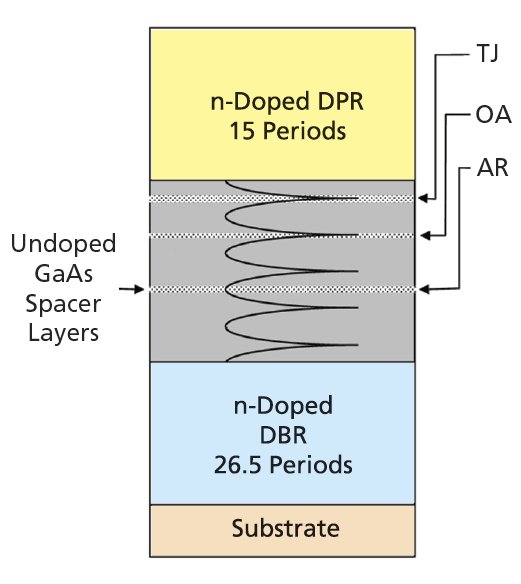
The present BC VCSELs were developed following a systematic approach to designing, fabricating, and characterizing the TJs (which are critical); incorporating the TJs into edge-emitting bipolar cascade lasers; and, finally, making the transition to VCSEL structures. In a departure from conventional practice, prior to fabrication and characterization of BC VCSELs, bipolar cascade light-emitting diodes that incorporate microcavities were investigated (the advantage of this departure was that it disentangled effects of microcavities from those of VCSEL cavities). Then best-performing design providing for electron-acceptor-doped (p-doped) OA microcavities was adopted for the microcavities in one-, two-, and threestage BC VCSELs to operate at a wavelength of 980 nm. These BC VCSELs were fabricated and tested. In the tests, the modulation frequency responses of the two-stage and three-stage VCSELs were found to be characterized by halfpower- falloff frequencies of 4.5 and 7.1 GHz, respectively, in response to smallsignal current injection at an operating temperature of -50°C. At room temperature, the half-power-falloff frequency of the three-stage device was 3.2 GHz.
This work was done by William J. Siskaninetz of the Air Force Institute of Technology for the Air Force Research Laboratory.
More From SAE Media Group
Photonics Tech Briefs
DFM Your Device? Simulation Is the Answer

Photonics & Imaging Technology
A Laser That Could Reshape the Landscape of Integrated Photonics
Air Force Research Laboratory Technology Horizons
Surface-Emitting Laser Arrays Bring Light to the Top
Photonics Tech Briefs
A High-Repetition-Rate Optical Communications Source
Aerospace & Defense Tech Briefs
Laser Integration on Silicon Photonic Circuits Through Transfer Printing
Air Force Research Laboratory Technology Horizons
Patterned Gallium Arsenide Devices for Infrared Countermeasures
Tech Briefs
Nanoscale LED Also Functions as a Laser
Photonics & Imaging Technology
A First-Of-Its-Kind Integrated Optical Isolator

Photonics Tech Briefs
Active Fiber Optic Microelectromechanical Systems Aligner
Photonics & Imaging Technology
Photonic Microwave Generation Using On-Chip Optical Frequency Combs
Photonics & Imaging Technology
2.2-Micron, Uncooled, InGaAs Photodiodes and Balanced Photoreceivers up to 25-GHz Bandwidth
Photonics & Imaging Technology
Ultrafast Beam-Steering Breakthrough at Sandia Labs
Photonics & Imaging Technology
How to Innovate and Overcome the Challenges of Blue Laser Beam Shaping
Photonics Tech Briefs
SPIE Photonics West 2015 Preview
Photonics Tech Briefs
Room-Temperature External-Cavity Diode Lasers at 2.0 µm
Photonics Tech Briefs
Multicolor Transceiver for Optoelectronic Communication
Photonics Tech Briefs
Cooling Lasers with Thin-Film Thermoelectric Coolers
Aerospace & Defense Tech Briefs
On the Pulsed Laser Ablation of Metals and Semiconductors

Aerospace & Defense Tech Briefs
Photonic Recirculating Delay Line for Analog-to-Digital Conversion

Aerospace & Defense Tech Briefs
Stimulated Brillouin Scattering (SBS) Suppression and Long Delivery Fibers at the Multikilowatt Level with Chirped Seed Lasers

Photonics Tech Briefs
Terahertz Quantum Cascade Laser With Efficient Coupling and Beam Profile
Aerospace & Defense Tech Briefs
Hybrid Micro-Electro-Mechanically Tunable Optical Filter
Photonics Tech Briefs
Stabilizing Microwave Frequency of a Photonic Oscillator
Photonics & Imaging Technology
SPIE Photonics West 2016 Preview
Top Stories
NewsRF & Microwave Electronics
 Microvision Aquires Luminar, Plans Relationship Restoration, Multi-industry Push
INSIDERAerospace
 A Next Generation Helmet System for Navy Pilots
INSIDERDesign
 New Raytheon and Lockheed Martin Agreements Expand Missile Defense Production
INSIDERMaterials
 How Airbus is Using w-DED to 3D Print Larger Titanium Airplane Parts
NewsPower
 Ford Announces 48-Volt Architecture for Future Electric Truck
ArticlesAR/AI

Webcasts
Electronics & Computers
 Cooling a New Generation of Aerospace and Defense Embedded...
Automotive
 Battery Abuse Testing: Pushing to Failure
Power
 A FREE Two-Day Event Dedicated to Connected Mobility
Unmanned Systems
 Quiet, Please: NVH Improvement Opportunities in the Early Design Cycle
Automotive
 Advantages of Smart Power Distribution Unit Design for Automotive &...
Energy
 Sesame Solar's Nanogrid Tech Promises Major Gains in Drone Endurance