




Hybrid Micro-Electro-Mechanically Tunable Optical Filter
Potential applications include optical communications, detection of chemicals, signal processing, and sensing.
A prototype hybrid micro-electro- mechanically tunable optical filter (MEM-TF) based partly on an electrostatic-actuation principle has been built and tested as an essential component needed for the further development of a prototype micro-electro- mechanically tunable vertical- cavity surface emitting laser (MT-VCSEL). In turn, MT-VCSELs are needed as essential controllable-wavelength sources in diverse advanced optoelectronic devices and systems including, for example, wavelength-division multiplexers in fiber-optic communication systems; lightweight, compact, portable spectroscopic instruments for detecting chemical and biological warfare agents; holographic memory devices; fiber-optic sensors; optoelectronic signal-processing systems; and remote-sensing systems. The development of the prototype MEM-TF also has additional significance in that it demonstrates the merit of the hybrid approach (in comparison with the monolithic-integration approach) to design and fabrication of some advanced optoelectronic devices.
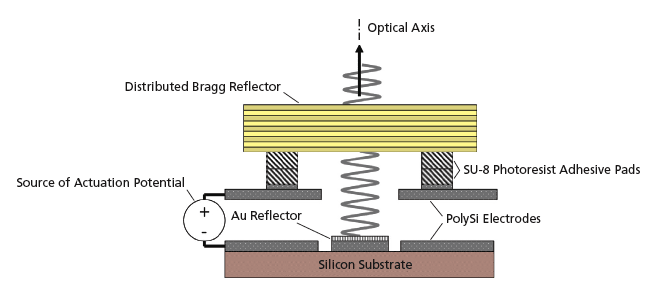
As used here, “hybrid” refers to the design and fabrication of a MEM-actuated optoelectronic device as an assembly, in contradistinction to a monolithic unit: In the hybrid approach the optical component(s) and the micro-electro-mechanical actuation component(s) of a device are first fabricated as separate units, then bonded together. The hybrid approach makes it possible to overcome limitations on design, fabrication, and function inherent in the monolithic-integration approach. In the hybrid approach, there is greater design flexibility in that designs of different components can be optimized separately and the components can be made from different materials that are not amenable to fabrication of the device a monolithic unit. Moreover, in the hybrid approach, unlike in the monolithic-integration approach, defective components identified in wafer-level pre-testing can be discarded prior to completing fabrication of devices.
One notable limitation on design and functionality of a monolithic electrostatically actuated optoelectronic device is that the applied electrostatic-actuation potential must be kept below a value that produces a stroke of about d/3, where d is the distance across an electrostatically variable gap when the electrostatic-actuation potential is zero. Application of a potential large enough to produce a greater stroke causes electrostatic pull-in, which results in catastrophic failure of the device. In the hybrid approach, the design electrostatic pull in potential and the design gap distance can be chosen independently of each other. The hybrid approach also enables the incorporation of polycrystalline silicon (polySi) dimples that can serve to prevent electrostatic pull-in and to reduce stiction (which also results in failure).
The hybrid MEM-TF (see figure) includes a distributed Bragg reflector that is spring-supported, on flexure arms, at a suitable distance from a gold reflector. A piston electrostatic actuator comprising electrodes made of polySi is used to vary the distance between the filter and the reflector and thereby vary the resonance wavelength of the filter. The distributed Bragg reflector, comprising alternating layers of Al0.4Ga0.6As and GaAs, has lateral dimensions of 250 by 250 μm and a thickness of 4.92 μm. The distributed Bragg reflector was fabricated separately, then flip-bonded to the piston electrostatic actuator using SU-8 photoresist as an adhesive. In a test of tunability, the resonance wavelength of the hybrid MEM-TF was found to vary over the range from 936.5 to 989.5 nm when the electrostatic-actuation potential was varied over the range from 0 to 10 V.
This work was done by Edward M. Ochoa of the Air Force Institute of Technology for the Air Force Research Laboratory.
AFRL-0066
This Brief includes a Technical Support Package (TSP).
Hybrid Micro-Electro-Mechanically Tunable Optical Filter
(reference AFRL-0066) is currently available for download from the TSP library.
Don't have an account?
More From SAE Media Group
Aerospace & Defense Tech Briefs
3D Meta-Optics for High-Energy Lasers
Photonics & Imaging Technology
Photonics West 2021 Preview
Photonics Tech Briefs
A High-Repetition-Rate Optical Communications Source
Photonics & Imaging Technology
SPIE Photonics West 2023 Preview
Photonics Tech Briefs
Active Fiber Optic Microelectromechanical Systems Aligner
Photonics Tech Briefs
Compact, Low-Power, Low-Voltage Laser Ignition System
Photonics Tech Briefs
Specialty Fibers Guide Light When the Going Gets Tough
Photonics Tech Briefs
Multicolor Transceiver for Optoelectronic Communication
Aerospace & Defense Tech Briefs
Optical-Fiber Infrasound Sensors
Photonics & Imaging Technology
SPIE Photonics West 2022 Preview
Tech Briefs
Platform for Quantum Technologies Using Gold
Photonics Tech Briefs
Methods of Manufacturing Fiber Optic Components
Photonics & Imaging Technology
Unique Amplifier Could Change Optical Communication
Photonics & Imaging Technology
Optical Signal Amplifying Technique
Photonics & Imaging Technology
New Products
Photonics & Imaging Technology INSIDER
New Product Launches and Technologies to See at Photonics West 2025

Photonics & Imaging Technology
Researchers Demonstrate Noise-Free Communication with Structured Light
Photonics Tech Briefs
Micro-Ball-Lens Optical Switch Driven by SMA Actuator
Photonics Tech Briefs
Pointing Reference Scheme for Free-Space Optical Communications Systems
Aerospace & Defense Tech Briefs
BC VCSELs for RF/Photonic Links
Photonics & Imaging Technology
A First-Of-Its-Kind Integrated Optical Isolator
Aerospace & Defense Tech Briefs
Photonic Microwave Generation Using On-Chip Optical Frequency Combs
Photonics Tech Briefs
Tunable Optical Assembly With Vibration Dampening
Tech Briefs
Sensitive Optical Receivers for Space
Photonics & Imaging Technology INSIDER
Stanford Researchers Develop Flexible Color-Changing Material
Photonics Tech Briefs
Enhancements to Fiber Optic Bragg Grating Sensors and Demodulation Systems

Photonics Tech Briefs
Discrete Wavelength-Locked External Cavity Laser
Photonics & Imaging Technology INSIDER
Infrared Imaging by Ultrathin Nanocrystal Layers
Overview
The document is a dissertation authored by Major Edward M. Ochoa, focusing on advancements in hybrid micro-electro-mechanical systems (MEMS) and their applications in tunable filters and vertical-cavity surface-emitting lasers (VCSELs). The research is conducted at the Air Force Institute of Technology and aims to enhance the performance and capabilities of these technologies.
The dissertation is organized into seven chapters. Chapter II provides a comprehensive review of MEMS, VCSELs, and tunable filters, laying the groundwork for understanding the subsequent chapters. Chapter III discusses the development of computer-aided design tools specifically tailored for simulating monolithic and hybrid MEM-TF (MEMS Tunable Filters) and MT-VCSEL (Micro-Tunable VCSEL) systems. This chapter emphasizes the importance of simulation in optimizing design and functionality.
In Chapter IV, the author reviews experiments involving sacrificial layers used to characterize candidate III-V etchants for micromachining processes relevant to MEM-TF and MT-VCSEL fabrication. This section highlights the technical challenges and solutions encountered during the research.
Chapter V focuses on the materials and methods investigated for flip-bonding, a critical process for enabling hybrid MEM-TF fabrication. The chapter discusses the selection of materials and the methodologies employed to ensure successful integration of components.
Chapter VI presents the fabrication and characterization of a first-generation hybrid MEM-TF, detailing the experimental results and performance metrics achieved. This chapter serves as a practical demonstration of the theoretical concepts discussed earlier in the dissertation.
Finally, Chapter VII concludes the dissertation with a summary of the research accomplishments, contributions to the field, and recommendations for future work. The author reflects on the significance of the findings and their potential impact on military and civilian applications.
Throughout the dissertation, the author acknowledges the support of mentors, colleagues, and family, emphasizing the collaborative nature of research and the personal journey involved in completing the work. The views expressed in the document are those of the author and do not reflect the official policy or position of the United States Air Force, Department of Defense, or the United States Government.
Overall, this dissertation represents a significant contribution to the field of MEMS and photonics, showcasing innovative approaches to enhancing the functionality of tunable filters and lasers.
Top Stories
NewsAutomotive
 Microvision Aquires Luminar, Plans Relationship Restoration, Multi-industry Push
INSIDERManned Systems
 A Next Generation Helmet System for Navy Pilots
INSIDERManufacturing & Prototyping
 New Raytheon and Lockheed Martin Agreements Expand Missile Defense Production
NewsAutomotive
 Ford Announces 48-Volt Architecture for Future Electric Truck
INSIDERAerospace
 Active Strake System Cuts Cruise Drag, Boosts Flight Efficiency
ArticlesAR/AI

Webcasts
Electronics & Computers
 Cooling a New Generation of Aerospace and Defense Embedded...
Power
 Battery Abuse Testing: Pushing to Failure
Communications
 A FREE Two-Day Event Dedicated to Connected Mobility
Transportation
 Quiet, Please: NVH Improvement Opportunities in the Early Design Cycle
Transportation
 Advantages of Smart Power Distribution Unit Design for Automotive &...
Unmanned Systems
 Sesame Solar's Nanogrid Tech Promises Major Gains in Drone Endurance