




Fuzzy System for Fault Diagnostics in Power Electronics-Based Brake-by-Wire System
This method locates faults within the circuit in the power electronics of a brake-by-wire system.
Research in fuzzy diagnostics of brake-by-wire systems focuses on the power electronics switches, since they are often considered to be the weakest link in the system. The objective of fault diagnostics in the power electronics of the brake-by-wire system is to accurately locate any faults within the circuit as soon as they occur.
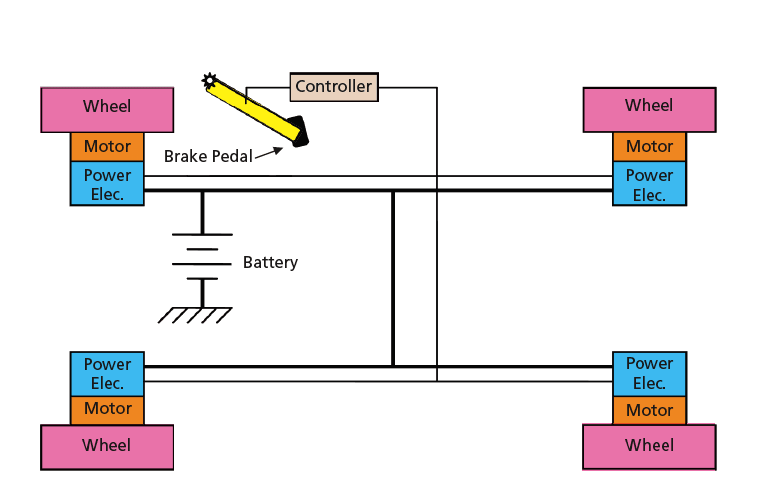
The figure illustrates the system architecture of a fully electromechanical brake-by-wire system. In this system, the battery is connected to the actuator motors and power electronics through wirings. The motor is a brushed DC motor, which is inexpensive and is available in the automotive industry abundantly, and which can be permanent-magnet-based or have a field winding. The system has four actuator motors corresponding to each wheel and located in the vicinity of the brakes. The thick lines in the figure represent the power lines from the battery. The signal lines are shown in thin lines. The position signal from the brake pedal goes to a controller, which generates control signals to activate each of the motors. Although a single thin line is shown running from the controller to the power electronic blocks, in reality, they are separate. This can help all four actuators run independently, is more robust during a failure of any one or more of the actuators, and can lead to better graceful degradation during a failure mode.
A reference voltage is obtained, which is fed to the motor terminals. This voltage is obtained from the DC battery by a mean of PWM (pulse width modulation) techniques, which allows synthesizing the desired V* based on the pulsed voltage initiated by the switches. This system model is implemented in BBW-SIM, a simulated model generated using MATLAB-Simulink.
This work was done by Yi L. Murphy and Abul Masrur of the University of Michigan- Dearborn, and ZhiHang Chen and BaiFang Zhang of the U.S. Army RDECOMTARDEC.
ARL-0049
This Brief includes a Technical Support Package (TSP).
Fuzzy System for Fault Diagnostics in Power Electronics-Based Brake-by-Wire System
(reference ARL-0049) is currently available for download from the TSP library.
Don't have an account?
More From SAE Media Group
Tech Briefs
High-Reliability Radio Frequency MEMS Switch
Tech Briefs
Low-Inductance DC Power Bus
Tech Briefs
Product of the Month

Aerospace & Defense Tech Briefs
Prognostic Health Management for Avionics System Power Supplies

Aerospace & Defense Tech Briefs
Monitoring and Charging System for a High-Power Battery

Tech Briefs
OMRON’s G9KB PCB Relay
Aerospace & Defense Tech Briefs
Development and Test of a Medium-Voltage Converter for Ocean Observatories
Tech Briefs
Improved Q-Switch Drivers
Battery Technology
Charge Control Methods for Supercapacitors
Tech Briefs
Ultra-Wide-Bandgap Power Electronics

Tech Briefs
Nanotransistors Stay Cool at High Voltages
Tech Briefs
Supercapacitors for Wearable Devices
Sensor Technology
MEMS — Smart Sensors for the IoT

Aerospace & Defense Tech Briefs
Understanding the “Black Art” of RF and Microwave Switching
Off-Highway Engineering
Filtering out Common Mode Noise with Monolithic EMI Filters

Overview
The document presents research on a structured fuzzy system for fault diagnostics in power electronics-based brake-by-wire systems, authored by Yi L. Murphey, Abul Masrur, ZhiHang Chen, and BaiFang Zhang from the University of Michigan-Dearborn and the U.S. Army RDECOM-TARDEC. The focus of the study is on the power electronics switches within electric motors, which are critical components in modern automotive systems, particularly as the industry shifts from mechanical to electric systems for various functions, including steering and braking.
The introduction highlights the growing trend in the automotive industry to replace mechanical systems with electric alternatives, emphasizing the advantages of reduced weight and improved packaging. However, the transition to electric systems introduces new challenges, particularly in fault diagnostics. The authors note that while fault diagnostics for internal combustion engine vehicles have been extensively studied, research in electric and hybrid vehicle diagnostics is still emerging.
The paper details the development of a simulated model of a brake-by-wire system that generates current and voltage signals under normal and six faulty conditions in the power electronics circuit. The proposed fuzzy diagnostic system is designed to accurately identify faults and their locations within the circuit as soon as they occur. The authors argue that traditional diagnostic methods, such as black box models, may lack the intuitive focus needed to pinpoint specific problems effectively.
The results of the experiments demonstrate that the fuzzy diagnostic system is effective in predicting faults and their locations, showcasing its potential as a reliable tool for enhancing the safety and reliability of electric vehicle systems. The research contributes to the growing body of knowledge in electrical system diagnostics, particularly in the context of automotive engineering.
In conclusion, the document underscores the importance of developing advanced diagnostic systems for electric vehicles, particularly as the industry moves towards more electric and hybrid technologies. The structured fuzzy system presented in this research offers a promising approach to improving fault detection and diagnosis in brake-by-wire systems, ultimately contributing to the advancement of automotive safety and performance.
Top Stories
NewsRF & Microwave Electronics
 Microvision Aquires Luminar, Plans Relationship Restoration, Multi-industry Push
INSIDERAerospace
 A Next Generation Helmet System for Navy Pilots
INSIDERDesign
 New Raytheon and Lockheed Martin Agreements Expand Missile Defense Production
INSIDERMaterials
 How Airbus is Using w-DED to 3D Print Larger Titanium Airplane Parts
NewsPower
 Ford Announces 48-Volt Architecture for Future Electric Truck
ArticlesAR/AI

Webcasts
Electronics & Computers
 Cooling a New Generation of Aerospace and Defense Embedded...
Automotive
 Battery Abuse Testing: Pushing to Failure
Power
 A FREE Two-Day Event Dedicated to Connected Mobility
Unmanned Systems
 Quiet, Please: NVH Improvement Opportunities in the Early Design Cycle
Automotive
 Advantages of Smart Power Distribution Unit Design for Automotive &...
Energy
 Sesame Solar's Nanogrid Tech Promises Major Gains in Drone Endurance