




Development and Test of a Medium-Voltage Converter for Ocean Observatories
This technology will improve power distribution in undersea cabled observatories.
A critical component in regional-scale undersea power systems is the medium-voltage converter (MVC). The MVC is a DC-DC converter in the primary network infrastructure that receives a medium-voltage power input from the shore-based power feed equipment (PFE) via the telecom cable, typically at 1-10 KVDC, and provides down-conversion to one or more lower-voltage outputs, typically 300-600 VDC, to feed power to science nodes and instrumentation in the secondary network infrastructure.
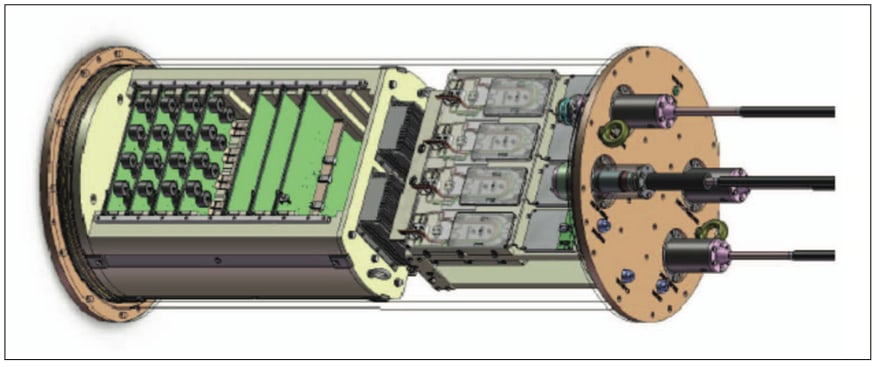
This work reports on the successful development, test, and subsea installation of a 3kV, 3 kW MVC based upon the Vorperian modular stacked architecture. The MVC provides 3000 VDC to 625 VDC conversion for primary undersea networks. The MVC design consists of 16 DC-DC subconverters wired in a series input configuration, with each subconverter input operating at approximately 187V (3000V/16). The 16 subconverter outputs are wired in an 8 × 2 series-parallel configuration, with each subconverter output operating at approximately 78V (625V/8). A feedback control loop monitors the MVC output, and pulse-width modulates the duty cycle of the subconverter switching to maintain precision output regulation.
The MVC consists of 16 low-voltage (LV) subconverter modules wired together in series at the inputs, an input plane that provides input protection, input monitoring, and converter startup, and an output plane that provides output filtering and PWM feedback control. The MVC converts a 3 KVDC cable input to a 625 VDC output at loads of circa 3 kW. The MVC system also includes additional output modules for control, switching, conversion, regulation, filtering, protection, and monitoring of power outputs to the internal housing payloads and to the external undersea instrumentation sites.
The MVC architecture was designed for modularity with the following building blocks: a thermally-conductive aluminum chassis with module slots; an input card with the input plane circuitry; a quad-subconverter card with four subconverters; a backplane card with monitoring, output plane, and PWM controller; one or more output cards; and power modules for internal payloads (e.g., optical amplifiers). The MVC is packaged in a 21-inch-diameter primary node housing. The chassis is mechanically mounted, electrically isolated, and thermally conducted to the left end cap. An optical payload is mounted in a similar fashion to the right end cap. The optical payload includes eight erbium-doped fiber amplifiers (EDFAs), optical add/drop multiplexers, optical attenuators, fiber management, and redundant Gigabit Ethernet telemetry units for primary node supervisory control and monitoring. The right end cap also includes undersea cable terminations to the primary and secondary power cable infrastructure, as well as connections to undersea electrodes for seawater power returns.
The subconverter stack, which dissipates a majority of heat in the MVC, is located near the end cap for conduction cooling. Additional card slots above the subconverters hold the input and output modules. Power converters for the primary node internal payloads are mounted to the top of the chassis. The MVCs were tested with a commercial off-the-shelf 3 KVDC power supply (a.k.a. power feed equipment or PFE) and a custom 160-km cable simulator. Kilowatt power loads with negative impedances and 20-km cable simulators were developed, built, and used during lab tests to simulate the secondary power infrastructure. Power supply efficiency was measured to be approximately 90% across the load range of 2-3 kW. Similar efficiency was obtained across the 2.5-3.5 kV input range. The efficiency dropped to about 82% at light load (725 Watts).
The output voltage regulation typically varied less than ±1 volt from no load to full load under static load conditions. The output voltage ripple was measured to be typically less than 200 mVpp across the same load range. The converter was exceptionally stable under dynamic loads, holding the output steady to within a few volts droop during 2-Amp off-on step load changes. The MVC output was also shown to hold load regulation under the failure of a subconverter module, demonstrating fault tolerance. The MVC architecture maintains operation with up to two failed subconverters for most common fault modes.
This work was done by Joseph Key of the Naval Surface Warfare Center, Carderock Division, and John Walrod of SAIC Advanced Systems Division. For more information, download the Technical Support Package (free white paper) at www.defensetechbriefs.com/tsp under the Electronics/Computers category. SAIC-0001
This Brief includes a Technical Support Package (TSP).
Development and Test of a Medium Voltage Converter for Ocean Observatories
(reference SAIC-0001) is currently available for download from the TSP library.
Don't have an account?
More From SAE Media Group
Tech Briefs
Vote for Tech Briefs Product of the Year 2021
Tech Briefs
Silicon Carbide High-Voltage Switch
Medical Design Briefs
Renamic Neo Offers Complete Wireless Connectivity to Implants
Tech Briefs
New on the Market: December 2020
Tech Briefs
New on the Market: July 2020
Aerospace & Defense Tech Briefs
Understanding the “Black Art” of RF and Microwave Switching
Aerospace & Defense Tech Briefs
Silicon Carbide Junction Field-Effect Transistor Devices for Scalable Solid-State Circuit Breakers
Electronics & Sensors INSIDER
Self-Powered Sensor Automatically Harvests Magnetic Energy
Tech Briefs
Processor Power and Energy Efficiency
Aerospace & Defense Tech Briefs
Ruggedization of Electronics for Deployed Military Environments
Electronics Tech Briefs
Supplementing Overvoltage Protection


Tech Briefs
Series-Connected Boost Regulators
Tech Briefs
X-Band, 17-Watt Solid-State Power Amplifier
Sensor Technology
New Products
Tech Briefs
New on the Market: June 2021
Aerospace & Defense Tech Briefs
Improved Magnetic Sensor Based on Giant Magneto-Impedance
Aerospace & Defense Tech Briefs
Fuzzy System for Fault Diagnostics in Power Electronics-Based Brake-by-Wire System
Tech Briefs
High-Voltage, Asymmetric-Waveform Generator
Embedded Technology
Testing DC Power Systems
Tech Briefs
High-Voltage Droplet Dispenser
Aerospace & Defense Tech Briefs
Empowering Soldiers Through ISPDS

Tech Briefs
New on the Market: August 2020
Aerospace & Defense Tech Briefs
Optimizing IoMT Device Battery Life With Emulation and Profiling Software
Overview
The document discusses the development and testing of a Medium Voltage Converter (MVC) designed for ocean observatories, highlighting the challenges and advancements in power system engineering for undersea applications. Over the past decade, various power architectures have been explored, including AC and DC systems, leading to the selection of a constant-voltage, branched DC architecture for programs like the U.S. MARS and Canadian NEPTUNE.
The MVC is a modular system that converts high-voltage DC input (2.5 – 3.5 kV) to a lower voltage output (625 V) while maintaining high efficiency (approximately 90% at full load). The architecture consists of 16 low-voltage subconverter modules arranged in series, allowing for fault tolerance and stability under dynamic loads. The MVC was tested with a commercial 3 kVDC power supply and a custom cable simulator, demonstrating robust performance with minimal voltage regulation variation and low output ripple.
In February 2008, a 7.25 kV-to-400 V MVC was installed off the California coast but failed shortly after due to a connector issue. This incident led to a recovery and repair process. In contrast, a 3.2 kV-to-625 V MVC, built in 2007, was successfully installed in May 2008 and has operated undersea for over a year, marking a significant achievement in undersea power systems.
The document emphasizes the importance of high-voltage, low-current power transmission to reduce losses in long undersea cables, which can span 10 to 400 km. The MVC's design incorporates features for input protection, monitoring, and output filtering, ensuring reliable operation in the challenging ocean environment characterized by high pressure, corrosive conditions, and inaccessibility.
Overall, the MVC represents a significant advancement in the engineering of power systems for ocean observatories, addressing the unique challenges posed by the underwater environment. The ongoing research and development efforts aim to enhance the reliability and efficiency of these systems, contributing to the broader goals of ocean exploration and scientific discovery.
Top Stories
INSIDERDefense
 New Raytheon and Lockheed Martin Agreements Expand Missile Defense Production
NewsAutomotive
 Ford Announces 48-Volt Architecture for Future Electric Truck
INSIDERManufacturing & Prototyping
 Active Strake System Cuts Cruise Drag, Boosts Flight Efficiency
ArticlesTransportation
 Accelerating Down the Road to Autonomy
INSIDERMaterials
 How Airbus is Using w-DED to 3D Print Larger Titanium Airplane Parts
Road ReadyTransportation

Webcasts
Electronics & Computers
 Cooling a New Generation of Aerospace and Defense Embedded...
Power
 Battery Abuse Testing: Pushing to Failure
Connectivity
 A FREE Two-Day Event Dedicated to Connected Mobility
Automotive
 Quiet, Please: NVH Improvement Opportunities in the Early Design Cycle
Transportation
 Advantages of Smart Power Distribution Unit Design for Automotive &...
Aerospace
 Sesame Solar's Nanogrid Tech Promises Major Gains in Drone Endurance