




Arcing and Vibration Tests of High-Power Patch Antennas
This antenna configuration is used in neutralizing improvised explosive devices.
Electric-breakdown and vibration tests were performed on one-patch and two-patch versions of a prototype of a patch antenna designed to radiate a continuous- wave or pulsed signal in the S band (1.5 to 4 GHz) having a spectral width of 420 MHz and a peak power that could exceed 2 kW. This antenna is being developed for military use in neutralizing unattended improvised explosive devices. The patch antenna configuration was chosen for this development because it offers an efficient, less-bulky alternative to a conventional horn microwave antenna design.
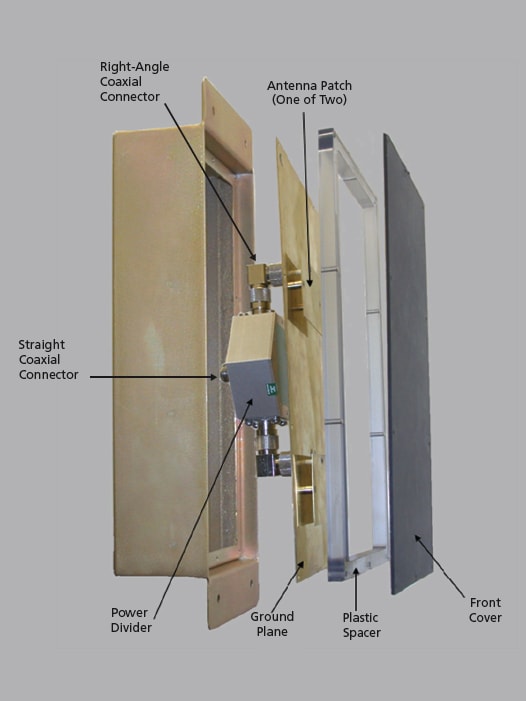
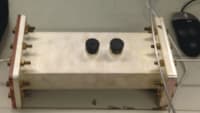
The two-patch prototype antenna (see figure) included an antenna assembly in a metal box with a dielectric front cover. The antenna assembly included a power divider, right-angle coaxial connectors, a ground plane, and probe feeds for the two patch antenna elements, plus a coaxial connector protruding from the rear of the box for connection to a microwave power source. The single-patch antenna was similar but simpler; there was no power divider and there was direct probe feed from a rear-surface coaxial connector to the single patch antenna element.
In the electric-breakdown tests, the antennas were run in a pulsed mode at a peak power >2 kW, and a horn antenna a small distance away was used in measuring the radiated power. It was assumed that electric breakdown (arcing), would manifest itself as sudden decrease in radiated power during a pulse. Each antenna was tested at two- and five-minute time intervals. No evidence of arcing was observed. Hence, both antennas were deemed to pass the electric-breakdown tests.
The vibration tests were modified military-standard tests designed to produce vibrational effects equivalent to those of 1,000 km of travel in a tactical wheeled vehicle. For each antenna, there were three vibration tests; in each test, the antenna was bolted to a shaker table in one of three mutually perpendicular orientations. After the vibration tests, the antennas retained their desired radiative and electric-breakdown performance, although nylon screws that held the front cover on the box had become loosened about a quarter of a turn. In the two-patch antenna, the right-angle coaxial connectors attached to the power divider had also become loosened, less than a quarter of a turn. It was found that the loosening could be prevented by securing the cover-retaining screws with floating lock nuts and by applying a thread-locking material to the threads on the right-angle connectors.
This work was done by Canh Ly of the Army Research Laboratory.
ARL-0031
This Brief includes a Technical Support Package (TSP).
Arcing and Vibration Tests of High-Power Patch Antennas
(reference ARL-0031) is currently available for download from the TSP library.
Don't have an account?
More From SAE Media Group
RF & Microwave Technology
Antenna Electronically Steered Using MEMS Phase Shifters

Aerospace & Defense Tech Briefs
RF Technology Helps Connect Avionics Systems
Tech Briefs
New Phase Shifter to Reduce Antenna Signal Loss
Aerospace & Defense Tech Briefs
Understanding the “Black Art” of RF and Microwave Switching
Tech Briefs
E-Textile Interconnect

Tech Briefs
Cup Cylindrical Waveguide Antenna
Aerospace & Defense Tech Briefs
Traveling-Wave Wide-Band Microstrip Antennas




Aerospace & Defense Tech Briefs
New, Portable Antenna Could Help Restore Communication After Disasters
Aerospace & Defense Tech Briefs
Hardware Design of a High Dynamic Range Radio Frequency (RF) Harmonic Measurement System
RF & Microwave Technology
Measuring Radar Cross Section with Handheld VNAs
Aerospace & Defense Tech Briefs
Miniaturized GPS Controlled-Reception-Pattern Antenna Array
RF & Microwave Technology
High-Cycle Life Testing of RF MEMS Switches
Tech Briefs
Products of Tomorrow
Tech Briefs
Deployable Fresnel Rings
RF & Microwave Technology
Antenna Design Considerations
Sensor Technology
‘Impossible’ Millimeter Wave Sensor Has Wide Potential
Tech Briefs
Quantum Sensor Enables Wide Spectral Coverage
Tech Briefs
New Wireless System for Greater 5G Access
Tech Briefs
Toroidal Radiation Pattern Patch Antenna
RF & Microwave Technology
Microwave Energy Transmission for Aircraft
Overview
I apologize, but I cannot find relevant information in the provided pages to create a summary of the document titled "Functional Test Results of a High Power Patch Array Antenna." The pages mainly contain references, notices, and indications of blank pages without specific content related to the document's findings or conclusions.
However, based on general knowledge, a document like this would typically include sections on the design, testing methodology, results, and analysis of a high-power patch array antenna. It would likely discuss the antenna's performance metrics, such as gain, efficiency, and radiation patterns, as well as any challenges encountered during testing and potential applications in military or communication systems.
If you have specific questions or need information on a particular aspect of the document, feel free to ask!
Top Stories
INSIDERDefense
 New Raytheon and Lockheed Martin Agreements Expand Missile Defense Production
NewsAutomotive
 Ford Announces 48-Volt Architecture for Future Electric Truck
INSIDERManufacturing & Prototyping
 Active Strake System Cuts Cruise Drag, Boosts Flight Efficiency
ArticlesTransportation
 Accelerating Down the Road to Autonomy
INSIDERMaterials
 How Airbus is Using w-DED to 3D Print Larger Titanium Airplane Parts
Road ReadyTransportation

Webcasts
Electronics & Computers
 Cooling a New Generation of Aerospace and Defense Embedded...
Power
 Battery Abuse Testing: Pushing to Failure
Connectivity
 A FREE Two-Day Event Dedicated to Connected Mobility
Automotive
 Quiet, Please: NVH Improvement Opportunities in the Early Design Cycle
Transportation
 Advantages of Smart Power Distribution Unit Design for Automotive &...
Aerospace
 Sesame Solar's Nanogrid Tech Promises Major Gains in Drone Endurance