




Miniaturized GPS Controlled-Reception-Pattern Antenna Array
Controlled-pattern reception is achieved in a smaller package.
A miniaturized Global Positioning System (GPS) antenna array is being developed for use on aircraft on which the room available for installation of this or any other equipment is severely limited and there is a requirement for an anti-jamming capability. This miniaturized GPS antenna array is, more specifically, a controlled-reception-pattern antenna array (CRPA), which affords a capability for (1) electronic beam forming to maximize the signals received from GPS satellites and/or (2) electronic null forming to minimize signals received from jamming transmitters or to suppress multipath signals. Heretofore, it has been possible to equip some aircraft with fixed-reception-pattern antenna arrays (FRPAs) but not with CRPAs, which have tended to be larger. It is envisioned that the present development effort will eventually yield anti-jamming GPS CRPAs no larger than the GPS FRPAs now used on military aircraft.
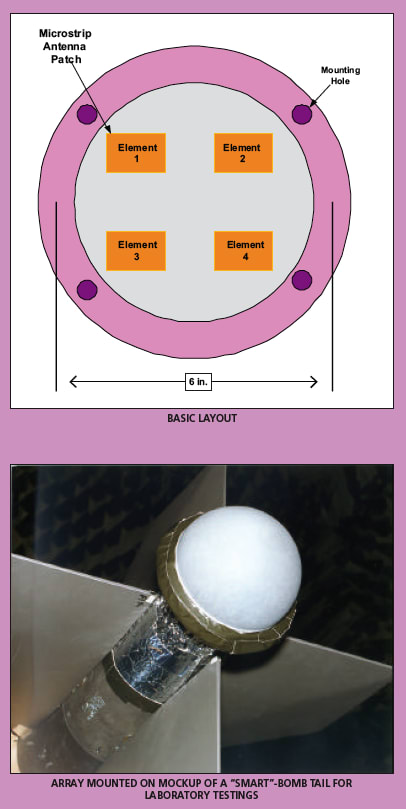
In its present form, the miniaturized GPS CRPA (see figure) includes a 6-in.- (15.2-cm)-diameter dielectric substrate with a ground plane on its inner surface, four rectangular microstrip patch antenna elements in a square array on its outer surface, and a superstrate (a dielectric lens) covering the antenna elements. The two elements on each side of the square are separated by half a dielectric wavelength (which is smaller than half a vacuum wavelength). The substrate material is chosen to have a permittivity large enough that the antenna elements can be made significantly smaller and significantly closer together than would be necessary if the dielectric were a vacuum. The permittivity and shape of the dielectric lens are chosen to minimize the mutual coupling between the antenna elements and to contribute to the overall reduction in size while enabling the array to exhibit the beam-forming or null-forming performance of a half-vacuum-wavelength antenna array.
The array is designed to be compatible with CRPA and GPS Antenna System 1 (GAS 1) electronic circuitry now used by the Department of Defense. In addition, the array is compatible with, and has been tested by use of, a high-gain advanced GPS receiver that includes a digital antenna- arraying subsystem that enables precise, digitally controlled beam-forming and null-forming. The test results confirmed that this miniaturized array performs, as desired, like a full-size CRPA.
This work was done by Alison Brown and Huan Wan Tseng of NAVSYS Corp. for the Naval Research Laboratory.
NRL-0015
This Brief includes a Technical Support Package (TSP).
Miniaturized GPS Controlled-Reception-Pattern Antenna Array
(reference NRL-0015) is currently available for download from the TSP library.
Don't have an account?
More From SAE Media Group
RF & Microwave Technology
Developing a Beam Former for Electronically Steered Antennas

Aerospace & Defense Tech Briefs
Traveling-Wave Wide-Band Microstrip Antennas
Tech Briefs
Deployable Fresnel Rings
Tech Briefs
Extended-Range Passive RFID and Sensor Tags
RF & Microwave Technology
Antenna Electronically Steered Using MEMS Phase Shifters
RF & Microwave Technology
Arcing and Vibration Tests of High-Power Patch Antennas
Tech Briefs
New Phase Shifter to Reduce Antenna Signal Loss



Photonics & Imaging Technology
Researchers Use Inkjet Printing to Make a Portable Multispectral 3D Camera
Tech Briefs
Toroidal Radiation Pattern Patch Antenna

Tech Briefs
Conformal, Lightweight, Aerogel-Based Antenna
Aerospace & Defense Tech Briefs
Army and Universities Deploy New Warfighter Communication Technology
Aerospace & Defense Tech Briefs
Communicating from Space: The Front End of Multiscale Modeling
Electronics Tech Briefs
Ferroelectric Electronic Scan Antennas


Aerospace & Defense Tech Briefs
Improvements in Measurement of Permeability and Permittivity
Aerospace & Defense Tech Briefs
Implementing a GPS Waveform Under the SCA
Aerospace & Defense Tech Briefs
Microstrip Patch Antennas Containing Multi-PBG Structures

Aerospace & Defense Tech Briefs
Next-Generation Phased Radar Systems Lead to Hardware Improvements
Tech Briefs
Improved Encryption-Mode GPS Receiver

Overview
The document presents a comprehensive overview of a miniaturized GPS antenna array developed by NAVSYS Corporation, focusing on its design, specifications, and performance testing. The antenna operates at a center frequency of 1575.42 MHz (L1 band) with a bandwidth of 20 MHz, featuring a square configuration with a diameter of 6 inches and comprising four rectangular microstrip elements. This innovative design allows for a significant reduction in physical size while maintaining the performance characteristics of a full-size antenna array.
A key highlight of the mini-array is its ability to provide identical phase relationships to larger arrays, achieved through the use of a high-dielectric lens that enables closer spacing between elements without compromising phase spatial separation. The document includes detailed specifications such as input impedance (50 Ohms) and a maximum Voltage Standing Wave Ratio (VSWR) of 2.2:1.
The performance of the mini-array was rigorously tested at MIT Lincoln Laboratory, where its beam-steering and null-steering capabilities were evaluated in the presence of multiple jammers. The results demonstrated that the mini-array could effectively nullify up to three jammers while maintaining gain across a wide field of view for tracked GPS satellites. This capability is particularly valuable in military and commercial applications where interference from jamming signals can significantly impact navigation accuracy.
Figures included in the document illustrate the mini-array's configuration and performance metrics, showcasing its effectiveness in various scenarios involving jamming signals. The testing results indicate that the mini-array is well-suited for integration into smaller munitions and aircraft that face size and weight constraints, making it a promising solution for enhancing GPS navigation in challenging environments.
Overall, the document emphasizes the potential of the miniaturized GPS antenna array to revolutionize navigation systems by providing robust performance in a compact form factor, thereby expanding its applicability in both military and commercial sectors. The findings suggest that this technology could lead to improved navigation capabilities and greater resilience against interference, ultimately enhancing operational effectiveness in various applications.
Top Stories
NewsRF & Microwave Electronics
 Microvision Aquires Luminar, Plans Relationship Restoration, Multi-industry Push
INSIDERAerospace
 A Next Generation Helmet System for Navy Pilots
INSIDERDesign
 New Raytheon and Lockheed Martin Agreements Expand Missile Defense Production
INSIDERMaterials
 How Airbus is Using w-DED to 3D Print Larger Titanium Airplane Parts
NewsPower
 Ford Announces 48-Volt Architecture for Future Electric Truck
ArticlesAR/AI

Webcasts
Electronics & Computers
 Cooling a New Generation of Aerospace and Defense Embedded...
Automotive
 Battery Abuse Testing: Pushing to Failure
Power
 A FREE Two-Day Event Dedicated to Connected Mobility
Unmanned Systems
 Quiet, Please: NVH Improvement Opportunities in the Early Design Cycle
Automotive
 Advantages of Smart Power Distribution Unit Design for Automotive &...
Energy
 Sesame Solar's Nanogrid Tech Promises Major Gains in Drone Endurance