




Microstrip Patch Antennas Containing Multi-PBG Structures
For given gain and efficiency levels, antennas could be made smaller.
Microstrip patch antennas of a proposed type would contain photonic- bandgap (PBG) structures characterized by multiple bandgaps. In a given antenna, the PBG structure(s) could be one or more periodic dielectric and/or metal structures that could be embedded in the dielectric substrate of the antenna and/or formed on either or both faces of the dielectric substrate. As explained below, the incorporation of PBG structures would facilitate the design of a smaller antenna capable of providing a given amount of gain at a given frequency.

The basis of the present proposal is the principle that a suitably designed PBG structure or combination of structures could suppress surface and substrate waves at one or more desired operating frequencies, thereby reducing the efficiency penalty associated with the high-permittivity substrate. The PBG structure( s) could be designed to suppress surface and substrate waves over a broad range of frequencies, thereby effectively increasing the bandwidth of the antenna.
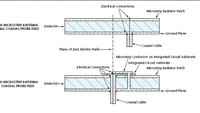
The figure presents a few examples of the essentially unlimited number of configurations for incorporating one or more PBG structure(s) into a microstrip patch antenna. Like other microstrip patch antennas, this antenna would include one or more radiating element(s) in the form of metal patches on the upper surface of the substrate and a ground plane in the form of a larger metal patch covering the entire lower surface of the substrate. Each radiating element would be connected to an external signal source or receiver by means of a coaxial feedline through the substrate.
One or more PBG structure(s) could be incorporated into this antenna in one or a combination of two or more of the following design variations:
- The substrate could consist of two or more dielectric layers, in which case a metal PBG structure or structures could be sandwiched between the dielectric layers. Such a PBG structure would consist of a repetitively patterned metal film; the structure could be, for example, a periodic array of annular holes in an otherwise solid metal film, with a central hole to accommodate the coaxial feedline.
- The substrate could consist of a single dielectric layer, and a metal-film PBG structure, possibly similar to the one described above, could be made to surround the radiating element(s) on the upper surface of the substrate.
- A PBG structure could be incorporated into the ground plane by etching a suitable periodic array of holes into the ground-plane metal film.
- A PBG structure could be incorporated into a single dielectric layer or into one or more multiple dielectric layers. Such a structure could include a periodic array of holes and/or slots in the dielectric layer, with or without metal plating of hole and/or slot surfaces as required by a specific design.
This work was done by Julie Anne LaComb of the Naval Research Laboratory. For further information, download the free white paper at www.defensetechbriefs.com under the Electronics/Computers category. NRL-0005
This Brief includes a Technical Support Package (TSP).

Microstrip Patch Antennas Containing Multi-PBG Structures
(reference NRL-0005) is currently available for download from the TSP library.
Don't have an account?
More From SAE Media Group
Tech Briefs
Multimode Broad-Band Patch Antennas
Tech Briefs
Aperture-Coupled Thin-Membrane L-Band Antenna
Tech Briefs
Finite-Width Coplanar-Waveguide Patch Antenna
Aerospace & Defense Tech Briefs
New, Portable Antenna Could Help Restore Communication After Disasters

Aerospace & Defense Tech Briefs
Shape-Shifting Origami Could Help Antenna Systems Adapt On-the-Fly
Tech Briefs
Cellular Reflectarray Antenna

Tech Briefs
High-Aperture-Efficiency Horn Antenna


Tech Briefs
Automated Fabric Circuit and Antenna Fabrication
Tech Briefs
Deployable Wide-Aperture Array Antennas
Tech Briefs
Submillimeter-Wave Image Sensor
Tech Briefs
Finned-Ladder Slow-Wave Circuit for a TWT
Tech Briefs
Dual-Band Feed for a Microwave Reflector Antenna
Electronics Tech Briefs
Ferroelectric Electronic Scan Antennas
Tech Briefs
Cup Cylindrical Waveguide Antenna
Tech Briefs
New Wireless System for Greater 5G Access
Overview
The document pertains to a patent application for a microstrip patch antenna that incorporates a multiband photonic bandgap structure. This invention is particularly relevant to the field of antenna technology, which is crucial for various applications, including telecommunications, aerospace, and military uses.
Microstrip patch antennas are known for their low profile, ease of manufacturing, and cost-effectiveness. They consist of thin, flat printed circuit boards with radiating elements made of conducting strips or patches on the upper surface of a dielectric substrate. This substrate is backed by a conducting ground plane, which enhances the antenna's performance. Due to their mechanical robustness and compact design, these antennas are often mounted on the exterior surfaces of aircraft, spacecraft, and submarines.
The innovative aspect of this invention lies in its use of photonic bandgap materials, which can create multiple bandgaps through periodic patterns introduced into the dielectric substrate. These patterns can be formed using various techniques, such as drilled holes, slots, and vias, which can be plated or unplated. The introduction of these periodic defects allows the antenna to operate efficiently across multiple frequency bands, enhancing its versatility and performance.
The document also highlights the potential for government use, indicating that the invention may be manufactured and utilized by the U.S. government without the payment of royalties. This suggests a significant interest in the technology for governmental applications, possibly in defense or communication systems.
Overall, the invention aims to provide a low-loss microstrip antenna that leverages high dielectric substrates, such as duroid or ceramic materials, to improve performance. The combination of a microstrip patch antenna with a photonic bandgap structure represents a significant advancement in antenna design, promising enhanced functionality and efficiency for a range of applications.
In summary, this patent application outlines a novel approach to microstrip patch antennas, focusing on the integration of photonic bandgap materials to achieve multiband capabilities, making it a valuable contribution to the field of antenna technology.
Top Stories
NewsRF & Microwave Electronics
 Microvision Aquires Luminar, Plans Relationship Restoration, Multi-industry Push
INSIDERAerospace
 A Next Generation Helmet System for Navy Pilots
INSIDERDesign
 New Raytheon and Lockheed Martin Agreements Expand Missile Defense Production
INSIDERMaterials
 How Airbus is Using w-DED to 3D Print Larger Titanium Airplane Parts
NewsPower
 Ford Announces 48-Volt Architecture for Future Electric Truck
ArticlesAR/AI

Webcasts
Electronics & Computers
 Cooling a New Generation of Aerospace and Defense Embedded...
Automotive
 Battery Abuse Testing: Pushing to Failure
Power
 A FREE Two-Day Event Dedicated to Connected Mobility
Unmanned Systems
 Quiet, Please: NVH Improvement Opportunities in the Early Design Cycle
Automotive
 Advantages of Smart Power Distribution Unit Design for Automotive &...
Energy
 Sesame Solar's Nanogrid Tech Promises Major Gains in Drone Endurance