




Navy Engineers Test Aging Equipment to Find a Cost-Saving Solution for MQ-25
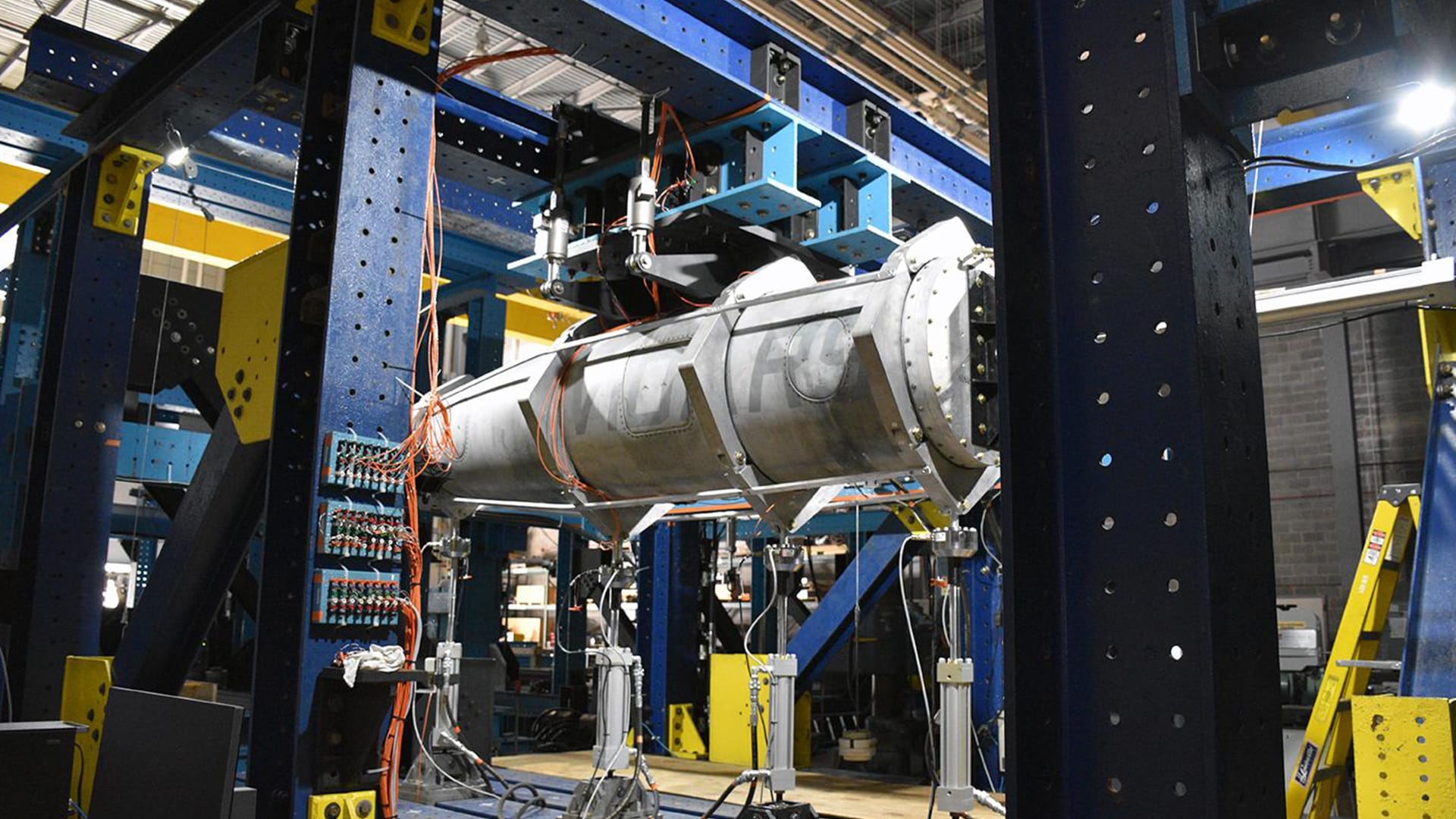
Engineers at the Naval Air Warfare Center Aircraft Division (NAWCAD) are testing the Navy’s current fleet of Aerial Refueling Store pods to support the service’s new air-to-air refueling tanker, the MQ-25 Stingray, potentially saving millions.
Today, the current fleet of Aerial Refueling Store pods fly aboard naval aircraft like F/A-18 and are expected to reach their estimated end-of-life in 2025. Conversely, the MQ-25 will need dozens of pods delivered between now and 2035 as the Stingray heads to the fleet.
“There are about 200 pods in inventory and each carry 2,000 lbs. of fuel,” said NAWCAD engineer, Tom Cavallaro. “With this proven life-extension testing, the pods should be able to expand Stingray’s reach and operate in the fleet through 2040.”
New fuel pods cost the Navy about $2.2 million each.
“If testing is successful, Flight Readiness Center (FRC) Southeast can reuse the current pod shells and update their internal workings at less than half the cost,” said NAWCAD structural engineer, Corey Golladay.
To test the integrity of the pods’ frame, NAWCAD engineers and technicians created a custom test rig featuring hydraulic arms that twist and flex the pod replicating gravity and acceleration forces gathered from flight data.
“The test took two-and-a-half months to run 6,292 unique cases of flight data – in total, 440,720 simulated loads,” said Golladay. “That’s equivalent to two lifetimes of force – with no visual damage to the shell exterior.”
NAWCAD’s Structures lab, with experts in aircraft structural and fatigue testing and strain gage installations, collaborated with the Navy’s Precision Strike Weapons Program Office (PMA-201) for the project. The team will next send the tested pod to FRC Southeast in Jacksonville, Florida, to check for wear and determine whether refurbishment will be the solution.
Watch a video of Navy engineers testing an aging refueling pod here: youtube.com/watch?v=uM6fwJeLzxo
More From SAE Media Group
Aerospace INSIDER
First Air-to-Air Refueling Using an Unmanned Aircraft
Aerospace & Defense Tech Briefs
MQ-25 Vehicle Management Computer Upgrade

Tech Briefs
Autonomous Aircraft: See the XQ-67A Fly
Aerospace INSIDER
A Next Generation Helmet System for Navy Pilots
Aerospace & Defense Tech Briefs
Aitech Defense Will Provide Data Interface Technology for Boeing’s Unmanned MQ-25 Refueling Platform
Aerospace INSIDER
Navy Receives First T-54A Training Aircraft

Aerospace INSIDER
WATCH: Air Force Research Lab's First Flight of XQ-67A Drone
Aerospace & Defense Tech Briefs
Unmanned Aerial Vehicle
Aerospace INSIDER
AI Algorithms Fly Uncrewed XQ-58A Valkyrie Drone for Three Hour Sortie
Aerospace INSIDER
Air Force to Inspect KC-135 Fleet for Non-Conforming Tail Pins
Aerospace & Defense Tech Briefs
Excalibur Flight Test and Modification
Aerospace & Defense Tech Briefs
Unmanned Demonstrator Aircraft for Maritime Surveillance
Aerospace INSIDER
U.S. Navy, Boeing Complete First Carrier Tests for MQ-25

Aerospace INSIDER
A-10 Warthog to Get New Mission Computer
Aerospace INSIDER
European KC-135s Get Real Time Cockpit System Upgrades
Aerospace INSIDER
F-35 Completes First Flight with Technology Refresh 3 Upgrades

Aerospace INSIDER
Key Production Milestones Achieved For F-35 Fighter
Aerospace & Defense Tech Briefs
Tiltrotor Aircraft: The CMV-22B Osprey
Aerospace & Defense Tech Briefs
Boeing's Pegasus Makes First Refueling Flight
Aerospace Manufacturing and Machining INSIDER
GA-ASI Installs First V-Tail from GKN Aerospace onto MQ-9B RPA
Aerospace & Defense Tech Briefs
Curtiss-Wright Will Provide Data Technology Support for Boeing’s MQ-25 Unmanned Air Refueling Platform
Aerospace INSIDER
Airbus Achieves Autonomous In-Flight Control of Drone From Tanker
Aerospace INSIDER
Can Microvanes Improve Fuel Efficiency for Legacy Air Force Aircraft?
Aerospace Manufacturing and Machining INSIDER
A New AI-Piloted VTOL Fighter Jet for Contested Environments

Top Stories
NewsSensors/Data Acquisition
 Microvision Aquires Luminar, Plans Relationship Restoration, Multi-industry Push
INSIDERRF & Microwave Electronics
 A Next Generation Helmet System for Navy Pilots
INSIDERWeapons Systems
 New Raytheon and Lockheed Martin Agreements Expand Missile Defense Production
NewsAutomotive
 Ford Announces 48-Volt Architecture for Future Electric Truck
INSIDERAerospace
 Active Strake System Cuts Cruise Drag, Boosts Flight Efficiency
ArticlesTransportation

Webcasts
Aerospace
 Cooling a New Generation of Aerospace and Defense Embedded...
Energy
 Battery Abuse Testing: Pushing to Failure
Power
 A FREE Two-Day Event Dedicated to Connected Mobility
Automotive
 Quiet, Please: NVH Improvement Opportunities in the Early Design Cycle
Electronics & Computers
 Advantages of Smart Power Distribution Unit Design for Automotive &...
Unmanned Systems
 Sesame Solar's Nanogrid Tech Promises Major Gains in Drone Endurance