




U.S. Navy, Boeing Complete First Carrier Tests for MQ-25

The U.S. Navy and Boeing have successfully maneuvered the Boeing-owned T1 test asset on a U.S. Navy aircraft carrier for the first time – an early step forward in ensuring the MQ-25 unmanned aerial refueler will seamlessly integrate into carrier operations.
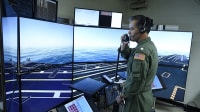
During an underway demonstration aboard the USS George H.W. Bush (CVN 77), Navy flight deck directors – known as “yellow shirts” – used standard hand signals to direct T1 just like any other carrier-based aircraft. Instead of a pilot receiving the commands, however, it was a Boeing MQ-25 Deck Handling Operator (DHO) right beside the “yellow shirt” who commanded the aircraft using a new handheld deck control device.
The demonstration was intended to ensure the design of the MQ-25 will successfully integrate into the carrier environment and to evaluate the functionality, capability and handling qualities of the deck handling system both in day and night conditions. Maneuvers included taxiing on the deck, connecting to the catapult, clearing the landing area and parking on the deck.
“The Navy has a rigorous, well-established process for moving aircraft on the carrier. Our goal was to ensure the MQ-25 fits into the process without changing it,” said Jim Young, MQ-25 chief engineer. “From the design of the aircraft to the design of the system moving it, our team has worked hard to make the MQ-25 carrier suitable in every way.”
DHO’s trained in Boeing’s deck handling simulation lab in St. Louis, where they practiced entering commands from simulated “yellow shirts” into the real handheld device. A simulated MQ-25, running the aircraft’s real operational flight code and interfaces, would move accordingly. The handheld controller is a simple, easy-to-use device designed specifically for a generation of sailors who natively understand such handheld technology and have experience with controllers used in the gaming industry today.
The deck handling demonstration followed a two-year flight test campaign for the Boeing-owned T1 test asset, during which the Boeing and Navy team refueled three different carrier-based aircraft – an F/A-18 Super Hornet, an E-2D Hawkeye and an F-35C Lightning II.
“The Navy gave us two key performance parameters for the program – aerial refueling and integration onto the carrier deck,” said Dave Bujold, Boeing MQ-25 program director. “We’ve shown that the MQ-25 can meet both requirements, and we’ve done it years earlier than traditional acquisition programs.”
More From SAE Media Group

Aerospace INSIDER
Short-Takeoff & Landing Capability to be Added to MQ-9B Aircraft

Aerospace INSIDER
Anduril Completes First Semi-Autonomous Flight of CCA Prototype

Aerospace INSIDER
First Air-to-Air Refueling Using an Unmanned Aircraft
Aerospace INSIDER
Autonomous Black Hawk® Flies Missions Without Pilots on Board

Aerospace & Defense Tech Briefs
Boeing Wins MQ-25 Contract
Aerospace & Defense Tech Briefs
MQ-25 Vehicle Management Computer Upgrade
Motion Design INSIDER
AI-Powered Vision System Helps Drones Navigate Safely
Aerospace Manufacturing and Machining INSIDER
A New AI-Piloted VTOL Fighter Jet for Contested Environments
Aerospace INSIDER
US Marine Corps to Get MQ-9A Extended Range Unmanned Aircraft Systems

Aerospace INSIDER
Air Force Pilots Perform Remote Flights with Joby eVTOL
Aerospace & Defense Tech Briefs
Fabrication and Testing of High-Speed Single-Rotor and Compound-Rotor Systems
Aerospace INSIDER
Osprey MK III Completes First Autonomous Flight
Aerospace INSIDER
F-22 Pilot Controls Drone With Tablet
Tech Briefs
Flimmer: The Flying, Swimming Drone

Aerospace & Defense Tech Briefs
Aitech Defense Will Provide Data Interface Technology for Boeing’s Unmanned MQ-25 Refueling Platform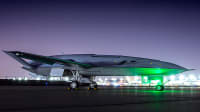
Aerospace & Defense Tech Briefs
Curtiss-Wright Will Provide Data Technology Support for Boeing’s MQ-25 Unmanned Air Refueling Platform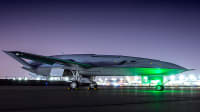
Aerospace INSIDER
Navy Starts First Assemblies of F-35 Lift Fan Clutch
Aerospace INSIDER
MQ-1C Completes First Air-Launched Effect Flight Demonstration

Aerospace INSIDER
GA-ASI Announces Gray Eagle 25M for Multi-Domain Operations
Aerospace INSIDER
New DARPA X-Plane Will Have No Moving Control Surfaces
Top Stories
INSIDERManufacturing & Prototyping
 How Airbus is Using w-DED to 3D Print Larger Titanium Airplane Parts
INSIDERManned Systems
 FAA to Replace Aging Network of Ground-Based Radars
NewsTransportation
 CES 2026: Bosch is Ready to Bring AI to Your (Likely ICE-powered) Vehicle
NewsSoftware
 Accelerating Down the Road to Autonomy
EditorialDesign
 DarkSky One Wants to Make the World a Darker Place
INSIDERMaterials
 Can This Self-Healing Composite Make Airplane and Spacecraft Components Last...
Webcasts
Defense
 How Sift's Unified Observability Platform Accelerates Drone Innovation
Automotive
 E/E Architecture Redefined: Building Smarter, Safer, and Scalable...
Power
 Hydrogen Engines Are Heating Up for Heavy Duty
Electronics & Computers
 Advantages of Smart Power Distribution Unit Design for Automotive...
Unmanned Systems
 Quiet, Please: NVH Improvement Opportunities in the Early Design...
