




DARPA Selects Industry Teams to Design Liberty Lifter X-Plane
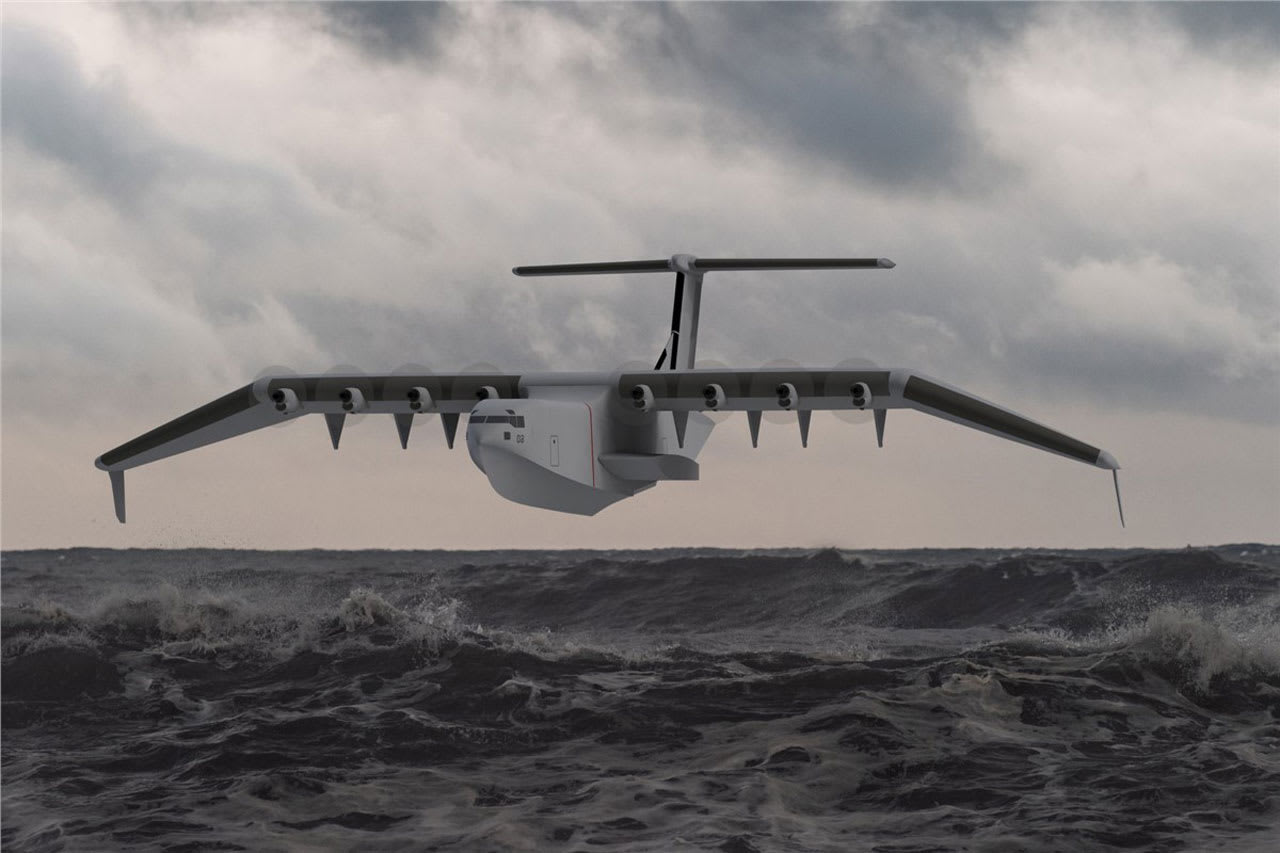
Two teams — General Atomics working with Maritime Applied Physics Corporation and Aurora Flight Sciences working with Gibbs & Cox and ReconCraft — will develop designs for the Defense Advanced Research Projects Agency (DARPA) Liberty Lifter Seaplane Wing-in-Ground Effect full-scale demonstrator. The Liberty Lifter program aims to demonstrate a leap-ahead in operational capability by designing, building, floating, and flying a long-range, low-cost X-Plane capable of seaborne strategic and tactical heavy lift.
The planned Liberty Lifter demonstrator will be a large flying boat similar in size and capacity to the C-17 Globemaster III transport aircraft. Goals include takeoff and land in Sea State 4, sustained on-water operation up to Sea State 5, and extended flight close to the water in ground effect with the capability to fly out of ground effect at altitudes up to 10,000 feet above sea level.
“We are excited to kick off this program and looking forward to working closely with both performer teams as they mature their point-of-departure design concepts through Phase 1,” said DARPA Liberty Lifter Program Manager Christopher Kent. “The two teams have taken distinctly different design approaches that will enable us to explore a relatively large design space during Phase 1.”
The General Atomics team has selected a twin-hull, mid-wing design to optimize on-water stability and seakeeping. It employs distributed propulsion using twelve turboshaft engines.
Aurora Flight Sciences point-of-departure design more closely resembles a traditional flying boat, with a single hull, high wing and eight turboprops for primary propulsion.
During Phase 1, DARPA will work with both performer teams and Department of Defense (DOD) stakeholders to refine the Liberty Lifter designs with particular attention to operational needs and operating concepts. The Phase 1 contract awards are for an 18-month period of performance with six months of conceptual design work and nine months of design maturation culminating in a preliminary design review. There will be an additional three months for manufacturing planning and test/demonstration planning reviews.
As scheduled, Phase 1 will transition into Phase 2 in mid-2024 with continued detailed design, manufacturing, and demonstration of a full-scale Liberty Lifter X-Plane. DARPA anticipates teaming with one or more DOD Service and international partners for those activities and further development of the Liberty Lifter concept into an operational vehicle.
More From SAE Media Group
Aerospace INSIDER
Embraer Subsidiary Shows First Full-Scale eVTOL Prototype
Aerospace INSIDER
These Four Companies Will Build DARPA High-Speed VTOL X-Plane Prototypes
Aerospace INSIDER
Quarterhorse Hypersonic Test Aircraft Completes First Flight

Tech Briefs
The Future of Supersonic Travel
Aerospace INSIDER
New DARPA X-Plane Will Have No Moving Control Surfaces
Aerospace & Defense Tech Briefs
Airbus to Fly Prototype eVTOL This Year
Aerospace INSIDER
Airbus Starts Testing Airplane Wing That Changes Shape In-Flight
Aerospace INSIDER
Archer Achieves First Untethered Flight with Midnight eVTOL
Aerospace INSIDER
NASA’s Quiet Supersonic Demonstrator Jet Completes First Flight
Tech Briefs
Improved Fixed-Wing Gust Load Alleviation Device
Aerospace INSIDER
Sikorsky is Designing a New Hybrid Electric Tilt Wing VTOL Demonstrator
Aerospace INSIDER
A Next Generation Helmet System for Navy Pilots
Aerospace INSIDER
Active Strake System Cuts Cruise Drag, Boosts Flight Efficiency
Tech Briefs
Novel Control Method in Tailless Aircraft
Aerospace INSIDER
Helsing Unveils New Autonomous Fighter Jet 'CA-1 Europa'
Tech Briefs
Fixed-Wing Angle eVTOL
Aerospace INSIDER
Lilium Starts Production of eVTOL Jet Batteries
Aerospace INSIDER
Electra Starts Proving Blown Lift eSTOL Technology

Tech Briefs
5Ws of the Wingless Transporter
Aerospace INSIDER
Turkey's KAAN Combat Aircraft Completes First Flight
Aerospace INSIDER
WATCH: Air Force Research Lab's First Flight of XQ-67A Drone
Aerospace INSIDER
Airbus Preparing to Fly New Prototype eVTOL This Year





Top Stories
INSIDERDefense
 New Raytheon and Lockheed Martin Agreements Expand Missile Defense Production
NewsAutomotive
 Ford Announces 48-Volt Architecture for Future Electric Truck
INSIDERManufacturing & Prototyping
 Active Strake System Cuts Cruise Drag, Boosts Flight Efficiency
ArticlesTransportation
 Accelerating Down the Road to Autonomy
INSIDERMaterials
 How Airbus is Using w-DED to 3D Print Larger Titanium Airplane Parts
Road ReadyTransportation

Webcasts
Electronics & Computers
 Cooling a New Generation of Aerospace and Defense Embedded...
Power
 Battery Abuse Testing: Pushing to Failure
Connectivity
 A FREE Two-Day Event Dedicated to Connected Mobility
Automotive
 Quiet, Please: NVH Improvement Opportunities in the Early Design Cycle
Transportation
 Advantages of Smart Power Distribution Unit Design for Automotive &...
Aerospace
 Sesame Solar's Nanogrid Tech Promises Major Gains in Drone Endurance