




Soldier Insights Drive Army's Development of Mixed-Reality Training System
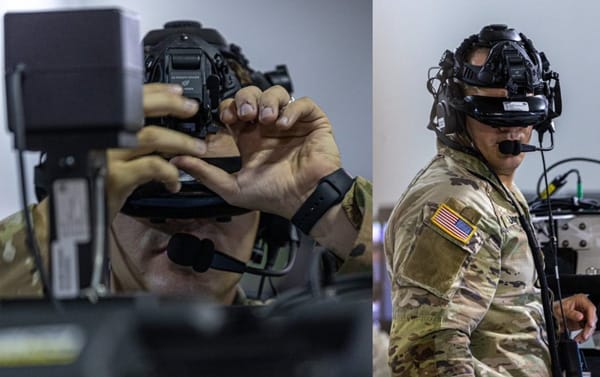
On a mid-August afternoon in central Texas, soldiers in combat uniform gather together, preparing to engage in realistic battlefield training. With temperatures outside approaching the high 90s, one might expect the upcoming drill, situated amid a flat and dusty expanse at Fort Hood, to verge on the sweltering. Instead, this particular group of soldiers is training inside the walls of the post’s Close Combat Tactical Training Center, surrounded by the steady hum of computers and a reliable flow of cool air conditioning.
The center, which facilitates state-of-the-art virtual collective training for warfighters, was hosting approximately 150 soldiers from Fort Bliss, Texas, and Fort Carson, Colorado as part of an operational assessment led by the U.S. Army Test and Evaluation Command. The purpose of the assessment was to understand how soldiers interact with the newest software and hardware iterations of the Army’s Synthetic Training Environment (STE) a capability that blends virtual, live, and collective training elements to produce an immersive experience that is location-agile and minimizes use of real firepower and other typically costly, one-time-use training resources.
Undergoing analysis at the event were two elements of the broader STE, the Information System, shortened STE-IS, and the Reconfigurable Virtual Collective Trainer (RVCT). The STE-IS is an intelligent suite of training simulation and management software that supports intuitive access and simultaneous training at multiple locations. The STE-IS also encompasses One World Terrain, a 3D mapping dataset that allows training coordinators to integrate actual terrain imagery from around the globe.
The RVCT is a highly adaptable hardware system that connects to the STE-IS to activate collective, mixed-reality training scenarios. The RVCT consists of high-tech, interactive equipment — including a heads-up display, high-resolution monitor and representational controllers — that enables soldiers, squads, platoons and companies to navigate exercises using actual and computer-generated movements. The STE-IS-powered family of RVCT systems is capable of replicating key aviation and ground platforms; the Fort Hood event is focused on RVCT ground models that can replicate Abrams, Bradley and Stryker fighting vehicles, as well as dismounted infantry.
Beyond testing out the new equipment, soldiers are providing critical feedback and data to STE development teams on the utility of the existing software and hardware and how it could be tweaked to portray in-person combat with greater realism. Soldiers participating in the assessment readily offer ideas on how to enhance current systems, such as by varying the volume of sound effects and making simulated movements smoother.
Initial insights emerging from the Soldier feedback process were shared with Army leaders, including Lt. Gen. Maria R. Gervais, Deputy Commanding General and Chief of Staff of the U.S. Army Training and Doctrine Command, during a distinguished visitor day held at the Close Combat Training Center on Aug. 17.
More From SAE Media Group
Aerospace & Defense Tech Briefs
Virtual Environment System
Aerospace & Defense Tech Briefs
Control Platform Toolkit
Electronics & Sensors INSIDER
Bringing Together Real-World Sensors and VR to Improve Building Maintenance

Off-Highway Engineering
New CM Labs Excavator Simulator Training Offers GPS Guidance, HMI Experience
Tech Briefs
Magazine Archives
Aerospace & Defense Tech Briefs
Military Training Simulation Software

Off-Highway Engineering
Virtual Meets Mixed Reality for Vehicle Development
Aerospace & Defense Tech Briefs
Small Arms Trainers
Aerospace & Defense Tech Briefs
Thailand Army Vehicle Computer System Upgrades
Tech Briefs
Rapid Imaging Software (RIS)

Aerospace & Defense Tech Briefs
T-45 Virtual/Augmented Reality Training Technology
Medical Design Briefs
How Virtual, Cloud-Based Technologies Are Powering the Next Industrial Revolution
Defense INSIDER
Anduril Brings AI-Powered Display to New EagleEye Army Helmets
Tech Briefs
Product of the Month
Tech Briefs
Why 2023 Will Be the Year of the ‘Platform’
Automotive Engineering
Simulating Forward Motion at VI-Grade’s Zero Prototypes Day
Defense INSIDER
Air Force Uses 3-D Scanner to Model Aircraft
Motion Control and Automation Technology INSIDER
New Method Combats Virtual Reality Sickness
Defense INSIDER
Mounted Troops to Get High-Tech Situational Awareness Tools
Medical Design Briefs
Incorporating 3D Artificial Intelligence with AR and VR Technology

Aerospace Manufacturing and Machining INSIDER
Army to Advance Prototype Competition for Future Electric Light Reconnaissance Vehicle
Robotics & Automation INSIDER
New Dual-Armed Telerobotic System for Hazardous Waste Clean-Up
Aerospace Manufacturing and Machining INSIDER
Army Unveils New Prototype M1E3 Abrams Tank
Top Stories
NewsSensors/Data Acquisition
 Microvision Aquires Luminar, Plans Relationship Restoration, Multi-industry Push
INSIDERRF & Microwave Electronics
 A Next Generation Helmet System for Navy Pilots
INSIDERWeapons Systems
 New Raytheon and Lockheed Martin Agreements Expand Missile Defense Production
NewsAutomotive
 Ford Announces 48-Volt Architecture for Future Electric Truck
INSIDERAerospace
 Active Strake System Cuts Cruise Drag, Boosts Flight Efficiency
ArticlesTransportation

Webcasts
Aerospace
 Cooling a New Generation of Aerospace and Defense Embedded...
Energy
 Battery Abuse Testing: Pushing to Failure
Power
 A FREE Two-Day Event Dedicated to Connected Mobility
Automotive
 Quiet, Please: NVH Improvement Opportunities in the Early Design Cycle
Electronics & Computers
 Advantages of Smart Power Distribution Unit Design for Automotive &...
Unmanned Systems
 Sesame Solar's Nanogrid Tech Promises Major Gains in Drone Endurance