




Fabrication of Lightweight Armored Doors for HMMWVs
A document describes a concept for fabricating lightweight armored doors for the Army’s high-mobility multipurpose wheeled vehicles (HMMWVs). Essentially, the concept is to reinforce high-hard (HH) steel armored doors used on some HMMWVs with a laminated, woven, high-tensile-strength glassfiber/ polyester-matrix composite that has performed well as armor material in previous military applications. A fabrication procedure for implementing the concept, described in the document, can be summarized as follows:
- Prepregs (sheets of the woven glass fibers pre-impregnated with the uncured polyester resin) are cut to sizes and shapes to fit their assigned place in the door.
- Cut prepregs are stacked as multiple plies to obtain the required thickness.
- Using the HH steel door panel as a mandrel or mold, the prepreg stack is vacuum-bagged and cured into the final composite form by heating according to a prescribed temperature- versus-time schedule.
- The HH steel door panel and the composite panel are prepared for adhesive bonding, then assembled with a polysulfide adhesive, then vacuum-bagged for room-temperature or optional elevatedtemperature curing of the adhesive.
- Other steps (e.g., installation of weatherstripping) in the ordinary fabrication of the door are completed.
This work was done by James P. Wolbert and David M. Spagnuolo of the Army Research Laboratory. For more information, download the Technical Support Package (free white paper) at www.defensetechbriefs.com/tsp under the Manufacturing & Prototyping category. ARL-0016
This Brief includes a Technical Support Package (TSP).
Fabrication of Lightweight Armored Doors for HMMWVs
(reference ARL-0016) is currently available for download from the TSP library.
Don't have an account?
More From SAE Media Group
Tech Briefs
Fiber Metal Laminates Made by the VARTM Process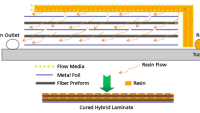
Aerospace & Defense Tech Briefs
Evaluation of Peel Ply Surface Preparation of Composite Surfaces for Secondary Bonding
Automotive Engineering
Recaro Pioneers Seating Shells Made with CF Recyclate
Tech Briefs
Automated Tow/Tape Placement System
Tech Briefs
AERoBOND: Large-Scale Composite Manufacturing

Tech Briefs
Using 3D Printing to Strengthen Jet Engines
Tech Briefs
Fiber-Metal Laminate Manufacturing Technique
Automotive Engineering
Battle for the Box

Aerospace & Defense Tech Briefs
Using Thermoplastic Composites for Aerospace Applications
Aerospace & Defense Tech Briefs
Hydraulic Testing of Polymer Matrix Composite 102mm Tube Section
Automotive Engineering
Tesla’s Cybertruck Is Audaciously Austenitic


Automotive Engineering
Linking Embroidery and Carbon Fiber to save Weight and Cost
Aerospace & Defense Tech Briefs
Evaluation of Additively Manufactured Ultrahard Steels
Aerospace & Defense Tech Briefs
Improvements in Manufacturing BMI/Fiber Composites Using AFP


Automotive Engineering
Lightweight Steel on a (Cold) Roll
Tech Briefs
3D-Printed Composites for High-Temperature Uses
Aerospace & Defense Tech Briefs
Composite Repair Engineering Case Studies for U.S. Army Aerostructures
Overview
The document titled "Lightweight HMMWV Armored Doors: A Detailed Approach of the Fabrication Process" by James P. Wolbert and David M. Spagnuolo, published in February 2007, serves as a comprehensive reference guide for the fabrication of lightweight armored doors specifically designed for the High Mobility Multipurpose Wheeled Vehicle (HMMWV). The report is intended to provide insights into the processes and methodologies involved in creating hybrid armor panels, which are crucial for enhancing the protection and operational capabilities of military vehicles.
The report outlines the intent to detail the fabrication process, emphasizing that it is more of a reference guide than a standard operating procedure. It highlights the importance of lightweight materials in armor design, which can significantly improve vehicle performance without compromising safety. The authors discuss various materials and techniques used in the construction of armored doors, focusing on the balance between weight, strength, and ballistic protection.
Additionally, the document mentions that some work has been conducted on HMMWV body panels, indicating ongoing research and development in this area. This suggests that the findings and methodologies presented in the report may be part of a broader effort to enhance the overall armor systems of military vehicles.
The report is structured to provide clear and concise information, making it accessible to military personnel, engineers, and researchers involved in vehicle armor development. It includes technical details that can aid in the understanding of the fabrication process, as well as considerations for future improvements in armor technology.
Overall, the document contributes to the field of military vehicle protection by offering a detailed examination of the fabrication of lightweight armored doors, which are essential for modern combat scenarios. It underscores the significance of innovation in materials and design to meet the evolving demands of military operations. The findings are not to be construed as an official Department of the Army position unless specified by other authorized documents, and the report is approved for public release, ensuring that the information can be disseminated widely for educational and practical applications.
Top Stories
INSIDERAerospace
 How Airbus is Using w-DED to 3D Print Larger Titanium Airplane Parts
NewsAutomotive
 Microvision Aquires Luminar, Plans Relationship Restoration, Multi-industry Push
INSIDERManufacturing & Prototyping
 A Next Generation Helmet System for Navy Pilots
INSIDERDefense
 New Raytheon and Lockheed Martin Agreements Expand Missile Defense Production
ArticlesAR/AI
 Accelerating Down the Road to Autonomy
Road ReadyDesign

Webcasts
Automotive
 Advantages of Smart Power Distribution Unit Design for Automotive...
Unmanned Systems
 Quiet, Please: NVH Improvement Opportunities in the Early Design...
Defense
 Cooling a New Generation of Aerospace and Defense Embedded...
Power
 Battery Abuse Testing: Pushing to Failure
Power
 A FREE Two-Day Event Dedicated to Connected Mobility
