




Progress in Research on Bacteria-Powered Motors
Bacteria can be attached to surface patterns and survive for 4 hours.
Progress has been made on several fronts in research on biomotors and especially on microscopic motors powered by bacteria. The progress consists mostly of advances in the art of attaching motile bacterial cells to surfaces in specific, pre-designed microarrays.
The accomplishments during the past four years are the following:
- The first advance was development of a method to fabricate microarrays capable of binding motile Escherichia coli cells. The microarrays were patterned with 16 mercaptohexadecanoic acid (MHA), then covalently functionalized with, variously, E. coli antibodies, lipopolysaccharide, or poly-Llysine (PLL). It was also found that the use of 11-mercaptoundecyl- penta(ethylene glycol) [PEG SH] or 11-mercapto- l-undecanol [MOU] as passivating molecules nearly completely inhibited non-specific binding of E. coli. Microcontact printing was used to prepare microarrays for adhesion of bacterial cells, and attachment of bacteria was examined by optical/fluorescence and atomic-force microscopy.
- It was shown that cells of the K-12 strain of E. Coli remain alive for more than four hours after initial adhesion to prefabricated surface structures.
- Attempts to bind E. Coli cells to PLL-MHA dots of various sizes revealed that the minimum surface feature size for binding of E. Coli is 1.3 μm. (Bacterial cells of species other than E. Coli may prefer different surface-feature sizes; this is the subject of a continuing investigation.)
- A substrate that contains a series of holes made by use of electron-beam lithography was prepared in order to use the holes as devices to hold bacterial cells in a "nose-on" orientation at the specific hole positions. The bottom surfaces of the holes were coated with gold and the gold was coated with MHA followed by PLL. The regions between the holes were passivated with penta(ethylene glycol). It was found to be possible to bind a single motile bacterial cell in a hole at a loose approximation of the "nose-on" orientation.
- The degree of adhesion of bacterial cells to surface features was found to depend on acidity or alkalinity: At a pH of 9, cells adhered to nearly all surface features, while at a pH of 4, nearly all the features were devoid of cells.
- CheY-deficient Pseudomonas aeruginosa cells, which have been characterized as "smooth swimming," have been attached to microarray surfaces. [CheY is an excitatory response regulator of chemotaxis; hence, CheY-deficient P. aeruginosa does not undergo chemotaxis.] P. aeruginosa are the bacteria of choice for micron-scale biomotors because, among other things, they swim about 40 times faster than do E. coli.
- Dip-pen nanolithography (DPN) was used to prepare microarrays for adhesion of bacterial cells. DPN is a particularly important soft lithographic method inasmuch as it enables placement of whole bacterial cells at designated sites on surface microarrays. It was found to be possible to attach a single motile P. aeruginosa cell to designated line and/or dot features. The cell can be bound via either its body or its flagellum. Cells bound in this way were found to remain alive for more than four hours.
- Biomotor devices consisting essentially of glass microscopeslide covers asymmetrically coated with Pseudomonas aeruginosa cells suspended in deionized water on gold threads were constructed. These devices were observed to spin in the water when the bacteria were alive, and not to spin when the bacteria were dead.
This work was done by Richard C. Holz of Utah State University for the Air Force Research Laboratory. For more information, download the Technical Support Package (free white paper) at www.defensetechbriefs.com/tsp under the Physical Sciences category. AFRL-0027
This Brief includes a Technical Support Package (TSP).
Progress in Research on Bacteria-Powered Motors
(reference AFRL-0027) is currently available for download from the TSP library.
Don't have an account?
More From SAE Media Group
Motion Design INSIDER
Can DNA-Nanoparticle Motors Get Up To Speed With Motor Proteins?
Photonics & Imaging Technology
Leveraging CAD for Precision in Wide Field Star Imaging and Spectroscopy
Tech Briefs
University of Pennsylvania School of Engineering
Tech Briefs
When Mushrooms Control Robots

Tech Briefs
Growing a Whole-Brain Organoid


Tech Briefs
Bioelectronic Devices Enable Real-Time Sensing
Aerospace & Defense Tech Briefs
Advances Toward Development of "Smart Dust" Biosensors
Tech Briefs
VaCNT Makes Up a Promising Membrane Material
Tech Briefs
Creating 2D All-Organic Perovskites
Motion Design INSIDER
First Toroidal Micro-Robot to Swim Autonomously in Viscous Liquids
Tech Briefs
Tunable, Narrow Linewidth, Chip-Scale Lasers
Aerospace & Defense Tech Briefs
Circuit Models for Robust, Adaptive Neural Control
Medical Design Briefs
Diagnostics
Aerospace & Defense Tech Briefs
Nanodevices Based on Actin-Filament End-Tracking Motors
Tech Briefs
Flexible Lightweight Radiation Shielding
Photonics & Imaging Technology
New Frequency Comb Can Identify Molecules in 20-Nanosecond Snapshots

Aerospace & Defense Tech Briefs
Next-Generation Spectrometers for Rapid Analysis of Complex Mixtures

Battery & Electrification Technology
Enhancing the Performance of All-Solid-State Batteries
Tech Briefs
The Rising Presence of Women in Engineering
Photonics & Imaging Technology
New Products
Electronics & Sensors INSIDER
New Photonic Effect Could Speed Drug Development
Overview
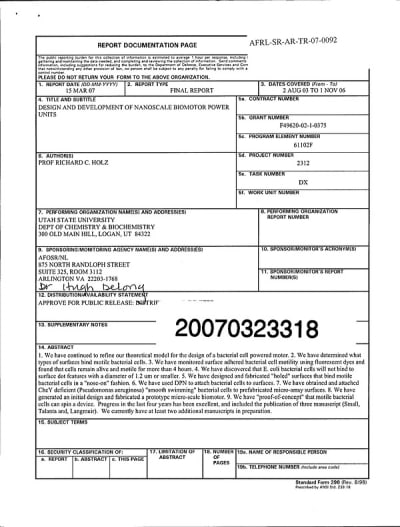
The document titled "Design and Development of Nanoscale Biomotor Power Units" is a final report detailing research conducted by Professor Richard C. Holz and his team at Utah State University from August 2003 to November 2006. The primary focus of the research was to explore the potential of motile bacteria as power units for nanoscale motors.
The report outlines several key objectives and accomplishments over the research period. The team refined a theoretical model for designing bacterial cell-powered motors and investigated the types of surfaces that effectively bind motile bacterial cells. They monitored the motility of surface-adhered bacterial cells using fluorescent dyes, confirming that these cells remained alive and motile for over four hours. A significant finding was that E. coli cells do not bind to surface dot features smaller than 1.2 micrometers in diameter.
The researchers designed and fabricated "holed" surfaces that allow motile bacterial cells to attach in a "nose-on" orientation, enhancing their utility in motor applications. They employed Dip-Pen Nanolithography (DPN) techniques to attach bacterial cells to surfaces and successfully obtained CheY deficient (Pseudomonas aeruginosa) "smooth swimming" bacterial cells for use on prefabricated micro-array surfaces.
The report highlights the progress made in the last four years, including the publication of three peer-reviewed manuscripts in journals such as Small and Talanta, with at least two additional manuscripts in preparation. The research has garnered attention, leading to 13 invited seminars and three poster presentations at various scientific meetings.
Overall, the findings demonstrate the feasibility of using motile bacterial cells as components in nanoscale biomotors, providing a proof-of-concept that these cells can indeed spin a device. The research contributes to the broader field of bioengineering and nanotechnology, with potential applications in creating novel power sources and devices at the microscale.
The document concludes with a summary of the research's implications and future directions, emphasizing the importance of continued exploration in this innovative area of study.
Top Stories
INSIDERAerospace
 How Airbus is Using w-DED to 3D Print Larger Titanium Airplane Parts
NewsAutomotive
 Microvision Aquires Luminar, Plans Relationship Restoration, Multi-industry Push
INSIDERManufacturing & Prototyping
 A Next Generation Helmet System for Navy Pilots
INSIDERDefense
 New Raytheon and Lockheed Martin Agreements Expand Missile Defense Production
ArticlesAR/AI
 Accelerating Down the Road to Autonomy
Road ReadyDesign

Webcasts
Automotive
 Advantages of Smart Power Distribution Unit Design for Automotive...
Unmanned Systems
 Quiet, Please: NVH Improvement Opportunities in the Early Design...
Defense
 Cooling a New Generation of Aerospace and Defense Embedded...
Power
 Battery Abuse Testing: Pushing to Failure
Power
 A FREE Two-Day Event Dedicated to Connected Mobility
