




Nanodevices Based on Actin-Filament End-Tracking Motors
Products incorporating these devices could include biosensors, microfluidic systems, and therapeutic agents.
In a continuing research project, nanoscale actuators based on actin-filament end- tracking motors have been synthesized and characterized. It is envisioned that such actuators will eventually be utilized, variously, as molecular shuttles in biosensor devices or as nanoscale biomotors for effecting selection or separation of target microorganisms or molecules. In addition, this research is expected to enhance the fundamental understanding of molecular motors, both in vitro and in vivo and lead to modification of previously developed biomolecular machines and nanobiostructures to make them perform new functions. Some nanoscale actuators like those developed in this research may prove useful as components of micro- and nanofluidic systems. By contributing to understanding of how living cells convert chemical energy into mechanical work during actin-based and microtubule-based cell motility in cell crawling and cell mitosis, this research may lead to development of new therapeutic agents for combating invasive and metastatic cancers, gouty arthritis, Wiskott Aldrich syndrome, and those neurodegenerative disorders linked to loss of functional synapses.
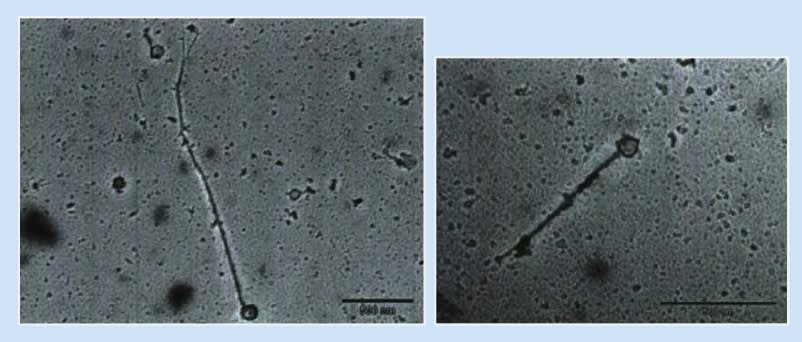
During division of bacterial cells, actin-filament end-tracking motors are responsible for segregating daughter chromosomes. End-tracking motors also provide cell motility for cell-to-cell propulsion of invasive microorganisms. In an actin-filament end-tracking motor, the propulsive force is associated with the elongation of a protein filament (or a bundle of protein filaments) via polymerization reactions at the ends. The elongation is faster at one end, denoted the plus end; the other, slower-growing end is denoted the minus end. The nature of the physical and chemical interactions at the plus end is such as to cause that end to bind strongly to the object being propelled. The minus end may or may not be anchored, depending on the intra- or extracellular character of the specific propulsion process.
One concept underlying this research is that the properties of actin-filament end-tracking motors that afford propulsion in vivo should be exploitable in vitro to effect analogous nanoscale actuation for such purposes as manipulation of beads (see figure), spores, and deoxyribonucleic acid (DNA) molecules. In a typical envisioned application, actin-filament end-tracking motors would be utilized for transport and/or concentration of such particles against diffusion gradients or opposing force fields. For example, it might be possible to use filament-bound nanoparticles or protein complexes with attached oligonucleotides for hybridization to target and separate specific DNA sequences without need for strong electric or magnetic fields required in some prior separation techniques. Uses include:
- Optimization of conditions for propulsion of particles in cell extracts;
- Development of single-filament actuators;
- Guidance of single-filament elongation on patterned and microfabricated substrata;
- Development and validation of a mathematical model that predicts particlepropulsion velocity as a function of controllable parameters;
- Development of novel methods of time-of-flight mass spectrometry for imaging of surfaces; and
- Development of techniques for direct, real-time observation of protein-protein interactions involved in filament end-tracking in vivo.
This work was done by Richard B. Dickinson, Daniel L. Purich, William Zeile, Joseph Phillips, Colin Sturm, and Kimberly Interliggi of the University of Florida; Suzanne Hens, Gary McGuire, Mark Ray, and Darin Thomas of the International Technology Center; Brian Holliday and William Cooke of the College of William and Mary; and Denis Wirtz and Melissa Thompson of Johns Hopkins University for the Defense Advanced Research Projects Agency (DARPA).
DARPA-0007
This Brief includes a Technical Support Package (TSP).
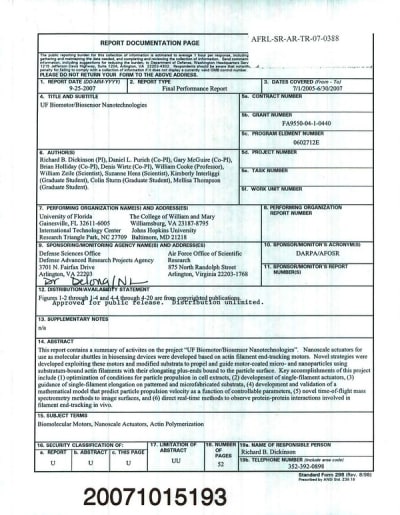
Nanodevices Based on Actin-Filament End-Tracking Motors
(reference DARPA-0007) is currently available for download from the TSP library.
Don't have an account?
More From SAE Media Group
Tech Briefs
University of Pennsylvania School of Engineering
Motion Design INSIDER
Can DNA-Nanoparticle Motors Get Up To Speed With Motor Proteins?
Aerospace & Defense Tech Briefs
Advances Toward Development of "Smart Dust" Biosensors

Electronics & Sensors INSIDER
New Photonic Effect Could Speed Drug Development
Medical Design Briefs
Biosensor Enables Ultrafast Detection of COVID-19
Tech Briefs
Growing a Whole-Brain Organoid
Medical Design Briefs
Material Improves Implantable Technology
Medical Design Briefs
DNA Nanotechnology Tools Help Develop New Therapies
Medical Design Briefs
Biosensors Measure Toxic Drugs in Cancer, Arthritis, and Organ Transplant Patients
Medical Design Briefs
Diagnostics
Aerospace & Defense Tech Briefs
Robust Quantum Sensors Program
Medical Design Briefs
Wearable Sensors Could Leverage Biotechnology to Monitor Personal, Environmental Data
Tech Briefs
When Mushrooms Control Robots
Tech Briefs
Levitating Objects with Light
Photonics & Imaging Technology
Ultra-Narrowband Optical Filters Pushing Boundaries from the UV to the LWIR
Medical Design Briefs
Noninvasive Test Detects Cancer Cells
Aerospace & Defense Tech Briefs
Circuit Models for Robust, Adaptive Neural Control
Tech Briefs
Products of Tomorrow
Medical Design Briefs
Gold Nanoparticles Enable Long-Term Implantable Sensor ‘Tattoo’
Sensor Technology
Tattoo Made of Gold Nanoparticles Revolutionizes Medical Diagnostics
Battery & Electrification Technology
Designing Safer, Higher-Performance Lithium Batteries
Tech Briefs
VaCNT Makes Up a Promising Membrane Material
Motion Design INSIDER
How To Shift Gears in a Molecular Motor
Motion Design
DNA-Based Controller to Operate Swarm Molecular Robots
Tech Briefs
Mask Prototype Can Detect COVID-19 Infection

Medical Design Briefs
Sensor Tracks Stress Hormone in Real Time
Tech Briefs
First Transformable Nanoscale Electronic Devices
Overview
The document is a final performance report on the project titled "UF Biomotor/Biosensor Nanotechnologies," which was conducted from July 1, 2005, to June 30, 2007. The project aimed to develop nanoscale actuators for use as molecular shuttles in biosensing devices, leveraging the properties of actin filament end-tracking motors.
Key accomplishments of the project included the optimization of conditions for particle propulsion in cell extracts, the development of single-filament actuators, and the guidance of single-filament elongation on patterned and microfabricated substrates. These advancements were crucial for enhancing the functionality of biosensing devices.
The report highlights the innovative strategies employed to propel and guide motor-coated micro- and nanoparticles. This was achieved by utilizing substratum-bound actin filaments, with their elongating plus-ends attached to the particle surfaces. The research team also developed a mathematical model to predict particle propulsion velocity based on controllable parameters, which is essential for fine-tuning the performance of the biosensing devices.
Additionally, the project introduced novel time-of-flight mass spectrometry (TOF-SIMS) methods for imaging surfaces, which allowed for high-resolution characterization of the devices. This technique involved focusing a high-energy primary ion onto a surface to analyze the mass-to-charge ratio of ejected particles, providing insights into the molecular composition of the surfaces.
The report also discusses the development of a high-throughput technology designed to analyze the multitude of ion masses present in TOF-SIMS spectra of biological samples. This involved dimension reduction to minimize the information in the spectra and mass-resolution enhancement to increase the density of the information extracted.
Overall, the project successfully integrated biophysical modeling and characterization with advanced nanotechnology to create effective biosensing solutions. The collaborative efforts of the research team, which included faculty members, graduate students, and scientists from various institutions, contributed to the project's success and laid the groundwork for future advancements in biomolecular motors and nanoscale actuators.
In summary, the report encapsulates significant progress in the field of biomotor and biosensor technologies, showcasing innovative methodologies and collaborative research efforts that have the potential to impact various applications in biosensing and molecular transport.
Top Stories
INSIDERDefense
 New Raytheon and Lockheed Martin Agreements Expand Missile Defense Production
NewsAutomotive
 Ford Announces 48-Volt Architecture for Future Electric Truck
INSIDERManufacturing & Prototyping
 Active Strake System Cuts Cruise Drag, Boosts Flight Efficiency
ArticlesTransportation
 Accelerating Down the Road to Autonomy
INSIDERMaterials
 How Airbus is Using w-DED to 3D Print Larger Titanium Airplane Parts
Road ReadyTransportation

Webcasts
Electronics & Computers
 Cooling a New Generation of Aerospace and Defense Embedded...
Power
 Battery Abuse Testing: Pushing to Failure
Connectivity
 A FREE Two-Day Event Dedicated to Connected Mobility
Automotive
 Quiet, Please: NVH Improvement Opportunities in the Early Design Cycle
Transportation
 Advantages of Smart Power Distribution Unit Design for Automotive &...
Aerospace
 Sesame Solar's Nanogrid Tech Promises Major Gains in Drone Endurance