




Advances Toward Development of "Smart Dust" Biosensors
Submillimeter-sized, optically interrogated sensors would detect chemical and biological agents.
Progress has been made toward meeting several technical challenges in a continuing effort to develop “smart dust” sensors for remote detection of chemical and biological agents. Until now, the state of the art of laboratory-on-a-chip devices has been typified by microfluidic cartridges variously mounted in or connected to desktop or handheld devices. Smart dust sensors would be smaller: they would be submillimeter-sized devices, the implementation of which would necessitate levels of miniaturization and integration heretofore known only in biological systems.
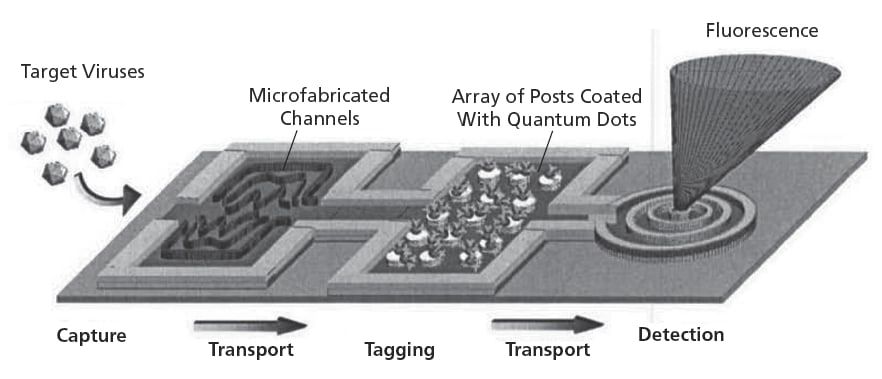
A promising approach toward the development of highly functional smart dust prototypes involves the design and fabrication of the prototypes as hybrid devices, in which biological nanomachines would be integrated into microfabricated synthetic structures. A representative example of a smart dust biosensor according to this approach is depicted schematically in the figure. In this example, antibody functionalized microtubules would capture analytes [that is, target chemical or biological agents (e.g., target viruses)] in a first chamber, molecular shuttles driven by biomolecular motors of which the microtubules would be integral parts would transport the analytes to a second chamber wherein the analytes would be tagged with quantum dots or fluorescent-dye-containing microspheres, then the shuttle motors would transport the tagged analytes to a third chamber, wherein the tags (and, hence, the analytes) would be detected remotely by fluorescence measurements.
Major technical challenges involved in this approach and the progress made in this development effort toward meeting the challenges are summarized as follows:
- Temperature stabilization of biomolecular motor powered devices - The activity rates of natural biological nanomachines vary significantly with temperature, making it necessary to regulate temperatures in traditional biotechnological and microfluidic devices. However, regulation of temperature would not be feasible in smart dust sensors, making it desirable to make activity rates remain as nearly constant as possible in the face of temperature changes. In this effort, experiments were performed on motor proteins, which are central in a number of nanobiodevices currently under development. The results of the experiments led to the conclusion that provided that certain preconditions are satisfied, at least partial temperature stabilization of enzyme activity levels can be achieved at the expense of enzyme turnover by reducing substrate concentrations substantially.
- Measurement of brightnesses of fluorescent tags for remote detection. - The brightnesses of fluorescent tags are critical design parameters. In this effort, absolute brightnesses of samples of fluorescent- dye-containing micro- spheres and variations of relative brightness among individual microspheres were measured.
- Optimization of velocity of the molecular shuttles for pick-up of fluorescent tags in the second chamber. - The need for optimization of velocity of molecular shuttles was demonstrated in experiments on the attachment of nanospheres via biotin-streptavidin linkages. The optimum speed depends on the characteristic times of subprocesses involved in the formation of the linkages. In essence, biotin and streptavidin act as glue that must harden for a sufficient time before stress can be applied.
- Proof-of-principle demonstration of a basic biomolecular motor powered sensor. - A circular well structure was fabricated by use of a photoresist. Biotinylated microtubules and biotinylated fluorescent microspheres were deposited in a central region of the circular well, leaving a region at the perimeter that was initially free of fluorescent micro-spheres. Injection of streptavidin (as a model of analyte molecules) and subsequent photolytic release of caged adenosine triphosphate led to capture of streptavidin by microtubules, pick-up of microspheres, and, finally, immobilization of microsphere-carrying microtubules at the wall of the well. This shows that molecular shuttles can drive the analyte-dependent transport of fluorescent tags.
This work was done by Henry Hess of the University of Florida for the Air Force Research Laboratory.
This Brief includes a Technical Support Package (TSP).
Advances Toward Development of "Smart Dust" Biosensors
(reference AFRL-0070) is currently available for download from the TSP library.
Don't have an account?
More From SAE Media Group
Aerospace & Defense Tech Briefs
Nanodevices Based on Actin-Filament End-Tracking Motors
Tech Briefs
When Mushrooms Control Robots
Motion Design INSIDER
Can DNA-Nanoparticle Motors Get Up To Speed With Motor Proteins?
Motion Design
Miniature 3D-Printed Actuators to Control Soft Robots
Electronics & Sensors INSIDER
New Photonic Effect Could Speed Drug Development

Photonics Tech Briefs
Integrated Miniature Arrays of Optical Biomolecule Detectors
Battery & Electrification Technology
Designing Safer, Higher-Performance Lithium Batteries
Tech Briefs
Products of Tomorrow

Tech Briefs
University of Pennsylvania School of Engineering
Aerospace & Defense Tech Briefs
Robust Quantum Sensors Program
Battery & Electrification Technology
Enhancing the Performance of All-Solid-State Batteries
Electronics & Sensors INSIDER
3D Printing of Organic Electronics

Photonics & Imaging Technology
New Frequency Comb Can Identify Molecules in 20-Nanosecond Snapshots
Tech Briefs
VaCNT Makes Up a Promising Membrane Material
Motion Design INSIDER
First Toroidal Micro-Robot to Swim Autonomously in Viscous Liquids

Photonics & Imaging Technology
Ultra-Narrowband Optical Filters Pushing Boundaries from the UV to the LWIR
Motion Design
Flexible Conductive Skin Gives Robots the Human Touch
Electronics & Sensors INSIDER
Careful Heating Unlocks Unprecedented Sensitivity to Pressure in Semiconductor Materials
Tech Briefs
Nanowire Electron Scattering Spectroscopy
Overview
The document outlines a collaborative research project aimed at developing a biomolecular motor-powered "smart dust" biosensor for remote detection of chemical and biological agents. This initiative involves partnerships among several prestigious institutions, including Sandia National Lab, the Naval Research Lab, Albert Einstein Medical College, and the Swiss Federal Institute of Technology (ETH Zurich), with funding from the DARPA-DSO Biomolecular Motors program.
The primary objective of the project is to create a biosensor that can be remotely read in standoff detection scenarios. The University of Florida team has contributed significantly by focusing on stabilizing biosensor performance against environmental fluctuations, such as temperature and light exposure, and testing the effectiveness of fluorescent tags and complete biosensors. The project has achieved notable milestones, including the development of methods for temperature stabilization, optimization of molecular shuttle velocities for tag pickup, and a proof-of-principle demonstration of the biosensor concept.
The biosensor design incorporates biomolecular motors to drive the transport of antibody-functionalized microtubules, which are essential for detecting target analytes. The document includes a schematic design illustrating how these microtubules, powered by biomolecular motors, can harvest and tag target viruses using quantum dots, enabling fluorescence emission for detection.
The report also highlights the completion of related research projects, with manuscripts detailing the advancements currently under consideration for publication. The next steps in the project involve further design and fabrication efforts for the biosensor, supported by the Office of Naval Research.
Overall, the document emphasizes the innovative approach of using biomolecular motors in sensor technology, showcasing the collaborative efforts of multiple research institutions to advance the field of remote detection of hazardous agents. The project represents a significant step forward in biosensor technology, with potential applications in various fields, including public health and national security. The research findings and methodologies developed through this project could pave the way for future advancements in biosensing technologies.
Top Stories
NewsRF & Microwave Electronics
 Microvision Aquires Luminar, Plans Relationship Restoration, Multi-industry Push
INSIDERAerospace
 A Next Generation Helmet System for Navy Pilots
INSIDERDesign
 New Raytheon and Lockheed Martin Agreements Expand Missile Defense Production
INSIDERMaterials
 How Airbus is Using w-DED to 3D Print Larger Titanium Airplane Parts
NewsPower
 Ford Announces 48-Volt Architecture for Future Electric Truck
ArticlesAR/AI

Webcasts
Electronics & Computers
 Cooling a New Generation of Aerospace and Defense Embedded...
Automotive
 Battery Abuse Testing: Pushing to Failure
Power
 A FREE Two-Day Event Dedicated to Connected Mobility
Unmanned Systems
 Quiet, Please: NVH Improvement Opportunities in the Early Design Cycle
Automotive
 Advantages of Smart Power Distribution Unit Design for Automotive &...
Energy
 Sesame Solar's Nanogrid Tech Promises Major Gains in Drone Endurance