




Airbus Lays Foundations for Future Urban Air Mobility in Germany
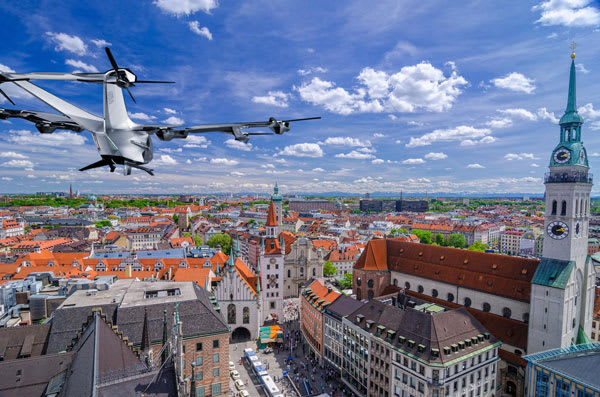
To contribute to the development of advanced air mobility, leading companies, universities, and research institutions, as well as municipalities, are joining forces under the leadership of Airbus to form the Air Mobility Initiative (AMI). The members of the Air Mobility Initiative include Airbus, City of Ingolstadt, Deutsche Bahn, Deutsche Flugsicherung, Diehl Aerospace, Droniq, Munich Airport, Red Cross, and Telekom.
This initiative, which is supported by the Free State of Bavaria and the Federal Republic of Germany, will set up a series of research projects aimed at making urban air mobility within and between cities a reality. The joint projects are centered around three main areas: electric vertical take-off and landing (eVTOL) aircraft, unmanned traffic management (UTM) services, airport & city integration including vertiports.
"In many parts of the world, eVTOLs will offer a whole new mobility service in the near future," said Markus May, Head of Operations for urban air mobility at Airbus. "Airbus and the AMI partners are aware that the introduction of such a system requires the cooperation of many players with different competences. Our goal is to build a transport service that benefits society and this is what we are setting up here in Bavaria.”
In a first step, the AMI partners will address the technological, infrastructural, legal, and social prerequisites for the future implementation of advanced air transport. Subsequently, the knowledge gained will be carried through a demonstration project under real conditions with eVTOLs.
Airbus is leading the vehicle stream together with Diehl Aerospace, University of Stuttgart and other partners. The UTM activities will deal with the safe and efficient flight of vehicles on their routes in and outside cities. This area is being advanced together with Droniq, Airbus, f.u.n.k.e. Avionics, SkyFive, BrigkAir, DFS, Telekom, Universities from Munich and Hamburg and other partners. Through the vertiport activities, AMI will work on take-off and landing sites for the aircraft, as well as their integration into airports and cities. Munich Airport, Deutsche Bahn, Bauhaus Luftfahrt, Airport Nürnberg, and the Universities of Ingolstadt and Munich are responsible for this topic.
Work on the individual AMI projects began in January 2022. The test flights of the demonstration project will be carried out in the region around Ingolstadt. The initiative is funded with a total of €17 million from the Free State of Bavaria and €24 million from the Federal Government. Together with the industry's own funds, this results in a total activity of € 86 million over a period of three years.
More From SAE Media Group

Aerospace INSIDER
Joby Aviation Announces Acoustic Data from NASA Testing
Aerospace & Defense Tech Briefs
High-Speed Vertical Take-Off and Landing Craft

Aerospace & Defense Tech Briefs
CityAirbus Urban Air Mobility Vehicle Completes First Flight
Aerospace & Defense Tech Briefs
1 Megawatt Turbogenerator

Aerospace & Defense Tech Briefs
Airbus to Fly Prototype eVTOL This Year
Aerospace INSIDER
Airbus Preparing to Fly New Prototype eVTOL This Year
Aerospace INSIDER
XQ-67A's First Flight Shows 'Genus' Approach to Aircraft Design
Aerospace INSIDER
Air Force Pilots Perform Remote Flights with Joby eVTOL
Autonomous Vehicle Engineering
Is the Future of Aerial Autonomy up in the Air?
Aerospace INSIDER
EASA Ready to Adopt Final Regulations for eVTOL Operations
Aerospace & Defense Tech Briefs
Vertical Aerospace Is Honeywell’s Latest Partner in the UAM Industry
Aerospace INSIDER
Quarterhorse Hypersonic Test Aircraft Completes First Flight
Aerospace INSIDER
Autonomous Black Hawk® Flies Missions Without Pilots on Board
Aerospace INSIDER
Autonomous Freight Aircraft Achieves Design/Development Milestones
Aerospace INSIDER
BAE Systems Acquires Developer of Electric Heavy Lift Quadcopters
NASA Spinoff
From Shark Searches to Space Tours
Aerospace & Defense Tech Briefs
Transport Canada Grants Astro Aerospace a Flight Test Certificate for Autonomous Urban Air Mobility Vehicle
Aerospace INSIDER
WATCH: Air Force Research Lab's First Flight of XQ-67A Drone
Tech Briefs
5Ws of the Wingless Transporter
Aerospace INSIDER
AI Algorithms Fly Uncrewed XQ-58A Valkyrie Drone for Three Hour Sortie


Aerospace INSIDER
Hermeus Rolls Out First Quarterhorse Hypersonic Test Aircraft
Aerospace INSIDER
Air Force to Buy Archer eVTOL Under New Contracts
Aerospace INSIDER
Airbus Achieves Autonomous In-Flight Control of Drone From Tanker

Aerospace INSIDER
MQ-1C Completes First Air-Launched Effect Flight Demonstration
Top Stories
INSIDERManufacturing & Prototyping
 How Airbus is Using w-DED to 3D Print Larger Titanium Airplane Parts
NewsAutomotive
 Microvision Aquires Luminar, Plans Relationship Restoration, Multi-industry Push
INSIDERAerospace
 A Next Generation Helmet System for Navy Pilots
INSIDERDesign
 New Raytheon and Lockheed Martin Agreements Expand Missile Defense Production
ArticlesAR/AI
 CES 2026: Bosch is Ready to Bring AI to Your (Likely ICE-powered) Vehicle
Road ReadyDesign

Webcasts
Semiconductors & ICs
 Advantages of Smart Power Distribution Unit Design for Automotive...
Unmanned Systems
 Quiet, Please: NVH Improvement Opportunities in the Early Design...
Electronics & Computers
 Cooling a New Generation of Aerospace and Defense Embedded...
Power
 Battery Abuse Testing: Pushing to Failure
AR/AI
 A FREE Two-Day Event Dedicated to Connected Mobility
