




Autonomous Freight Aircraft Achieves Design/Development Milestones
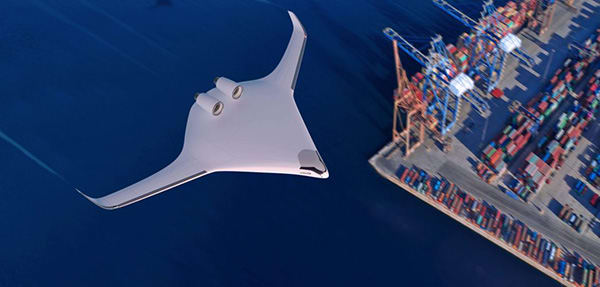
Natilus, Inc., the U.S. company working to democratize global freight transport by making air cargo more competitive, recently announced major milestones in the design and development of its fleet of autonomous aircraft and an important new contract with Collins Aerospace to provide specialized cargo loading systems.
Natilus is offering a family of autonomous cargo aircraft with greater efficiency and cost-savings by innovating the design of freight transport aircraft to increase cargo volume by 60%. This will lower the cost of freight operations by 60% and cut carbon emissions in half.
“Currently, 90% of all goods are transported worldwide via shipping, but 90% of all ‘value goods’ are shipped through air freight – just because of current capacity and cost,” explained Aleksey Matyushev, CEO and co-founder of Natilus. “Our goal is to dramatically change this equation through efficiencies of design and operations to make air freight more competitive to capture market share. Our new contract with Collins brings us another step closer to entering the cargo aircraft manufacturing market.”
“Collins Aerospace is a global leader in the design, manufacture and certification of advanced cargo handling systems for commercial aircraft,” said Alison Davidson, vice president and general manager, Cargo/Hoist & Winch for Collins Aerospace. “For the Natilus family of aircraft, we’re adapting proven cargo handling designs with millions of flight hours in service to create a new system that efficiently uses the additional space of the Natilus blended wing design to maximize cargo capacity.”
The Natilus contract with Collins is instrumental in creating efficiencies of operation, including increasing aircraft cargo volume. Collins is designing a specialized Cargo Loading System for the Natilus 3.8T prototype with rolling ball mats, attachments, and standard flip-up latches and will accommodate LD3-New and LD3-45 containers and bulk loads.
The Natilus family of cargo aircraft includes:
8T: 3.8 ton payload short-haul feeder UAV
N60T: 60 ton payload medium/long range UAV
N100T: 100 ton payload long-range UAV
N130T: 130 ton payload long-range UAV
The design of the Natilus 3.8T is complete and has undergone initial wind tunnel testing. Natilus also initiated production of the vertical tails of the N3.8T aircraft, another major milestone in the company’s timeline. Flights are scheduled to begin in 2023.
Natilus aircraft use existing ground infrastructure and standard air cargo containers, as well as offer remote piloting to produce an innovative turnkey solution for its customers. Natilus already has more than $6B in pre-orders.
More From SAE Media Group

Aerospace INSIDER
BAE Systems Acquires Developer of Electric Heavy Lift Quadcopters
Aerospace INSIDER
Joby Aviation Announces Acoustic Data from NASA Testing
Aerospace INSIDER
Two Startups Partner to Expand Hydrogen-Powered Drone Production
Aerospace INSIDER
WATCH: Air Force Research Lab's First Flight of XQ-67A Drone
Defense INSIDER
Sikorsky Converts Black Hawk into U-Hawk Autonomous Helicopter
Aerospace INSIDER
Delta Air Lines, JetZero to Design Commercial Blended Wing Body Airliner
Motion Design INSIDER
Tailless Jet Flies Free with Novel Control Technique
Motion Design INSIDER
Extending Quadcopter Flight Time — By Adding Wings
Aerospace INSIDER
Quarterhorse Hypersonic Test Aircraft Completes First Flight
Aerospace INSIDER
XQ-67A's First Flight Shows 'Genus' Approach to Aircraft Design
Tech Briefs
5Ws of the Wingless Transporter
Aerospace INSIDER
Air Force Researchers Design, Build and Fly Drone in 24 Hours
NASA Spinoff
From Shark Searches to Space Tours
Aerospace INSIDER
Hermeus Rolls Out First Quarterhorse Hypersonic Test Aircraft
Aerospace INSIDER
MQ-1C Completes First Air-Launched Effect Flight Demonstration
Aerospace & Defense Tech Briefs
1 Megawatt Turbogenerator
Tech Briefs
Anti-Phase Noise Suppression Rotor Technologies
NASA Spinoff
Swinging the HAMR

Defense INSIDER
AFWERX Tests Alternative Navigation System on Osprey MK III
Aerospace & Defense Tech Briefs
High-Speed Vertical Take-Off and Landing Craft
Aerospace INSIDER
German Air Force Starts Flight Testing New Heron ISR Drone
Aerospace INSIDER
Paris Air Show: New Aerospace Technologies, Updates and Research

Motion Design INSIDER
AI-Powered Vision System Helps Drones Navigate Safely
Top Stories
INSIDERDefense
 New Raytheon and Lockheed Martin Agreements Expand Missile Defense Production
NewsAutomotive
 Ford Announces 48-Volt Architecture for Future Electric Truck
INSIDERManufacturing & Prototyping
 Active Strake System Cuts Cruise Drag, Boosts Flight Efficiency
ArticlesTransportation
 Accelerating Down the Road to Autonomy
INSIDERMaterials
 How Airbus is Using w-DED to 3D Print Larger Titanium Airplane Parts
Road ReadyTransportation

Webcasts
Electronics & Computers
 Cooling a New Generation of Aerospace and Defense Embedded...
Power
 Battery Abuse Testing: Pushing to Failure
Connectivity
 A FREE Two-Day Event Dedicated to Connected Mobility
Automotive
 Quiet, Please: NVH Improvement Opportunities in the Early Design Cycle
Transportation
 Advantages of Smart Power Distribution Unit Design for Automotive &...
Aerospace
 Sesame Solar's Nanogrid Tech Promises Major Gains in Drone Endurance