




Automotive Engineering - November 2016
Inside this issue
Overview
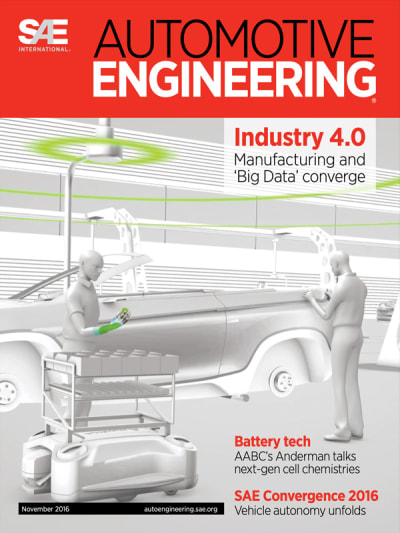
The November 2016 issue of Automotive Engineering presents a comprehensive overview of the latest trends and advancements in the automotive industry, focusing on electrification, autonomy, and the integration of advanced technologies. The issue highlights key discussions from the SAE Convergence 2016 conference, where industry leaders gathered to explore the future of automotive engineering.
Keynote Insights and Industry Perspectives: The issue opens with insights from Raj Nair, Executive Vice President of Product Development and Chief Technical Officer at Ford, who emphasized the importance of consumer-focused innovation. The conference served as a platform for high-level discussions on various topics, including human-machine interfaces and supply-chain transformations. A significant theme was the imminent arrival of autonomous vehicles, with industry executives expressing optimism about their deployment in the near future. Jeff Owens, Chief Technology Officer at Delphi, and Ken Washington, Vice President at Ford, both asserted that fully autonomous vehicles could be on the roads as early as 2021, aligning with the SAE’s J3016 standard.
General Motors is also making strides in autonomous technology, with Jon Lauckner, GM’s Vice President and CTO, noting ongoing public road testing in cities like San Francisco and Scottsdale. The consensus among panelists was that the timeline for autonomous vehicles is much shorter than skeptics suggest, with a focus on rapid development and deployment rather than prolonged testing phases.
Technological Innovations: The issue features a variety of technological advancements, including Nissan's unveiling of a variable-compression-ratio internal combustion engine (ICE) for the 2018 Infiniti production model. This innovation represents a significant step in optimizing engine performance and efficiency. Additionally, the magazine discusses the ongoing search for higher-energy-content batteries, which are crucial for the future of electric vehicles (EVs) and hybrid systems.
The integration of intelligent systems and Big Data analytics in manufacturing processes is another focal point. The concept of Industry 4.0 is explored, highlighting how smart factories are transforming the production landscape by improving quality, safety, and efficiency. The use of advanced analytics and connectivity is set to revolutionize automotive manufacturing, making it more responsive to market demands.
Autonomous Driving and Connectivity: The issue delves deeper into the implications of autonomous driving technologies. While the introduction of these vehicles is anticipated soon, the magazine notes that widespread adoption may take longer due to regulatory, infrastructure, and consumer acceptance challenges. The role of connected car technologies is also discussed, emphasizing the need for robust cybersecurity measures to protect vehicles from potential threats.
Phillip Eyler, Executive Vice President at Harman International, contributed to the discussion by highlighting the importance of driver-interface hardware and software in the transition to autonomous vehicles. The magazine underscores the necessity for automakers and suppliers to collaborate closely to ensure a seamless integration of these technologies into consumer vehicles.
Market Trends and Consumer Expectations: The editorial section reflects on the promise of 48-volt systems in enhancing vehicle efficiency and performance. This technology is seen as a bridge between traditional internal combustion engines and fully electric powertrains, offering automakers a viable path toward electrification without a complete overhaul of existing systems.
The issue also addresses consumer expectations regarding vehicle technology. As consumers become more accustomed to advanced features in their vehicles, automakers must prioritize user-friendly interfaces and reliable performance. The magazine suggests that understanding consumer behavior and preferences will be critical for the successful launch of new technologies.
Conclusion: In summary, the November 2016 issue of Automotive Engineering encapsulates the dynamic landscape of the automotive industry, characterized by rapid technological advancements and a strong push toward electrification and autonomy. The insights from industry leaders at the SAE Convergence conference provide a glimpse into the future of automotive engineering, where innovation and consumer focus will drive the next wave of developments. As the industry navigates the challenges of integrating new technologies, the collaboration between automakers, suppliers, and technology companies will be essential in shaping the future of mobility. The issue serves as a valuable resource for professionals seeking to stay informed about the latest trends and innovations in automotive engineering.
Features
-
Articles
SAE Convergence 2016: Automakers, Suppliers Firm That Autonomous Driving Not Decades Away
Bob Lutz: What Makes a Great Engineer?
Regulars
-
Global Vehicles
Aero-Slick Land Rover Discovery Sheds 1,058 Lb, Gains Features
I.D. Concept Heralds VW’s Electric Bolt Fighter for 2020
-
Technology Reports
Optimizing Engine Oil Warm-Up Strategies for 'Real-World' Driving
In Search of Higher-Energy-Content Batteries
Nissan Unveils 2018 Production Variable-Compression-Ratio ICE
-
Product Briefs
Flying Probe Technology and High Frequency Testing
Bussmann Series Electric Vehicle Fuses
SIDACtor Protection Thyristors
Heavy-Duty LVIT Inductive Linear Position Sensors
PLM Platform for Manufacturing Process Planning
-
What’s Online
Stories
-
News
TULIPP Project Aims to Improve ADAS Image Processing
Design Simplicity Is Key to New 48-V Systems
Nexteer Opens Manufacturing Plant in Pune
Bosch Expands Development Activities in India
Indian JV Offers Engineering Services for BIW Weld Shops
Cameras Are Focal Point at ZF TRW's New Global Tech Center in Michigan
Top Stories
INSIDERManufacturing & Prototyping
 How Airbus is Using w-DED to 3D Print Larger Titanium Airplane Parts
INSIDERManned Systems
 FAA to Replace Aging Network of Ground-Based Radars
NewsTransportation
 CES 2026: Bosch is Ready to Bring AI to Your (Likely ICE-powered) Vehicle
NewsSoftware
 Accelerating Down the Road to Autonomy
EditorialDesign
 DarkSky One Wants to Make the World a Darker Place
INSIDERMaterials
 Can This Self-Healing Composite Make Airplane and Spacecraft Components Last...
Webcasts
Defense
 How Sift's Unified Observability Platform Accelerates Drone Innovation
Automotive
 E/E Architecture Redefined: Building Smarter, Safer, and Scalable...
Power
 Hydrogen Engines Are Heating Up for Heavy Duty
Electronics & Computers
 Advantages of Smart Power Distribution Unit Design for Automotive...
Unmanned Systems
 Quiet, Please: NVH Improvement Opportunities in the Early Design...
