




Cameras Are Focal Point at ZF TRW's New Global Tech Center in Michigan

With its newest work space designated a center of excellence for cameras, ZF TRW underscores the critical role that vision-systems technology plays in automated driving.
“As our Advanced Driver Assistance System (ADAS) business grows, we need to do a higher volume of development and testing. With this new facility, we’re now much better suited to do that work,” said Brian Loh, Senior Vice President of ADAS in the Active & Passive Safety Technology Division.
Loh and other ZF TRW technologists spoke with Automotive Engineering at the opening of the company’s newly opened $30 million Global Electronics Technical Center in Farmington Hills, MI.
The 171,000 ft2 (15,886 m2) center, staffed by more than 600 engineers and support staff, contains 35,000 ft2 (3252ft 2) of lab space for radio frequency, passive and active safety products, including the company’s S-Cam family of cameras in single- and multiple-lens versions.
“This facility is where the technology is being developed for our TriCam, a tri-focal lens camera with near-, mid-, and fisheye views," Loh said. "With the combination of all three of these lenses, the sensing envelope is much broader than a traditional single lens camera.” The TriCam is slated to enter production in mid-2018 for application on vehicles with automated driving capability.
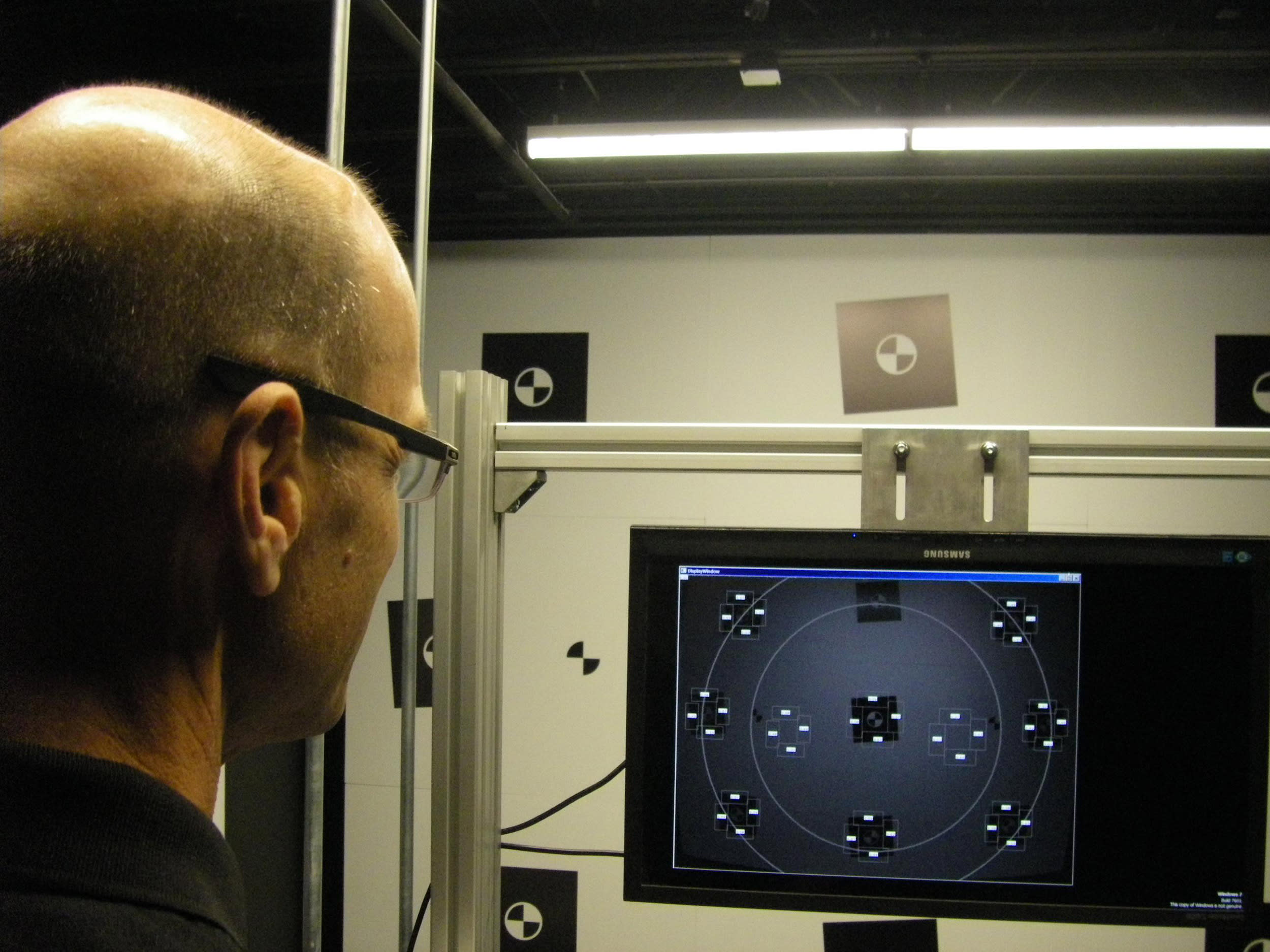
As the only R&D lab of its kind within ZF TRW, the electronics tech center’s optics-target room enables technical specialists to access a camera’s focus and alignment, according to Mike Babala, Senior Technical Specialist for Optics Engineering.
“Our job in the core optics group is to make sure everything in front of the lens, which is object-based, gets accurately represented behind the lens, which is image space,” Babala explained.
The optics target room is a highly controlled environment, unlike the supplier’s former work space in a converted garage bay. “In the past we had to take special care to be sure that stray light didn’t enter the room from underneath the doors or walls and cause glare on the optic wall targets during measurements,” Babala said, adding, “There’s no stray light in this light-tight lab.”
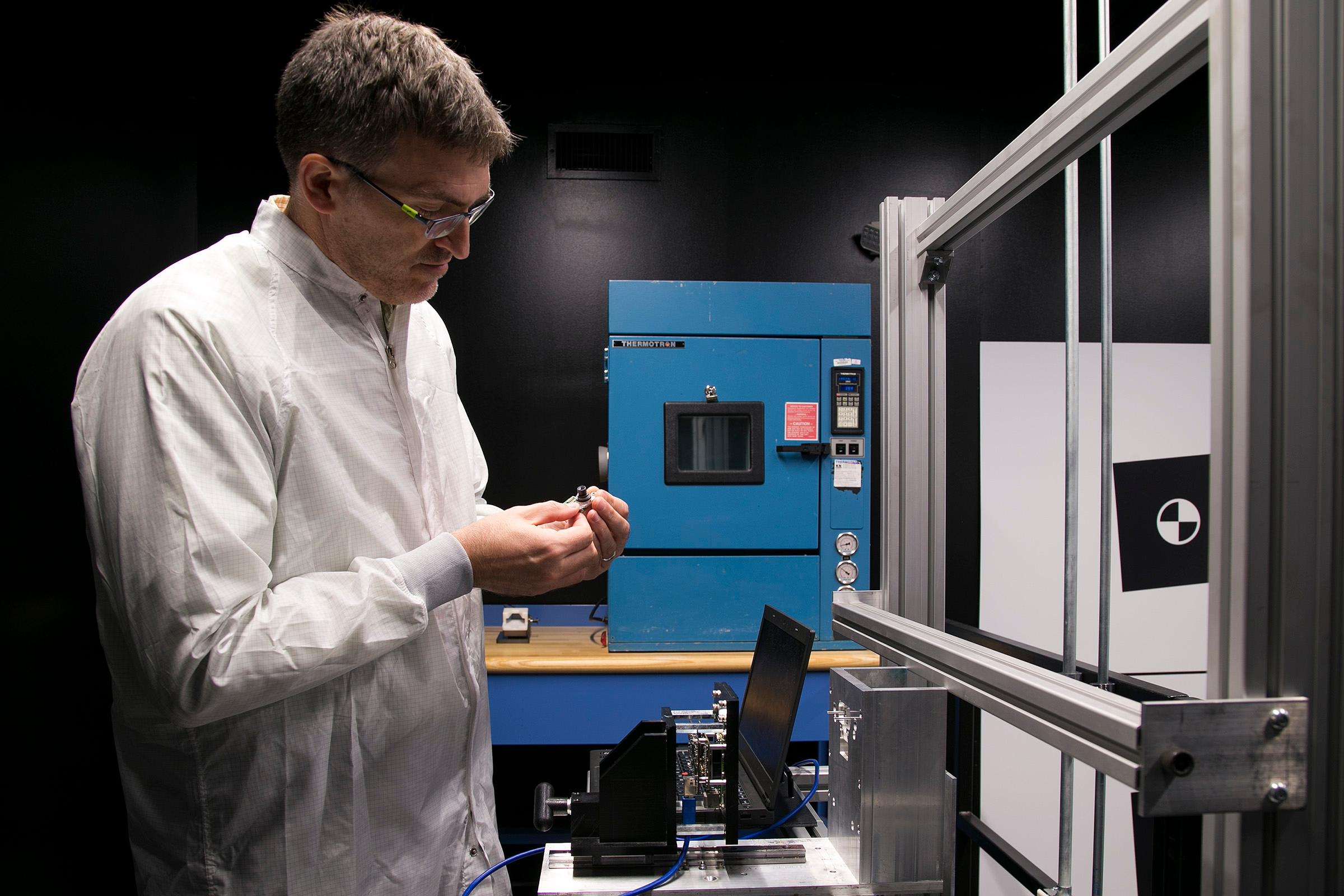
Raad Konja, Director of ADAS Engineering, said developing a robust and reliable camera system relies on repeatable measurements. “Everything is standardized, so there’s no drift from test to test. The only thing that needs to change are the improvements that we drive into our optical path, which is comprised of a lens, an imager, and the technology that converts the images into electronics,” Konja said.
For the purpose of systems development, the engineers are using four Opel Insignia vehicles equipped with ZF TRW braking and steering. "We’ve added long- and short-range radars and a forward-looking camera with everything cooperatively operating on internally developed algorithms,” Loh said. The cars' SAE Level 2 technologies permit hands-free steering and foot-off pedal control at highway speeds, including lane changes prompted by the driver using the turn indicator.
The roadmap for ZF TRW engineers is to take these R&D cars to SAE Levels 3 and 4 capability. “We’re adding more sophisticated sensors, and now with our 40% stake in Ibeo Automotive Systems GmbH we’re working to add solid-state LiDAR,” Loh said.
Media who attended the new facility's opening were given the opportunity to ride with Andrew Whydell, the company's Director of Product Planning and Strategy for Vehicle Systems, which includes the company’s automated driving activities.
“We’re demonstrating technologies that are close to production, and I would say around 2018 you’ll start to see these technologies in the U.S. on passenger vehicles,” Whydell said while the Insignia was traveling at highway speeds on a metro Detroit expressway in its SAE Level 2 automated mode.
More From SAE Media Group
Off-Highway Engineering
Forward-Looking Lidar Can Revolutionize Driver-Assistance Systems
Automotive Engineering
Nissan's ProPILOT Assist Is More Than Lane-Keeping
Automotive Engineering
SAE Publishes Terminology Standard for Automated Driving Systems

Automotive Engineering
Intel Inside the Cloud-Based Data Future
Automotive Engineering
Harman Advanced Concept Brings Intuitive HMI to Automated Driving
Automotive Engineering
Nader: Are Glitch-Free Autonomous Vehicles Possible?
Off-Highway Engineering
Autonomous Trucking Tech Hits High Gear
Automotive Engineering
Integrated Electronic Stability Control
Autonomous Vehicle Engineering
Platform-Agnostic Interface Aims to Accelerate Truck Autonomy
Off-Highway Engineering
Level 1 Automated Driving Coming to Class 8 Truck Fleets
Automotive Engineering
BorgWarner Prepares Manual Gearchange for ADAS Vehicles
Automotive Engineering
JLR Sheds Light on R&D Projects in Advanced HMI, Automated Driving
Automotive Engineering
CES 2025 Preview: All the Tech That’s Fit to Print
Automotive Engineering
Sensor Fusion Expanding in Step with Advancing Vehicle Sophistication
Autonomous Vehicle Engineering
ZF’s Autonomous Systems Head Takes a Pragmatic View of the ‘Levels’ Playing Field
Automotive Engineering
Artificial Intelligence Becomes a Reality
Autonomous Vehicle Engineering
Predicting the Road to Efficiency
Autonomous Vehicle Engineering
The Future of Automated Vehicle Cabins
Autonomous Vehicle Engineering
'Level 2+': Making Automated Driving Profitable, Mainstream
Off-Highway Engineering
Volvo Trucks, FedEx Demonstrate 3-Truck Platoon on North Carolina Highway
Off-Highway Engineering
Daimler Truck and Torc Intensify Pursuit of Autonomous Trucks
Automotive Engineering
Are Today’s Sensors Ready for Next-Level Automated Driving?
Autonomous Vehicle Engineering
Hopeful but Closer Scrutiny for SAE Level 4 Automation
ADAS & Autonomous Vehicle Engineering
Automated Driving’s Journey: One Step Forward…
Autonomous Vehicle Engineering
Navigating the Language of Vehicle Autonomy
Automotive Engineering
Chassis Brakes International Debuts First NA-Produced Products
ADAS & Autonomous Vehicle Engineering
Automated Driving in Italy’s 1,000 Miglia Rally
Automotive Engineering
Taking ‘Eyes-Off’ the ADAS Future
ADAS & Autonomous Vehicle Engineering
Tesla’s FSD Recall Impacts AV Industry
Top Stories
INSIDERManufacturing & Prototyping
 How Airbus is Using w-DED to 3D Print Larger Titanium Airplane Parts
INSIDERManned Systems
 FAA to Replace Aging Network of Ground-Based Radars
NewsTransportation
 CES 2026: Bosch is Ready to Bring AI to Your (Likely ICE-powered) Vehicle
NewsSoftware
 Accelerating Down the Road to Autonomy
EditorialDesign
 DarkSky One Wants to Make the World a Darker Place
INSIDERMaterials
 Can This Self-Healing Composite Make Airplane and Spacecraft Components Last...
Webcasts
Defense
 How Sift's Unified Observability Platform Accelerates Drone Innovation
Automotive
 E/E Architecture Redefined: Building Smarter, Safer, and Scalable...
Power
 Hydrogen Engines Are Heating Up for Heavy Duty
Electronics & Computers
 Advantages of Smart Power Distribution Unit Design for Automotive...
Unmanned Systems
 Quiet, Please: NVH Improvement Opportunities in the Early Design...
