




JLR Sheds Light on R&D Projects in Advanced HMI, Automated Driving
Jaguar Land Rover (JLR) has tugged hard on its veil of technology secrecy to reveal a raft of R&D projects that are part of the automaker's recently announced $3.5B investment in new-product creation. Besides what company officials term “a major new car” every six months, there are up to 50 “major production actions” (including the new Ingenium modular engine program; see "JLR's All-New 2015 Modular Engines Feature Roller-Bearing Cams, Balance Shaft") over the next five years.

JLR is placing great emphasis on its huge R&D investment. R&D Director Dr. Wolfgang Epple revealed several programs, some of which will remain in the lab, but many others will make production, he said. As well as U.K. facilities, JLR has an U.S. R&D center in Portland, OR, close to Intel’s facility.
Laser (or "coherent light systems") work covers headlight applications, road marking for warning signals, and a system dubbed Laser Wade Aid that can measure water depth before a vehicle even gets its front tires wet.
The human-machine interface (HMI) is a priority and includes the use of self-learning algorithm systems to anticipate driver and passenger requirements ranging from infotainment to diary dates. “The aim of our self-learning car technology is to minimize driver distraction,” said Epple.

Gesture control using e-field sensing is also under development at JLR for such things as sat nav. Epple said the company's technology features "carefully calibrated motion sensors.”
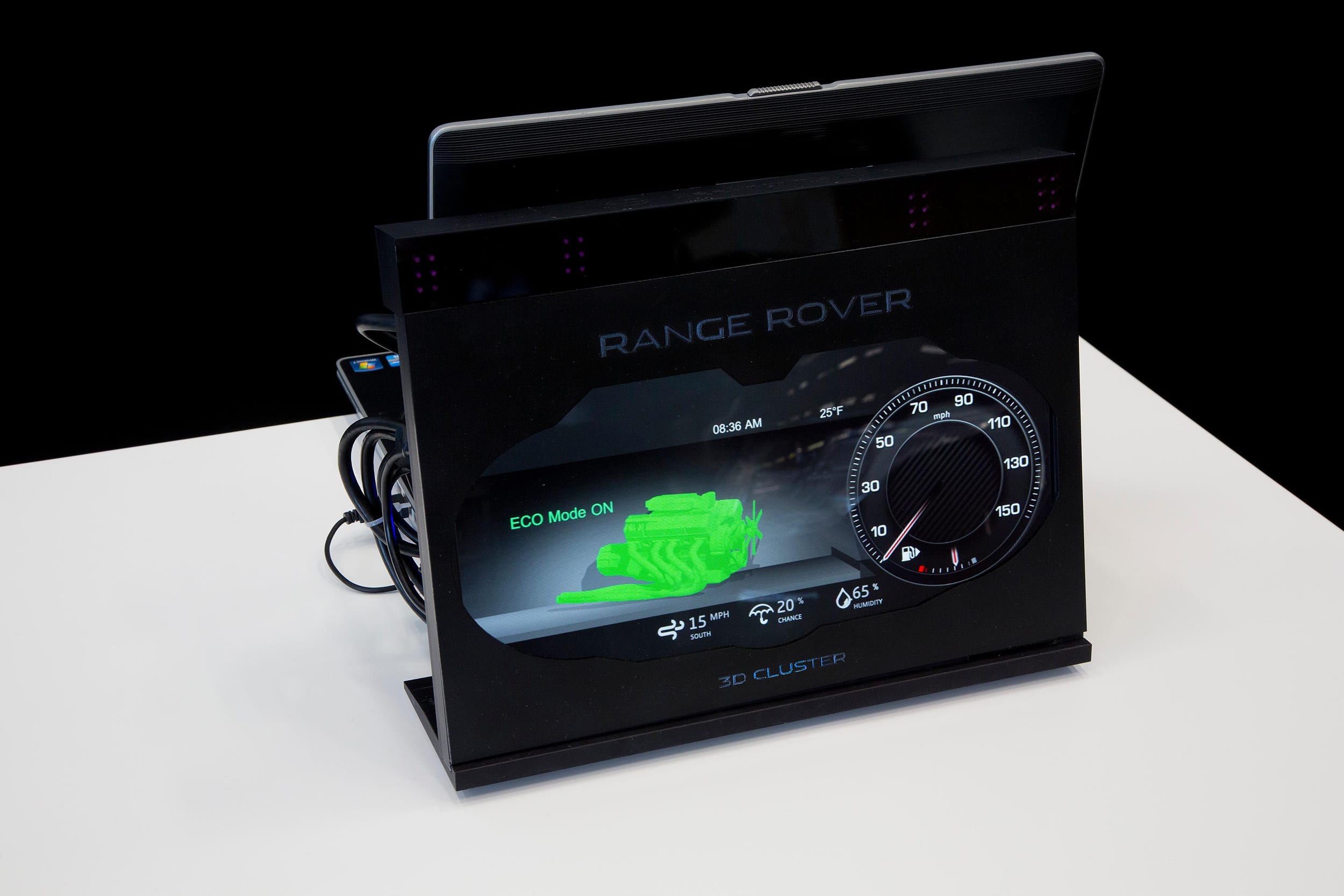
JLR also unveiled a 3-D instrument cluster using head and eye tracking technology via mini cameras. Software adjusts the image projection to create a three-dimensional effect by feeding each eye two slightly differing angles of an image; 3D eyeglasses are not necessary. It took this Automotive Engineering editor’s eyes just a moment to adjust to such interesting technology, which could also be used to replace rear-view mirrors, as it facilitates driver judgment of speed and distance.
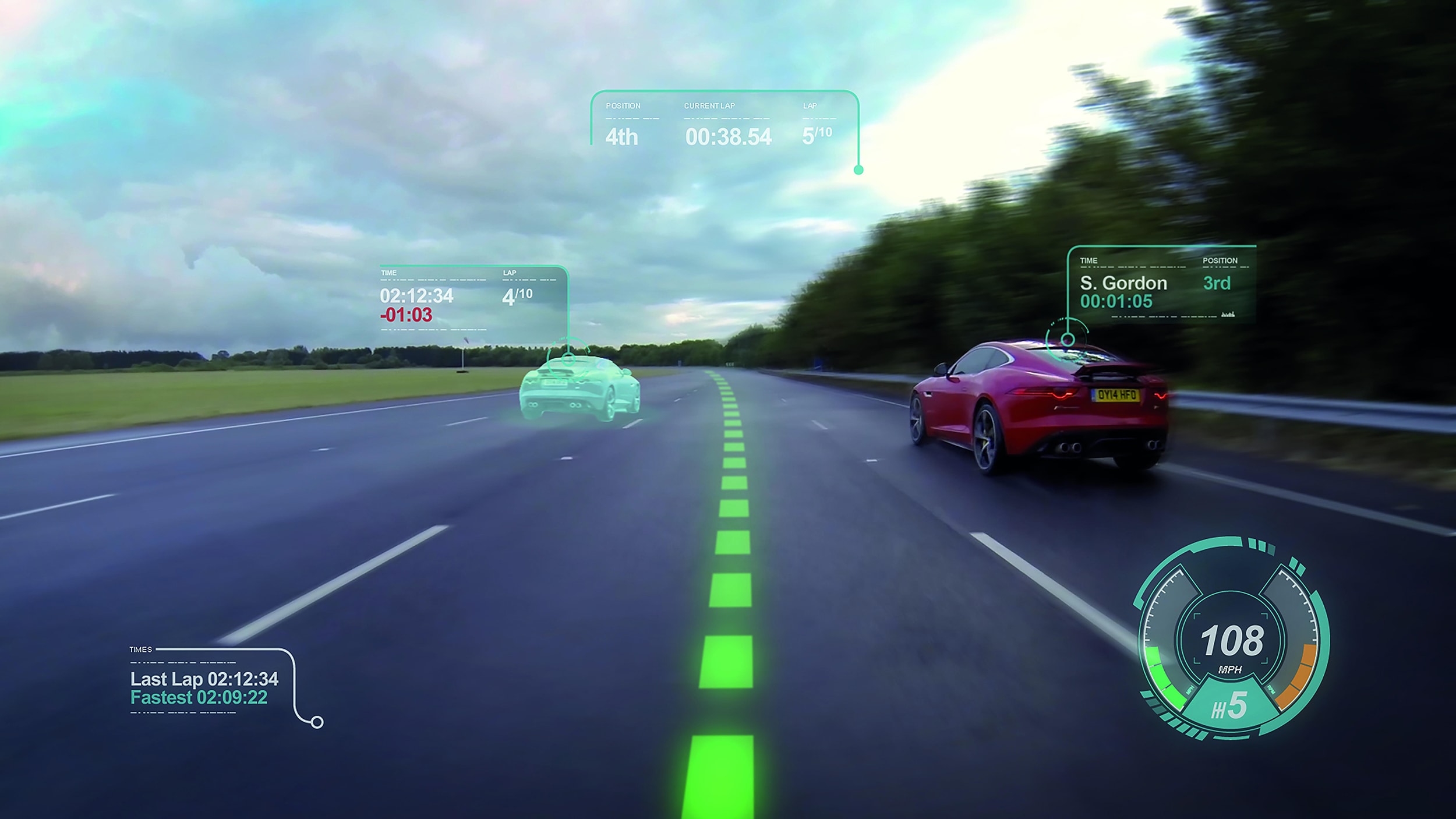
An extraordinary project revealed by Dr. Epple is the Jaguar Virtual Windshield. Instead of a small head-up image, the whole windshield becomes a display. From the aspect of safety, hazard warning, speed, and navigation icons could be projected, but as a performance car manufacturer, Jaguar sees other possibilities including a track application, which engineers demonstrated.
Symbols on the screen show the racing line to take through corners. Braking points are also clearly marked. It is also possible to virtually project another car ahead as a “specter image” to bring an element of added competition into the drive.
The system also lends itself to test work. Virtual cones can be displayed on the windshield to form a slalom pattern and the car actually driven round them. It saves on labor; the virtual cones do not need to be stood up again when clipped by aggressive or careless drivers.
JLR is giving no firm indication of whether the system will be offered on a production car and whether they have a supplier able to meet the necessary criteria. Dr. Epple regards the Virtual Windshield system as potentially giving a driver improved information “to enhance the driving experience” and to keep eyes focused outside the vehicle.
He added: “By presenting the highest quality imagery possible, a driver need only look at a display once. Showing virtual images that allow the driver to accurately judge speed and distance will enable better decision-making and offer real benefits for everyday driving on the road or the track.”
Autonomous, or highly automated, driving is also very much on JLR’s R&D “to do” list as part of its Intelligent Driving program.
Further tugs by JLR on its veil of secrecy are expected and anticipated with great curiosity.
More From SAE Media Group
Off-Highway Engineering
Forward-Looking Lidar Can Revolutionize Driver-Assistance Systems
Automotive Engineering
Integrated Electronic Stability Control
Automotive Engineering
Nissan's ProPILOT Assist Is More Than Lane-Keeping
Automotive Engineering
Harman Advanced Concept Brings Intuitive HMI to Automated Driving
Automotive Engineering
SAE Publishes Terminology Standard for Automated Driving Systems
Automotive Engineering
BorgWarner Prepares Manual Gearchange for ADAS Vehicles
Automotive Engineering
Cameras Are Focal Point at ZF TRW's New Global Tech Center in Michigan
Off-Highway Engineering
Level 1 Automated Driving Coming to Class 8 Truck Fleets
Automotive Engineering
Nader: Are Glitch-Free Autonomous Vehicles Possible?
Automotive Engineering
CES 2025 Preview: All the Tech That’s Fit to Print
Automotive Engineering
Intel Inside the Cloud-Based Data Future

Off-Highway Engineering
Autonomous Trucking Tech Hits High Gear
Autonomous Vehicle Engineering
Platform-Agnostic Interface Aims to Accelerate Truck Autonomy
Autonomous Vehicle Engineering
Predicting the Road to Efficiency
Off-Highway Engineering
Daimler Truck and Torc Intensify Pursuit of Autonomous Trucks
Off-Highway Engineering
Volvo Trucks, FedEx Demonstrate 3-Truck Platoon on North Carolina Highway
Automotive Engineering
Chassis Brakes International Debuts First NA-Produced Products
Automotive Engineering
Sensor Fusion Expanding in Step with Advancing Vehicle Sophistication
Automotive Engineering
Artificial Intelligence Becomes a Reality
Autonomous Vehicle Engineering
The Future of Automated Vehicle Cabins
Automotive Engineering
Self-Parking Vehicle Via Valeo Valet
Autonomous Vehicle Engineering
ZF’s Autonomous Systems Head Takes a Pragmatic View of the ‘Levels’ Playing Field
Autonomous Vehicle Engineering
Hopeful but Closer Scrutiny for SAE Level 4 Automation
Automotive Engineering
Preview: SAE 2021 WCX
Autonomous Vehicle Engineering
Purpose, Perceptions for Driver-Assist Tech Solidify
Automotive Engineering
Are Today’s Sensors Ready for Next-Level Automated Driving?
Off-Highway Engineering
Peloton CEO Talks Level 4 ‘Automated Following’
Automotive Engineering
New-Mobility Visionary Burns: Automated Driving ‘Getting Close’
Automotive Engineering
MOIA’s L4 ID. Buzz AVs Starting Service Next Year
Top Stories
INSIDERManufacturing & Prototyping
 How Airbus is Using w-DED to 3D Print Larger Titanium Airplane Parts
INSIDERManned Systems
 FAA to Replace Aging Network of Ground-Based Radars
NewsTransportation
 CES 2026: Bosch is Ready to Bring AI to Your (Likely ICE-powered) Vehicle
NewsSoftware
 Accelerating Down the Road to Autonomy
EditorialDesign
 DarkSky One Wants to Make the World a Darker Place
INSIDERMaterials
 Can This Self-Healing Composite Make Airplane and Spacecraft Components Last...
Webcasts
Defense
 How Sift's Unified Observability Platform Accelerates Drone Innovation
Automotive
 E/E Architecture Redefined: Building Smarter, Safer, and Scalable...
Power
 Hydrogen Engines Are Heating Up for Heavy Duty
Electronics & Computers
 Advantages of Smart Power Distribution Unit Design for Automotive...
Unmanned Systems
 Quiet, Please: NVH Improvement Opportunities in the Early Design...
