




First-Of-Its Kind High-Volume Production Cell Set to Start Producing Competitive CNG Tanks for Auto Industry

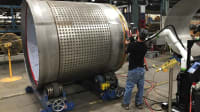
Composite machine manufacturer Mikrosam delivered a fully automated filament winding line for CNG tanks to automotive supplier Magna’s Austria plant. According to the Macedonian company, this high-volume production cell was invented for manufacturing a cost-effective, lightweight CNG tank module. Using filament winding technology and application of composite materials produced an alternative propulsion system that would result in reduction of car weight up to 50%, as well as 40% lower fuel expenses, claims Mikrosam.
The filament-winding technology also has the potential, when used in high volume, to reduce manufacturing cost of composite pressure tanks needed for both compressed natural gas (CNG) and hydrogen—for years an impediment to the introduction of high-pressure gaseous fuels for automotive use. The current price of such tanks is, of course, many times that of incumbent stamped-steel or blow-molded plastic gasoline tanks.
The fully integrated solution consists of multi-spindle filament winding machines with Mikrosam cut-and-restart patented solution for automated cut and restart of the fibers tape during winding process; automatic handling operations of the liners or winded tanks and cured tanks between numerous equipment units in the production process; and sophisticated curing oven that matches curing requirements of different resin systems.
The machine is equipped with two winding carriages: one carriage for winding of main composite structure and one carriage for winding of outer protective layer, so that full continuous production of the CNG tanks is realized on the same machine in a single winding cycle. In total, there are 24 servomotor-controlled axes integrated in the filament winding machine itself, which, according to Mikrosam, makes it probably one of the most advanced winding machines in the world built to date.
What makes this production line unique, says the company, is the flexibility to change the production cycle from one tank size to another. When this is required, all programs, and mechanical and electrical parts, are automatically adjusted to the different CNG tanks sizes that are necessary to be produced.
The opportunity to make these changes, as well as adjust the capacity of each single equipment station, quickly increases productivity of the overall production line, reports Mikrosam.
More From SAE Media Group
Tech Briefs
Calibration System for Automated Fiber Placement

Tech Briefs
2025 Award Finalists

Robotics & Automation INSIDER
Gripper Robot Can Grasp Objects from Very Fine to Large

Tech Briefs
Lasers Assemble Miniature Robots from Bubbles

Medical Design Briefs
How Automation Can Improve Tubing Manufacturing
Motion Design
Reducing Plasma Cutting Cycle Time with a Cobot Cutter
Motion Design
Origami Inspires Shape-Shifting ‘Transformer Bots’

Motion Design
Cobot Cuts Cost and Risk While Boosting On-Time Delivery
Motion Design
New Products
Motion Design INSIDER
Machine Intelligence to Build Soft Machines
Tech Briefs
Robotic Assembly of Photovoltaic Arrays
Aerospace & Defense Tech Briefs
European Researchers Leverage AI in Manufacturing Rocket Parts
Aerospace & Defense Tech Briefs
Laser Cleaner Robot
Motion Design
Small Shape-Shifting Miniature Robot with Big Impact
Tech Briefs
Single-Step 3D-Printing Process to Build Robots
Medical Design Briefs
Video Spotlight on Products and Services

Motion Design
When Cobots Make a Manufacturing Difference
Medical Design Briefs INSIDER
MD&M South Debuts in Charlotte, NC
Top Stories
INSIDERManufacturing & Prototyping
 How Airbus is Using w-DED to 3D Print Larger Titanium Airplane Parts
INSIDERManned Systems
 FAA to Replace Aging Network of Ground-Based Radars
NewsTransportation
 CES 2026: Bosch is Ready to Bring AI to Your (Likely ICE-powered) Vehicle
NewsSoftware
 Accelerating Down the Road to Autonomy
EditorialDesign
 DarkSky One Wants to Make the World a Darker Place
INSIDERMaterials
 Can This Self-Healing Composite Make Airplane and Spacecraft Components Last...
Webcasts
Defense
 How Sift's Unified Observability Platform Accelerates Drone Innovation
Automotive
 E/E Architecture Redefined: Building Smarter, Safer, and Scalable...
Power
 Hydrogen Engines Are Heating Up for Heavy Duty
Electronics & Computers
 Advantages of Smart Power Distribution Unit Design for Automotive...
Unmanned Systems
 Quiet, Please: NVH Improvement Opportunities in the Early Design...
