




Automotive Engineering - October 2018

Inside this issue
Supplements
Overview
This issue of Automotive Engineering magazine features a range of topics that reflect the current trends and challenges in the automotive industry. The editorial section, led by Bill Visnic, discusses the relationship between original equipment manufacturers (OEMs) and their suppliers, highlighting how often these partnerships go unnoticed despite their critical importance in the development of automotive technologies.
One of the key themes in this issue is the evolution of mobility solutions, particularly the concept of "first mile/last mile" mobility. This term refers to the challenges of transportation that occur at the beginning and end of a journey, which are often overlooked in discussions about public transit and urban planning. The editorial comments from readers express a mix of opinions on the state of mobility solutions, with some advocating for more responsible use of public spaces like sidewalks.
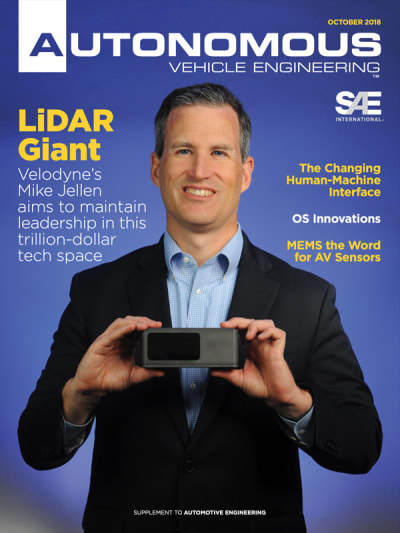
The magazine also delves into the advancements in LiDAR technology, which has gained significant traction in the automotive sector, especially in the context of autonomous vehicles. A feature article discusses how nearly 100 companies are competing to develop automotive-grade LiDAR sensors that are not only effective but also affordable and compact. This technology is seen as a crucial component in providing vehicles with enhanced perception capabilities, akin to giving them a "new set of eyes."
In addition to LiDAR, the issue covers various innovations in automotive engineering, including developments in electric vehicles (EVs) and hybrid technologies. The editorial team emphasizes the importance of engineering solutions that are both sustainable and efficient, reflecting the industry's shift towards greener technologies. The magazine highlights the ongoing research and development efforts aimed at improving battery technologies, charging infrastructure, and overall vehicle efficiency.
The issue also features reader feedback on recent vehicle models, including the 2017 Toyota Tacoma and the Honda Ridgeline. Readers express their thoughts on the practicality and design of these vehicles, showcasing the diverse preferences and needs of consumers in the automotive market. The discussions reveal a desire for vehicles that balance functionality with modern design, catering to a wide range of lifestyles and use cases.
Moreover, the magazine includes insights into the role of organizations like SAE International in shaping the future of automotive engineering. The editorial team notes that SAE is taking a more analytical approach to address the changing landscape of the industry, aiming to provide greater value to the technical community. This includes developing new products and activities based on recent research, which is crucial for keeping pace with rapid technological advancements.
The issue also touches on the importance of collaboration between different stakeholders in the automotive sector, including manufacturers, suppliers, and regulatory bodies. The need for a cohesive approach to address challenges such as safety, emissions, and technological integration is emphasized, as these factors are critical for the industry's future.
In summary, this issue of Automotive Engineering magazine provides a comprehensive overview of the current state of the automotive industry, focusing on key trends such as mobility solutions, LiDAR technology, electric vehicles, and the evolving role of engineering organizations. Through a combination of editorial insights, reader feedback, and feature articles, the magazine captures the dynamic nature of the automotive landscape and the ongoing efforts to innovate and adapt in a rapidly changing environment.
Features
-
Articles
BorgWarner’s Dual-Volute Turbocharger Enables First-Ever 4-Cylinder Power for GM Fullsize Pickups
Regulars
-
Editorial
-
SAE Standards News
Battery-Size Standards Technical Information Report Available
-
Supplier Eye
-
The Navigator
-
What We're Driving
2018 Mercedes-Benz A200 AMG Line
-
Technology Reports
Mercedes Doubles down on Electric Vans, Considers Fuel Cells
Autonomous Vehicles Present Passive-Safety Challenges
Tackling the Lubrication Challenges of Electric Vehicles
OEMs Add Functional Engineering as Digital Tools Evolve
-
Road Ready
2019 Toyota Corolla Injects Sport, Adds Hatchback
2019 Honda Pilot Gets Refined 9-Speed, Tougher Styling and Standard Safety Suite
Subaru 'Ascends' New Three-Row SUV on Global Platform
With 2019 Sierra, GMC Puts Brand Differentiation Behind It—literally
Stories
Top Stories
INSIDERDefense
 New Raytheon and Lockheed Martin Agreements Expand Missile Defense Production
NewsAutomotive
 Ford Announces 48-Volt Architecture for Future Electric Truck
INSIDERManufacturing & Prototyping
 Active Strake System Cuts Cruise Drag, Boosts Flight Efficiency
ArticlesTransportation
 Accelerating Down the Road to Autonomy
INSIDERMaterials
 How Airbus is Using w-DED to 3D Print Larger Titanium Airplane Parts
Road ReadyTransportation

Webcasts
Electronics & Computers
 Cooling a New Generation of Aerospace and Defense Embedded...
Power
 Battery Abuse Testing: Pushing to Failure
Connectivity
 A FREE Two-Day Event Dedicated to Connected Mobility
Automotive
 Quiet, Please: NVH Improvement Opportunities in the Early Design Cycle
Transportation
 Advantages of Smart Power Distribution Unit Design for Automotive &...
Aerospace
 Sesame Solar's Nanogrid Tech Promises Major Gains in Drone Endurance