




2019 Frankfurt Auto Show: Porsche Unveils Taycan Electric Sedan
Porsche’s first fully-electric model retains much of the Mission E concept’s startling design and delivers on the company’s primary brand identifier: exemplary performance.
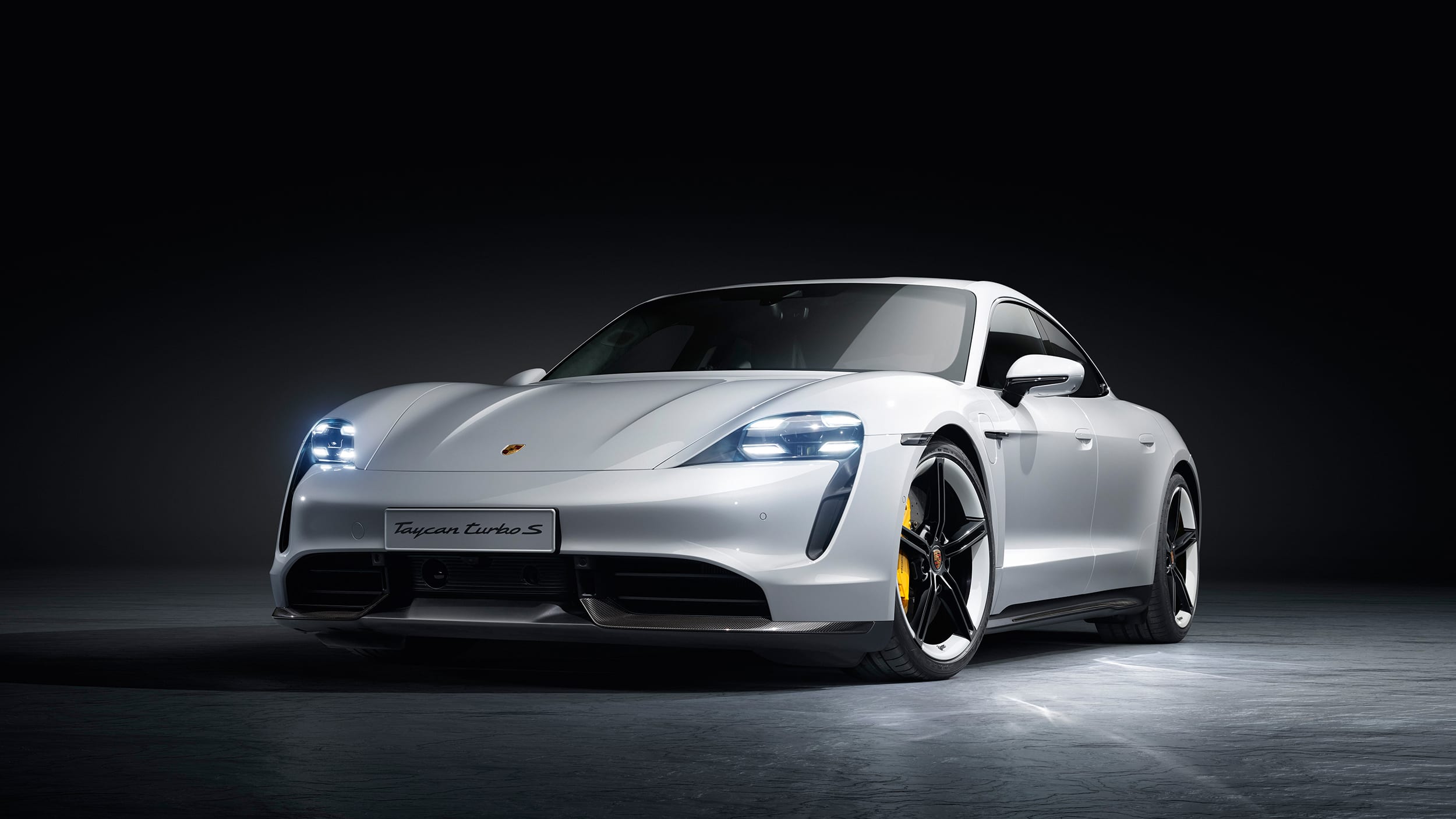
After four years of teasing and meticulously-metered release of technical details, Porsche unveiled the production version of its Taycan electric vehicle (EV) at this week’s Frankfurt motor show. Porsche’s fast and expensive 4-door competitor to the Tesla Model S is scheduled to be in European showrooms later this year and in the U.S. in early 2020.
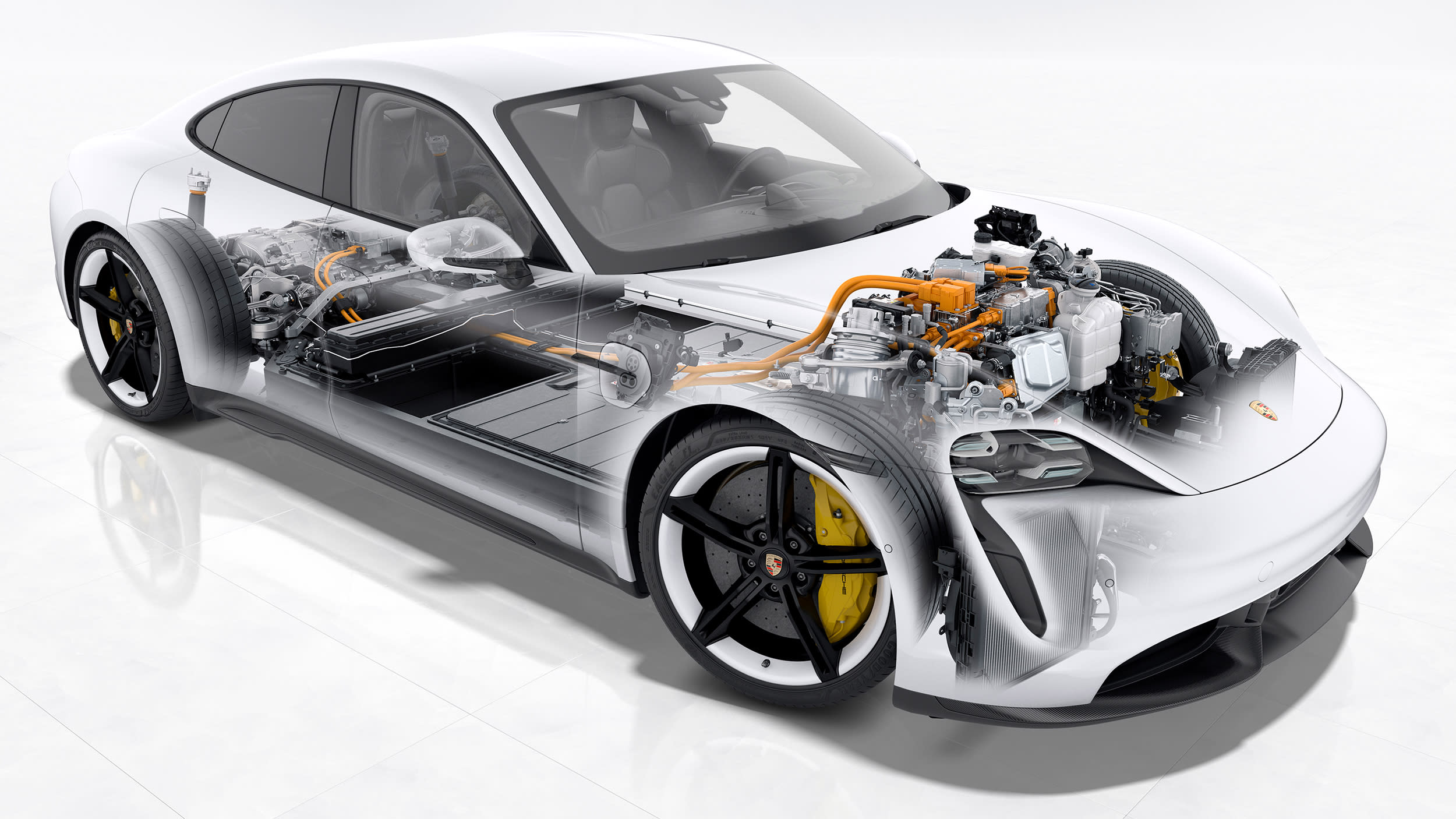
Launching with two variants, the Turbo and Turbo S, the Taycan’s curvaceous sheetmetal is satisfyingly loyal to the Mission E concept car that presaged the Taycan when it was unveiled at the Frankfurt show in 2015. Although it is based on an all-new EV platform, the Taycan’s exterior dimensions—overall length of 195.4 in. (4963 mm), wheelbase of 114.2 in. (2900 mm) and width of 77.4 in (1966 mm)—are quite similar to Porsche’s current 4-door sedan, the Panamera.
But with just over 94 kWh of capacity from the 396 pouch-type lithium-ion batteries of the Performance Battery Plus (insinuating lower-capacity battery packs are probable for lower-specification variants) even a multi-material steel and aluminum body-in-white cannot disguise the Taycan’s Turbo S's stupendous listed curb weight of 2,295 kg (5060 lb).
Performance priority
The primary difference between the Taycan Turbo and the Turbo S is total power output from the twin permanent-magnet electric motors, one for each axle. Porsche said the Turbo generates maximum power (in launch-control mode) of 500 kW (670 hp) and the Taycan Turbo S raises system output to 560 kW (751 hp) and 1050 Nm (774 lb-ft). Apart from delivering on the baseline EV goal of zero tailpipe emissions, the brand’s brief is for the Taycan to uphold the performance credentials established by its internal-combustion history; thus even at two-and-a-half tons, the Taycan Turbo S can hammer from 0-to-62 mph (100 km/h) in 2.8 s. The Turbo variant needs just 3 s to accomplish the feat and top speed for either model, said Porsche, is 260 km/h (161 mph).
The company confirmed less-powerful and rear-drive variants will follow.
Meanwhile, the company listed the power efficiency of the Taycan Turbo at 26 kWh/100 km and the Turbo S model at a slighter higher draw of 26.9 kWh/100 km. In the all-important metric of driving range, the Taycan Turbo’s maximum—based on the European Worldwide Light-vehicle Test Procedure (WLTP)—is 450 km (279 miles) and 412 km (256 miles) for the Turbo S. When certified in the U.S., the Taycan’s rated driving range is almost certain to be markedly reduced. This comparatively abbreviated range is well short of the 370-mile (595-km) maximum for the long-range variant of Tesla’s Model S and poses the likelihood of Porsche offering longer range in a future Taycan variant.
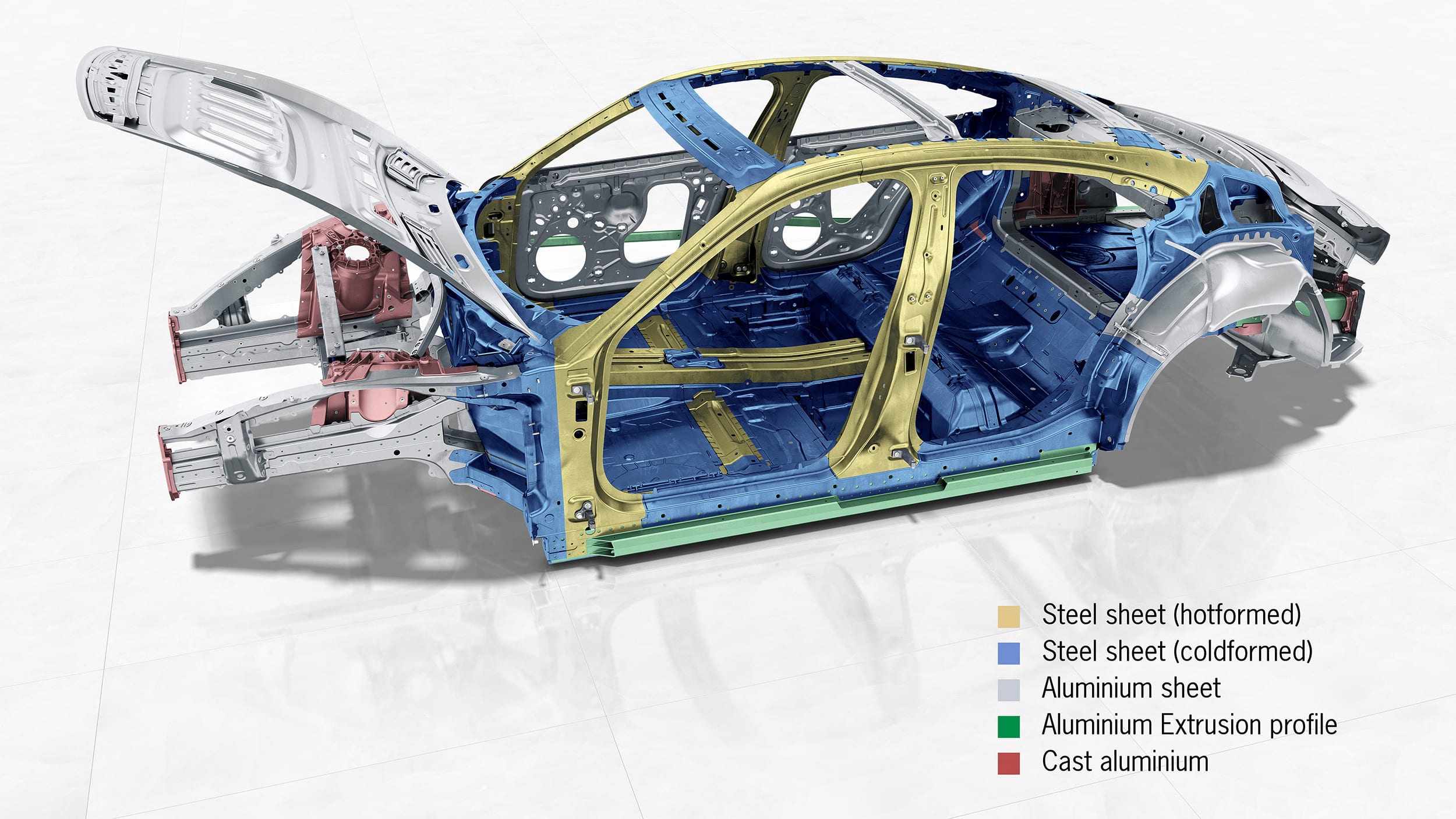
The traction motor for the Taycan’s front axle drives through a single-speed reduction gear, while a two-speed transmission for the rear axle offers optimized acceleration, with the second ratio enabling maximized efficiency, Porsche said.
Electronic torque vectoring, adjustable air suspension and rear-wheel steering are chassis highlights, as well as de rigeuer oversized brakes (despite the fact Porsche said 90% of “everyday” braking can be accomplished with regenerative braking) including the option for Porsche’s now-famous carbon-ceramic brake rotors.
Speedy charging – kinda
Porsche had long promised the Taycan’s industry-first 800-V electrical system and onboard capability for direct-current (DC) fast-charging at up to 350 kW would make for liquid-fuel-rivaling recharging times. But the Taycan is launching with a maximum recharging capability of 270 kW, which the company said offers a recharge time from 95% depleted to 80% charged in 22.5 minutes “under ideal conditions.” Five minutes of such charging can bring 100 km (62 miles) of added range.
More From SAE Media Group
Automotive Engineering
2024 Honda Prologue Is a Cautious Invitation to Drive Electric
Automotive Engineering
Honda E Prototype Makes It Simple, Again
Automotive Engineering
2026 Toyota BZ: Improved, but Still Not a WheeeeeEV
Automotive Engineering
Tuning the 2024 Corvette E-Ray for Exceptional Drivability
Automotive Engineering
Acura’s 2024 ZDX Latest Example of Honda, GM Joint Engineering
Automotive Engineering
Mercedes-Benz EQS Concept: The S-Class of Electric Vehicles?
Automotive Engineering
BMW Engineers for the EV-Transition Reality
Automotive Engineering
Vinfast Needs to Stop Digging
Automotive Engineering
Volkswagen Signals New EV Era with Launch of ID.3
Automotive Engineering
Audi Unveils Production Version of First-Ever EV: E-Tron
Automotive Engineering
2025 Hyundai Ioniq 5 N Makes E-Shift Feel Real
Automotive Engineering
2019 S60 and V60 Volvo’s Newest Chips in the Transformation Game
Automotive Engineering
Bollinger Motors Reveals Second-Gen Class-3 EV Prototypes
Automotive Engineering
Converting Classic Cars Is Just Step One of This Mission
Automotive Engineering
Engineering a ‘Beast’ of an Electric SUV
Automotive Engineering
Dodge Ready with a Sting for the Compact-SUV Market
Automotive Engineering
SAE Launches New Standards Document to Rate Power of Electrified Vehicles
Off-Highway Engineering
JLG Reveals New Electric Telehandler
Automotive Engineering
2025 Lucid Air Review: Unnecessarily Fast, Astonishingly Efficient
Automotive Engineering
Mercedes-Benz Product Boss: Europe, North America EVs, EV Charging to Rapidly Get Better
Automotive Engineering
Cadillac Lyriq Spearheads GM’s EV Assault
Automotive Engineering
NAIAS 2019: Infiniti Debuts QX Inspiration SUV Concept
Automotive Engineering
Elaphe Readies In-Wheel Motors for OEM EVs After 2030
Automotive Engineering
Tremec-Trification
Automotive Engineering
VW Introduces Singular ID.Buzz in Three-Row Layout
Automotive Engineering
Volvo’s Polestar Powerhouse Plug-In Hybrid
Automotive Engineering
Cadillac Counts on 2025 Escalade IQ for EV Sizzle
Automotive Engineering
2021 ID.4 Is Volkswagen’s First U.S.-Market Dedicated EV
Automotive Engineering
Toyota Punches up the Prius
Automotive Engineering
Mazda’s 2024 CX-90 Offers Turbo I-6, PHEV Propulsion
Top Stories
NewsRF & Microwave Electronics
 Microvision Aquires Luminar, Plans Relationship Restoration, Multi-industry Push
INSIDERAerospace
 A Next Generation Helmet System for Navy Pilots
INSIDERDesign
 New Raytheon and Lockheed Martin Agreements Expand Missile Defense Production
INSIDERMaterials
 How Airbus is Using w-DED to 3D Print Larger Titanium Airplane Parts
NewsPower
 Ford Announces 48-Volt Architecture for Future Electric Truck
ArticlesAR/AI

Webcasts
Electronics & Computers
 Cooling a New Generation of Aerospace and Defense Embedded...
Automotive
 Battery Abuse Testing: Pushing to Failure
Power
 A FREE Two-Day Event Dedicated to Connected Mobility
Unmanned Systems
 Quiet, Please: NVH Improvement Opportunities in the Early Design Cycle
Automotive
 Advantages of Smart Power Distribution Unit Design for Automotive &...
Energy
 Sesame Solar's Nanogrid Tech Promises Major Gains in Drone Endurance