




Magna’s New FreeForm Enables Sculpted, Seamless Seat Surface
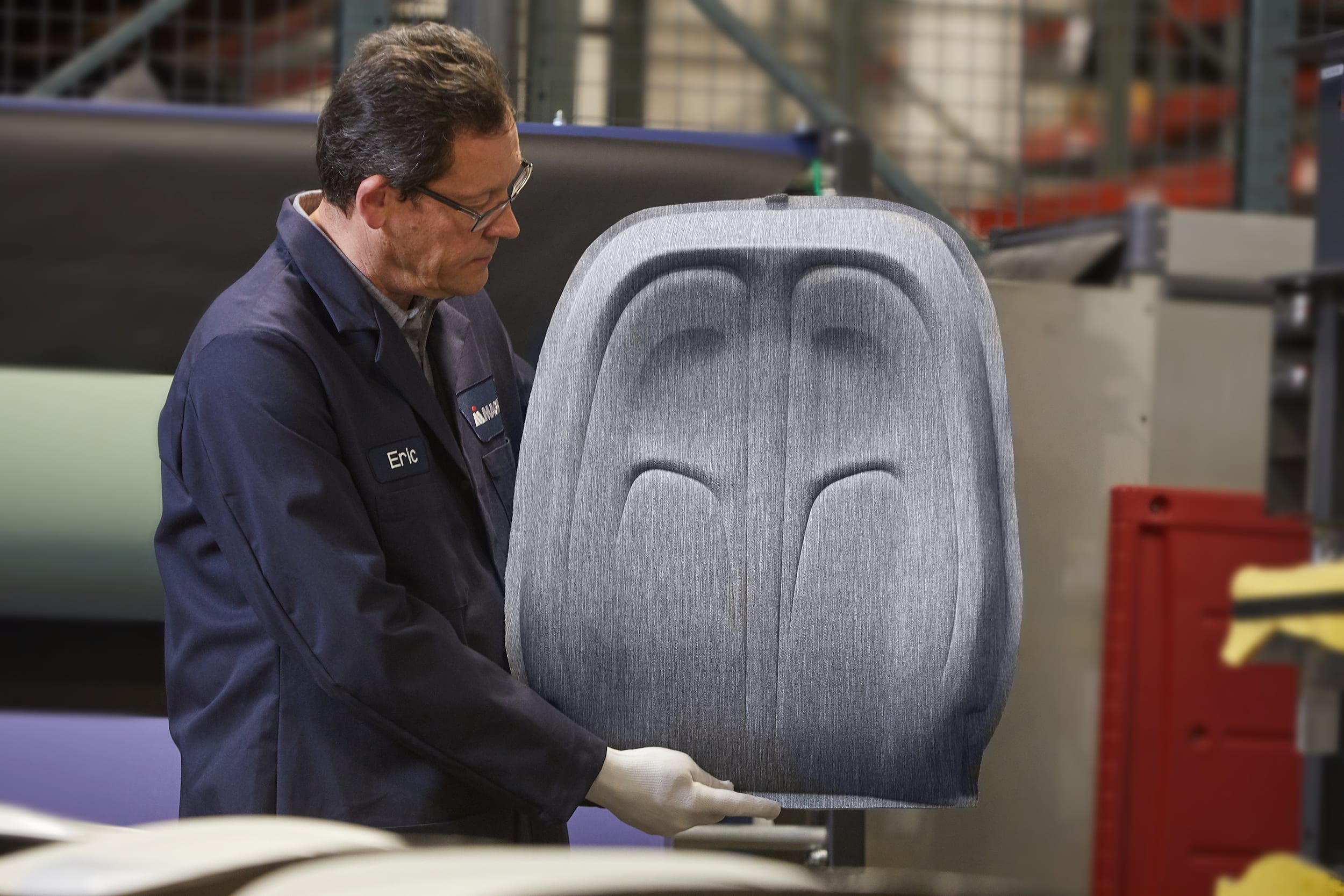
Seat comfort and clean cover surfaces are high on the list of interior “wants” for consumers, but seats designed and produced with traditional cut-and-sew surfaces can dull the comfort level and impede the cleaning process. Seating specialist Magna has an answer: a next-generation seat trim cover that began with a new foam formulation created by the global supplier’s in-house chemists.


“The new chemistry formulation is really the breakthrough, as it allows us to create a new foam laminate. We can mold shapes with this construction that are not feasible with the traditional cutting and sewing of trim covers,” Dino Nardicchio, global vice president of advanced technology engineering for Magna Seating, said in an interview.
Compared to current molded trim technologies, Magna’s FreeForm is four times more breathable. The seat trim cover technology, produced via a patent-pending process, also enables design details as precise as a 3 to 4 mm (0.118 to 0.157-in) radius versus the 20 to 25 mm (0.787 to 0.984-in) for traditional cut-and-sew. Deep draws on a seatback mean second- or third-row occupants can gain up to 4 in (102 mm) of additional knee clearance.
Seat cleaning is aided by FreeForm’s sculpted, seamless surface. “Consumers identify the small crevices between the seat bolster and insert as being very undesirable, as debris collects in these areas, which makes the seat difficult to clean,” Nardicchio said.
Multi-material surfaces within the same seat cover—such as leather and suede, vinyl and leather, cloth and vinyl or another mixed-material combination—are possible. Zipper on/off covers are another option. “We have the means to remove the topper cover to either clean it or replace it via a zipper. This is especially appealing for ride sharing domains because fleet owners want the ability to clean vehicle interiors with minimal downtime,” said Nardicchio.
Up to 80 conventional trim attachment components, including listing wires, are eliminated because FreeForm uses hidden tiedowns, said Nardicchio. “Without all of these components, there is much better surface control.”

Magna’s FreeForm seat covers could reach the marketplace as early as 2021. “It’s perfect for (vehicle) mid-cycle trim changes, because the base foam pad is common. We can literally provide differentiation by simply removing the topper cover,” Nardicchio said. FreeForm can be used in vehicle programs of any volume.
More From SAE Media Group
Automotive Engineering
Seats and Instrument Panel in Faurecia's Autonomous Vehicle Sights
Autonomous Vehicle Engineering
Magna Fighting COVID-19 with Ozone
Automotive Engineering
New Magna Seat Puts Connectivity in the Second Row
Aerospace & Defense Tech Briefs
Etihad and Eos Partner to Develop 3D-Printed Cabin Interiors
Automotive Engineering
Chevrolet Unveils 2024 Corvette E-Ray Hybrid
Aerospace & Defense Tech Briefs
Latest Boeing Business Jets 777X VIP Cabin Concept Debuts at MEBAA in Dubai
Automotive Engineering
2026 Escalade IQL Is Cadillac’s Biggest, Roomiest EV Yet
Automotive Engineering
Porsche to Use 3D Printing to Customize Seats
Automotive Engineering
What We’re Driving: 2020 Infiniti QX80
Automotive Engineering
Toyota Muscles-Up 4-Cylinder for Revised 2022 GR 86 Coupe
Automotive Engineering
Cadillac Counts on 2025 Escalade IQ for EV Sizzle
Automotive Engineering
2024 Lincoln Nautilus: The Brand’s First Global SUV
Automotive Engineering
Johnson Controls Presents Interior Concept for Autonomous Driving at 2015 NAIAS
Automotive Engineering
Yanfeng Shows Autonomous Vehicle Interior Concepts
Automotive Engineering
VW Introduces Singular ID.Buzz in Three-Row Layout
Automotive Engineering
Honda Expands Its Virtual Development
Automotive Engineering
What We’re Driving: 2020 Nissan Versa SR
Automotive Engineering
Toyota Stretches SUV Line-Up with World Debut of Grand Highlander
Automotive Engineering
What We’re Driving: 2020 Genesis G90 Ultimate
Automotive Engineering
2022 Jeep Compass Gets Class-Leading Safety Upgrades
Automotive Engineering
2019 Suzuki Jimny
Automotive Engineering
Honda E Prototype Makes It Simple, Again
Automotive Engineering
2019 VW Beetle Convertible Final Edition
Automotive Engineering
Johnson Controls to Create World's Largest Interiors Company with Chinese Firm
Automotive Engineering
Active Seatbelt Retractor
Automotive Engineering
Kia Announces New Interior Features for 3rd-Gen Sorento
Automotive Engineering
Hyundai Bears down on EV Charging, Sustainability
Automotive Engineering
All-Wheel-Drive Returns to Chrysler Pacifica for 2021
Automotive Engineering
2021 Cadillac Escalade Brings Curved OLED to the Dash
Automotive Engineering
What We’re Driving: 2020 Nissan Sentra 2.0 SR CVT
Top Stories
INSIDERManufacturing & Prototyping
 How Airbus is Using w-DED to 3D Print Larger Titanium Airplane Parts
INSIDERManned Systems
 FAA to Replace Aging Network of Ground-Based Radars
NewsTransportation
 CES 2026: Bosch is Ready to Bring AI to Your (Likely ICE-powered) Vehicle
NewsSoftware
 Accelerating Down the Road to Autonomy
EditorialDesign
 DarkSky One Wants to Make the World a Darker Place
INSIDERMaterials
 Can This Self-Healing Composite Make Airplane and Spacecraft Components Last...
Webcasts
Defense
 How Sift's Unified Observability Platform Accelerates Drone Innovation
Automotive
 E/E Architecture Redefined: Building Smarter, Safer, and Scalable...
Power
 Hydrogen Engines Are Heating Up for Heavy Duty
Electronics & Computers
 Advantages of Smart Power Distribution Unit Design for Automotive...
Unmanned Systems
 Quiet, Please: NVH Improvement Opportunities in the Early Design...
