




New Magna Seat Puts Connectivity in the Second Row
New automated seating system improves passenger ingress and egress.
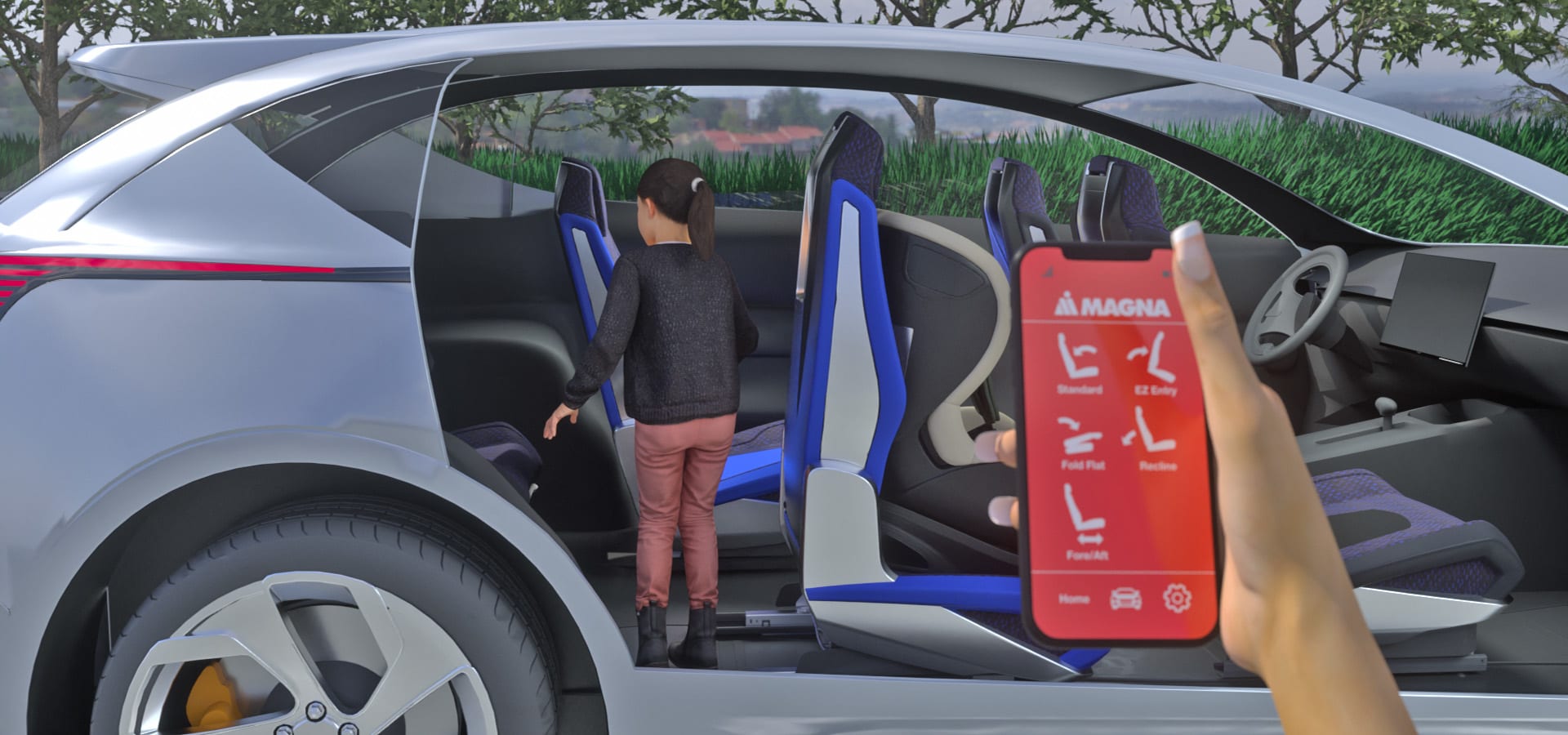
With one tap of a smartphone app, second-row vehicle seats can be quickly reconfigured to accommodate fold-flat cargo or provide an easier entry and exit route to third-row seating. Magna’s next-generation EZ Entry seat automates the functionality of the company’s current-gen EZ Entry seat, while providing the looks and feel of “a first-row experience,” the company’s seating engineering director Joe Meyer told SAE International.. The new seating feature is expected to enter production for the 2023 model year.
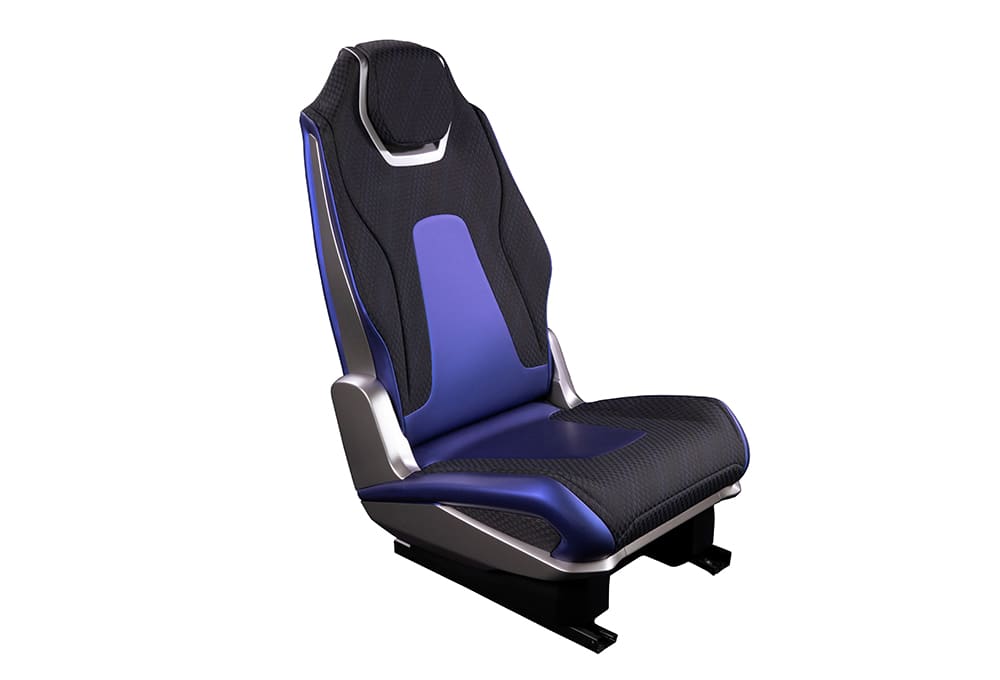

Magna’s current-generation EZ Entry seat, which launched on the Chevrolet Traverse in 2016, has manual-only adjustments. Control of the new seat’s movements comes not just by smartphone app, but also via a cluster of in-vehicle buttons or the vehicle’s interactive digital screen, Meyer explained.
A potential foot-snagging point related to the second-row seat striker (part of the latching mechanism on the incumbent EZ Entry design) has been eliminated. “You need a place to land your feet and the striker was something that could be simplified, improved, and relocated,” Meyer said, noting the now-enclosed mechanism’s under-seat placement.
The new seat design features a simplified bill of material (BoM); it uses five linkages versus nine on the previous seat. Fewer components contribute to a mass savings of up to 3 kg (6.6 lb) per seat. The new design offers up to 75 mm (2.95-in) of additional seat cushion area. The demonstrator has two under-seat motors: one controls fore-and-aft track movement and one motor controls the pitching arc of the seat base. A separate motor within the seatback controls the upright support.
For cargo loading, the next-generation version folds flat to a 3-degree angle, same as the current EZ Entry. The folding method differs from the current seat, however. “There’s still a diving motion. But the kinematic motion of the optimized linkage is rearward and down, rather than the current linkage pushing the seat cushion forward and down,” Meyer said. The pitch-and-slide movements also permit an attached child car seat to stay in place during power-recline adjustments.
The seat demonstrator being shown to industry customers and media also showcases Magna’s FreeForm sculpted, seamless seat surface. Unlike a traditional cut-and-sew seat trim cover, FreeForm eliminates the small crevices that can harbor debris. FreeForm launched in third-quarter 2020 for a GM-model seatback panel. Magna is “working with multiple OEMs for an A surface,” Meyer said. A second-row single seat and a 60/40-split bench seat also are under development. The bench seat has been fully tested, he said.
More From SAE Media Group
Automotive Engineering
Toyota Stretches SUV Line-Up with World Debut of Grand Highlander
Automotive Engineering
What We’re Driving: 2020 Infiniti QX80
Automotive Engineering
2019 Suzuki Jimny
Automotive Engineering
What We’re Driving: Toyota Land Cruiser
Automotive Engineering
Honda Fills a Gap with 2019 Passport
Automotive Engineering
2026 Escalade IQL Is Cadillac’s Biggest, Roomiest EV Yet
Automotive Engineering
Magna’s New FreeForm Enables Sculpted, Seamless Seat Surface
Automotive Engineering
Cadillac Counts on 2025 Escalade IQ for EV Sizzle
Automotive Engineering
VW Introduces Singular ID.Buzz in Three-Row Layout
Automotive Engineering
Honda Expands Its Virtual Development
Automotive Engineering
GM Readies Comprehensive New Vehicle-Software Platform
Automotive Engineering
Porsche to Use 3D Printing to Customize Seats
Automotive Engineering
Toyota Muscles-Up 4-Cylinder for Revised 2022 GR 86 Coupe
Automotive Engineering
2024 Lincoln Nautilus: The Brand’s First Global SUV
Automotive Engineering
2021 Cadillac Escalade Brings Curved OLED to the Dash
Automotive Engineering
Seats and Instrument Panel in Faurecia's Autonomous Vehicle Sights
Automotive Engineering
When a Van Beats a Pickup
Automotive Engineering
Honda E Prototype Makes It Simple, Again
Automotive Engineering
Horsepower and Kilowatts Compete at 2019 Geneva Motor Show
Automotive Engineering
Hyundai Bears down on EV Charging, Sustainability
Automotive Engineering
What We’re Driving: 2020 Nissan Versa SR
Automotive Engineering
What We’re Driving: 2020 Genesis G90 Ultimate
Automotive Engineering
All-New 2019 Ram 1500 Launches with a Bed-Load of Innovations
Automotive Engineering
2022 Jeep Compass Gets Class-Leading Safety Upgrades
Automotive Engineering
Cadillac's Future-Tech Flagship
Automotive Engineering
Mercedes Reveals Its Experimental Safety Vehicle 2019 – Mobile Robot Included
Automotive Engineering
NAIAS 2019: Infiniti Debuts QX Inspiration SUV Concept
Automotive Engineering
BMW Previews an HMI Future Without Dashboard Screens
ADAS & Autonomous Vehicle Engineering
Inner Visions
Automotive Engineering
JLR Developing a “Morphable” Smart Seat
Top Stories
INSIDERManufacturing & Prototyping
 How Airbus is Using w-DED to 3D Print Larger Titanium Airplane Parts
INSIDERManned Systems
 FAA to Replace Aging Network of Ground-Based Radars
NewsTransportation
 CES 2026: Bosch is Ready to Bring AI to Your (Likely ICE-powered) Vehicle
NewsSoftware
 Accelerating Down the Road to Autonomy
EditorialDesign
 DarkSky One Wants to Make the World a Darker Place
INSIDERMaterials
 Can This Self-Healing Composite Make Airplane and Spacecraft Components Last...
Webcasts
Defense
 How Sift's Unified Observability Platform Accelerates Drone Innovation
Automotive
 E/E Architecture Redefined: Building Smarter, Safer, and Scalable...
Power
 Hydrogen Engines Are Heating Up for Heavy Duty
Electronics & Computers
 Advantages of Smart Power Distribution Unit Design for Automotive...
Unmanned Systems
 Quiet, Please: NVH Improvement Opportunities in the Early Design...
