




Gordon Murray Reveals Lightweight T.50 Supercar: V12, Ground-Effects Fan, $2.5-Million Pricetag
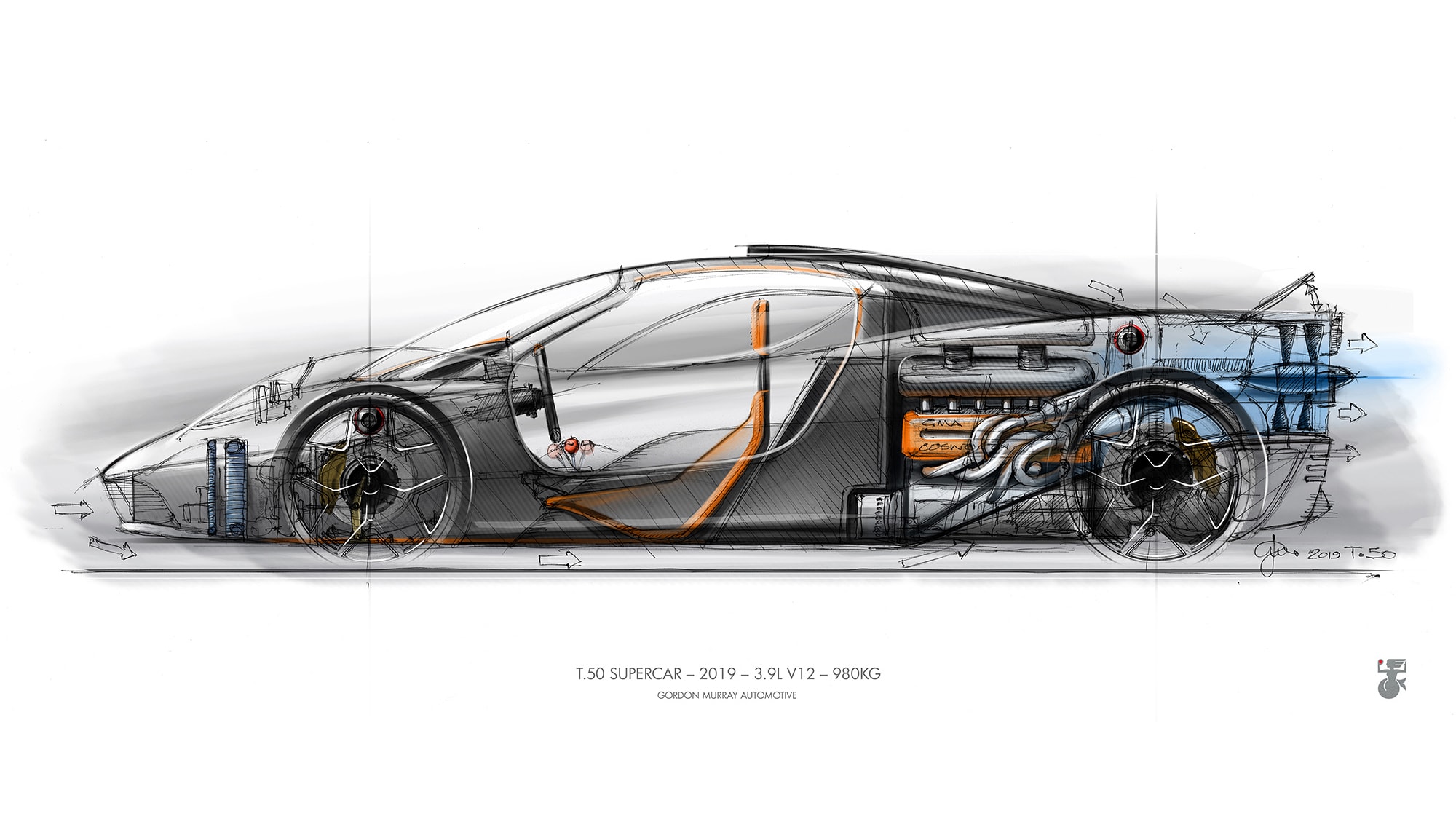
It will be the aural signature of Prof. Gordon Murray, Formula 1 racecar and environmental-efficiency vehicle creator: the sound of a bespoke V12 hitting its high note at 12,100 rpm as it delivers 650 hp with what is claimed to be the highest-revving, highest power-density naturally-aspirated engine ever used in a road car.
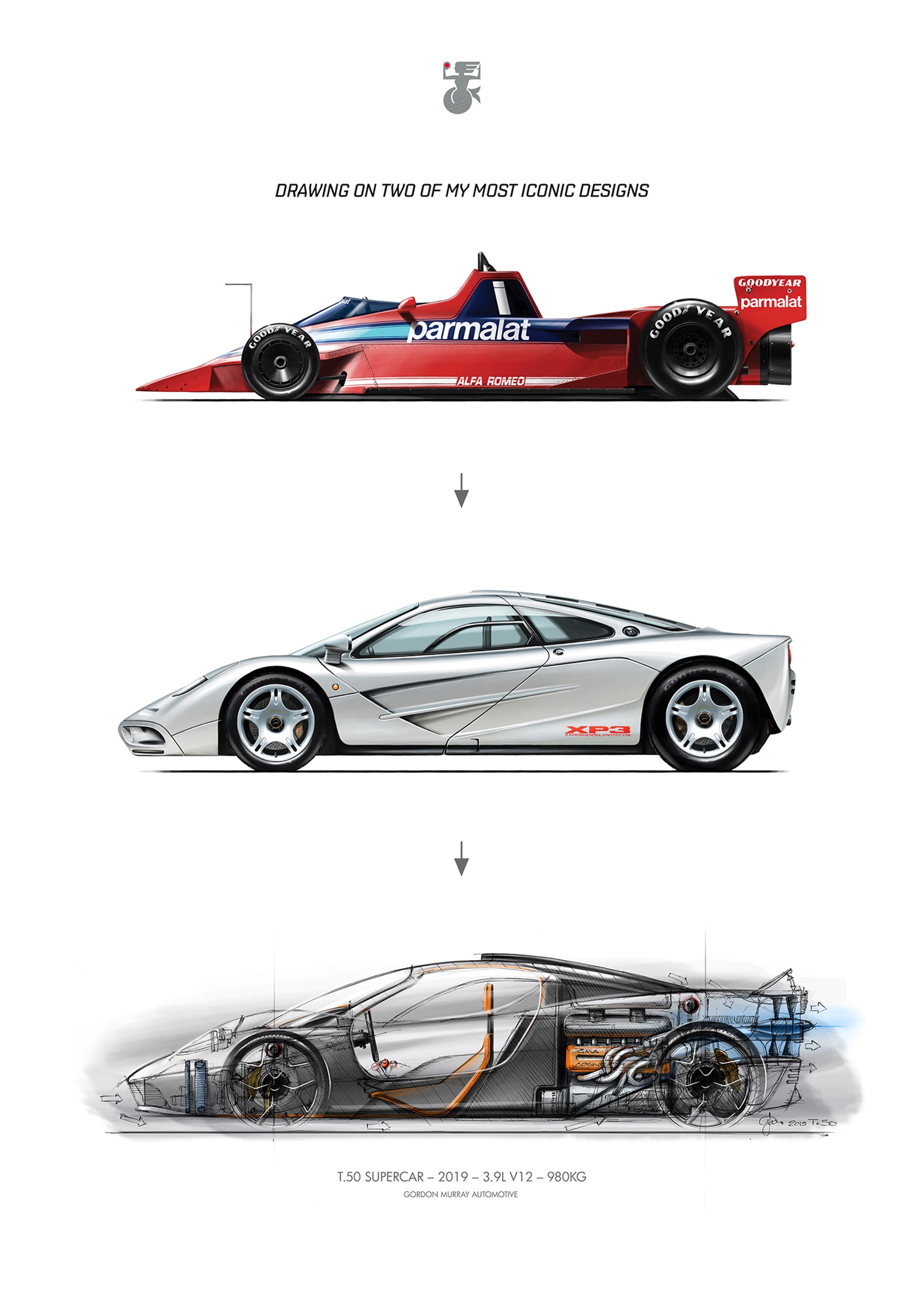
That car is Murray’s 3-seat T.50, a supercar that he sees as the spiritual successor to his McLaren F1 road car that accelerated instantly to classic status. The T.50, he believes, is likely to be “the last ‘analogue’ supercar.”
Murray describes its design and engineering as rewriting the supercar rulebook: “An unflinching dedication to lightweighting, highly-advanced active aerodynamics and world-leading standards of advanced engineering.” At the T.50’s core is the all-new, designed-by Cosworth for Gordon Murray Automotive (GMA) 3.9-L V12, its cylinders set at 65-degrees. Along with delivering 650 hp (485 kW) and torque of 450 Nm (332 lb-ft), the engine is fed intake air from a rooftop ram-air induction tract and benefits from weight-saving magnesium and titanium—and the lightweighting philosophy extends to zero consideration for hybridization, electrification or turbocharging.
Driver-focused The T.50’s V12 drives through a 6-speed manual gearbox to give performance figures of….what?
Unlike most car makers—particularly those presuming to build supercars—Murray isn’t driven by such details. He said the car has simply been designed, engineered and built to be as light, powerful, aerodynamic and driver-focused as possible, so target performance figures are not specifically in his equation. But a weight of 980 kg (2161 lb)—described by Murray as being approximately one-third lighter than the average supercar—that provides a power-to-weight ratio of 663 hp/ton indicates the potential for which others will be guesstimating.
Certainly those numbers will be exceptionally low for acceleration, but Murray regards top-speed-chasing as just resulting in added weight. “We are taking a very different approach,” he said, stressing, “We’re not interested in simply chasing numbers—and never will be.”
But then he adds: “Rest assured it will be quick!”
The engine, which is semi-structural, has been designed, developed and manufactured by Cosworth for GMA. Cosworth managing director Bruce Wood said, “Developing an engine that delivers superlative performance while meeting stringent emissions targets is a challenge that demonstrates Cosworth’s unique capabilities. To be so intrinsically aligned with a supercar that puts engine performance, response and lightweighting at the very heart of the driving experience is the ultimate accolade and underscores Cosworth’s reputation and capabilities as a leading OEM Tier One powertrain supplier.”
Xtrac, designer and manufacturer of high-performance transmissions and driveline components, is part of the T.50’s technology supplier team. Lightweight, monobloc alloy brake calipers clamp carbon-ceramic discs.
Ground-effects fan The T.50 may be light on weight but certainly not on technology; another claim for the T.50 is that it has “the most advanced aerodynamics of any road car,” incorporating plenty of Murray F1 know-how, including use of a 400-mm (15.7-in.) ground-effects fan similar to that of the Brabham BT46B F1 car of 1978, although there is nothing yesteryear about the T.50’s aerodynamics. GMA is working with “a Formula One team” and using its rolling road wind tunnel to good aerodynamic effect.
Murray has very clear opinions on aerodynamics and says the T.50 has purity of design, unhindered by “unsightly wings, outlets, vents or bulges.”
The car’s dimensions include a length of 4380 mm (172.4 in.) and width of 1850 mm (72.8 in.); the T.50 is charcterized as having a smaller footprint than the Porsche 911.
The hand-made, sandwich-panel monocoque of the T.50 uses high-modulus adhesive; panels are carbon composite and there is a carbon-fiber tub. Suspension includes double wishbones and anti-roll bar at the front and double wishbones at the rear. A powertrain mass damper is fitted.
The T.50, like Murray’s seminal F1 road car, has a central driving position forward of two flanking passenger seats and “jet fighter-style” visibility. Analog instruments are fitted and driver-centric controls are described as being positioned to provide “an even more intuitive” driving experience than the F1. Dihedral doors are fitted a la the F1 road car.
The price of all this? “In excess” of £2 million sterling (about $2.5 million)—and only 100 examples will be built at a new facility in southern England. All major components will be bespoke and U.K-sourced, GMA said.
When can you have one? Deliveries start in 2022, so plenty of time to save up.
More From SAE Media Group
Automotive Engineering
With 2019 Sierra, GMC Puts Brand Differentiation Behind It—literally
Automotive Engineering
What We’re Driving: 2018 BMW M5
Automotive Engineering
2018 Porsche 718 Boxster
Automotive Engineering
Ford’s Max Mustang Brings ‘World Class’ into the Sports Coupe Conversation
Automotive Engineering
Engineering the 2020 Chevrolet Corvette
Automotive Engineering
Lightweighting Tour-De-Force: 2021 Ducati Superleggera V4
Automotive Engineering
NAIAS 2022: Seventh-Generation of Ford Mustang Is Highest Performer Yet
Automotive Engineering
Volkswagen Unveils New-Generation Golf R
Automotive Engineering
Ford’s Latest Mustang Improves the Breed
Automotive Engineering
2020 Supra: Toyota's Japanese Spin on German Engineering
Automotive Engineering
Dodge Debuts Charger Daytona SRT Concept Electric Musclecar
Automotive Engineering
2019 Genesis G70 RWD
Automotive Engineering
2020 Toyota Camry TRD
Automotive Engineering
Civic Type R Is Honda’s Technology Showcase
Automotive Engineering
Driving the 2020 Corvette Stingray
Automotive Engineering
Brembo’s New Octyma Brakes Provide 8 Reasons for Better Deceleration
Automotive Engineering
Balancing the Scales in Dakar
Automotive Engineering
2018 Lexus LS500
Automotive Engineering
Gordon Murray Calls New IStream Superlight Chassis Concept a Paradigm Shift
Automotive Engineering
2019 Hyundai Veloster R-Spec
Automotive Engineering
The Ford GT
Automotive Engineering
Heavy Capability for Chevy’s 2020 Silverado Heavy-Duty Pickups
Automotive Engineering
2019 Dodge Challenger: Deceased Demon Seeds Stronger and Wider Muscle-Car Lineup
Automotive Engineering
2025 BMW M5 First Drive: Stuffed like Schnitzel with PHEV Tech
Automotive Engineering
What We’re Driving: 2020 BMW X3 M Competition
Automotive Engineering
What We’re Driving: 2019 Toyota Corolla Hatchback
Automotive Engineering
Toyota Muscles-Up 4-Cylinder for Revised 2022 GR 86 Coupe
Automotive Engineering
Engineering the Chevrolet Corvette's First-Ever Mid-Engine Architecture
Automotive Engineering
2019 Suzuki Jimny
Automotive Engineering
Chevy Reveals 2020 Corvette Stingray Convertible, C8.R Racer
Top Stories
NewsSensors/Data Acquisition
 Microvision Aquires Luminar, Plans Relationship Restoration, Multi-industry Push
INSIDERRF & Microwave Electronics
 A Next Generation Helmet System for Navy Pilots
INSIDERWeapons Systems
 New Raytheon and Lockheed Martin Agreements Expand Missile Defense Production
NewsAutomotive
 Ford Announces 48-Volt Architecture for Future Electric Truck
INSIDERAerospace
 Active Strake System Cuts Cruise Drag, Boosts Flight Efficiency
ArticlesTransportation

Webcasts
Aerospace
 Cooling a New Generation of Aerospace and Defense Embedded...
Energy
 Battery Abuse Testing: Pushing to Failure
Power
 A FREE Two-Day Event Dedicated to Connected Mobility
Automotive
 Quiet, Please: NVH Improvement Opportunities in the Early Design Cycle
Electronics & Computers
 Advantages of Smart Power Distribution Unit Design for Automotive &...
Unmanned Systems
 Sesame Solar's Nanogrid Tech Promises Major Gains in Drone Endurance