




Revolutionizing ADAS with Forward-Looking Lidar, Part I
The first installment in a multipart series on the potential lifesaving and cost-saving benefits of an advanced driver-assistance system (ADAS) with forward-looking lidar.
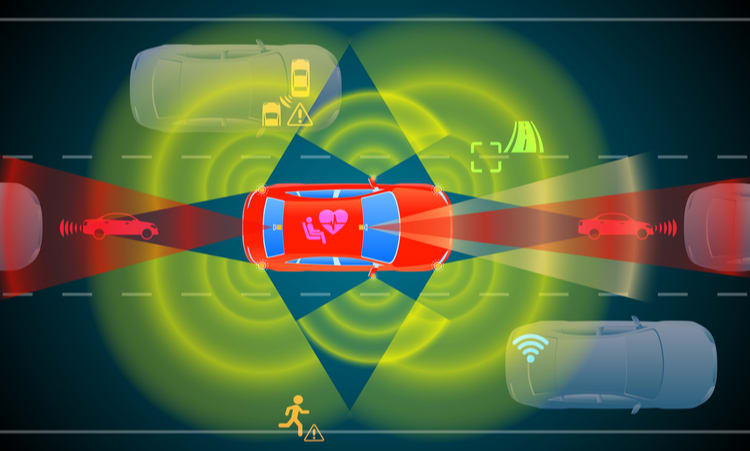
Most vehicle crashes are forward-facing and result from driver error. Although automakers are striving to develop advanced driver-assistance systems (ADAS) to prevent these crashes, there is still significant room for improvement. This multipart series explores how adding one cost-effective directional lidar (light detection and ranging) sensor would contribute to the prevention of forward-facing crashes.
Defining the problem
According to our analysis of 2016 figures provided by the National Highway Traffic Safety Administration (NHTSA), at least half of all crashes resulting in death, injury, or property damage were multi-vehicle collisions in which at least one vehicle was forward-facing.[1] Altogether, in 2016, this type of crash caused more than 12,000 fatalities; 1,200,000 injuries; and 2,700,000 additional reports of property damage only.[2] These multi-vehicle crashes include front-to-rear collisions, which comprised 32.6% of all 2016 crashes, and head-on collisions, which represented 2.6%. In addition, 20.9% of 2016 crashes were multi-vehicle collisions that occurred at an angle; it is reasonable to conclude that, in the vast majority of angle crashes, one vehicle experiences frontal impact.
Dr. David Heeren is the Senior Technical Product Marketing Manager at Velodyne Lidar Inc. Dr. Mircea Gradu is the Senior Vice President of Validation and Chief Quality Officer at Velodyne Lidar Inc.
References
[1] National Highway Traffic Safety Administration (NHTSA), “ Crashes by First Harmful Event, Manner of Collision, and Crash Severity , 2016”.
[2] These statistics are conservative because they reflect reported incidents, which may have involved multiple fatalities or injuries.
More From SAE Media Group
Automotive Engineering
Designing and Assessing Vehicle Safety Functions with a Use Case Approach

Autonomous Vehicle Engineering
GM Announces Door-To-Door Ultra Cruise ADAS
Automotive Engineering
Luminar Expands into Automotive LiDAR with $250 Million in Fundraising
Off-Highway Engineering
Canada’s Highway 407 ETR Tests High Contrast AV Highway Markings
Off-Highway Engineering
Peloton Develops a Level 4 Automated Platooning System, but Keeps the Driver in Charge

Automotive Engineering
Valeo Debuts New Lidars, EV Tech at CES 2022
Automotive Engineering
New Lidar Tech Illuminates CES 2022
ADAS & Autonomous Vehicle Engineering
AV Life After Argo AI
Automotive Engineering
Single-chip digital imaging radar heads for 2022 production

Off-Highway Engineering
Uhnder and Spartan to Partner on Hi-rez Radar
Off-Highway Engineering
Forward-Looking Lidar Can Revolutionize Driver-Assistance Systems
Off-Highway Engineering
Vermeer Concept Targets Autonomous Baling
Automotive Engineering
New R&D Boss Details RoboSense’s LiDAR Strategy
Photonics & Imaging Technology
Add LiDAR to ADAS for Pedestrian Safety
Automotive Engineering
Automated Vehicle Safety Series Addresses Design, Testing, Verification, and Validation
Automotive Engineering
SAE WCX 2022: OEM Learnings from Level 2 ADAS
Automotive Engineering
Expanding ADAS Roles for Radar and Cameras
Off-Highway Engineering
WCX 2019: IAMTS Association Will Establish Standardization and Testing for Connected Vehicles
Autonomous Vehicle Engineering
The ‘Buzz’ in Driverless Shuttling
Automotive Engineering
Osram and Vergence Automation Develop New Lidar and 4D Camera for Autonomous Vehicles
Automotive Engineering
Nvidia’s New Level 2+ Autonomy Platform Is Making Cars Safer Today
Autonomous Vehicle Engineering
New Roles for Lidar in Autonomy’s Lower Levels
Automotive Engineering
Honda to Reveal Autonomous Work Vehicle at CONEXPO
Automotive Engineering
SAE Rolls out Introduction to Automated Vehicle Safety in Shanghai
Autonomous Vehicle Engineering
Opsys Tech Demos Cost-Effective Solid-State Lidar-Module Prototypes
Top Stories
NewsRF & Microwave Electronics
 Microvision Aquires Luminar, Plans Relationship Restoration, Multi-industry Push
INSIDERAerospace
 A Next Generation Helmet System for Navy Pilots
INSIDERDesign
 New Raytheon and Lockheed Martin Agreements Expand Missile Defense Production
INSIDERMaterials
 How Airbus is Using w-DED to 3D Print Larger Titanium Airplane Parts
NewsPower
 Ford Announces 48-Volt Architecture for Future Electric Truck
ArticlesAR/AI

Webcasts
Electronics & Computers
 Cooling a New Generation of Aerospace and Defense Embedded...
Automotive
 Battery Abuse Testing: Pushing to Failure
Power
 A FREE Two-Day Event Dedicated to Connected Mobility
Unmanned Systems
 Quiet, Please: NVH Improvement Opportunities in the Early Design Cycle
Automotive
 Advantages of Smart Power Distribution Unit Design for Automotive &...
Energy
 Sesame Solar's Nanogrid Tech Promises Major Gains in Drone Endurance