




NASA Spacecraft Reaches Farthest Target in History
New Horizons successfully explores Ultima Thule
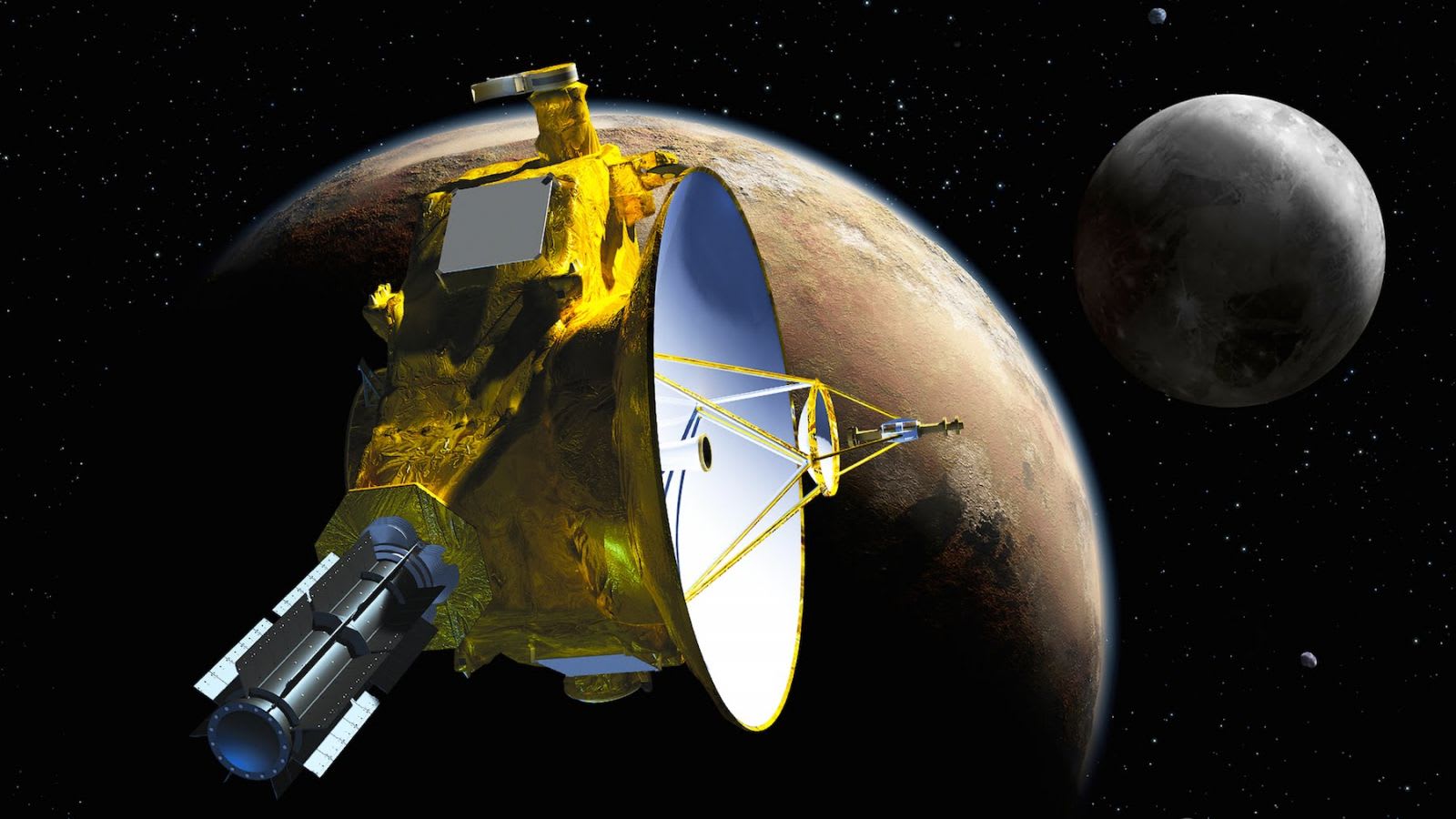
NASA 's New Horizons spacecraft flew past Ultima Thule in the early hours of New Year's Day, ushering in the era of exploration from the enigmatic Kuiper Belt, a region of primordial objects that holds keys to understanding the origins of the solar system.

Signals confirming the spacecraft is healthy and had filled its digital recorders with science data on Ultima Thule reached the mission operations center at the Johns Hopkins Applied Physics Laboratory (APL) almost exactly 10 hours after New Horizons' closest approach to the object.
"This flyby is a historic achievement," says New Horizons Principal Investigator Alan Stern of the Southwest Research Institute in Boulder, Colorado. "Never before has any spacecraft team tracked down such a small body at such high speed so far away in the abyss of space. New Horizons has set a new bar for state-of-the-art spacecraft navigation."
Images taken during the spacecraft's approach, approximately 17,000 miles (27,000 kilometers) away from Ultima Thule, reveal that the Kuiper Belt object – now being called a world – is a red “contact binary” object, 19 miles long, spinning end over end. Its remarkable appearance, unlike anything documented before, illuminates the processes that built the planets four and a half billion years ago.
“This object will revolutionize our understanding of planetary science,” says Stern.
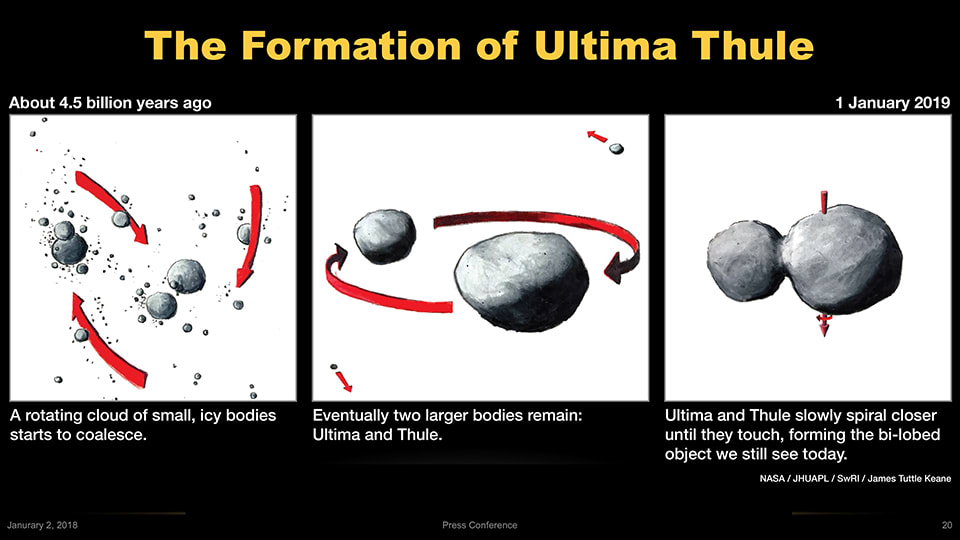
Researchers state that this is first discovered planetesimal – affirming a widely accepted planetary formation theory that stipulates that planets form through accretion and collision of dust. Researchers also believe that the two spheres collided extremely slowly as early as 99 percent of the way back to the formation of the solar system, with their mutual gravitational pull holding them together.
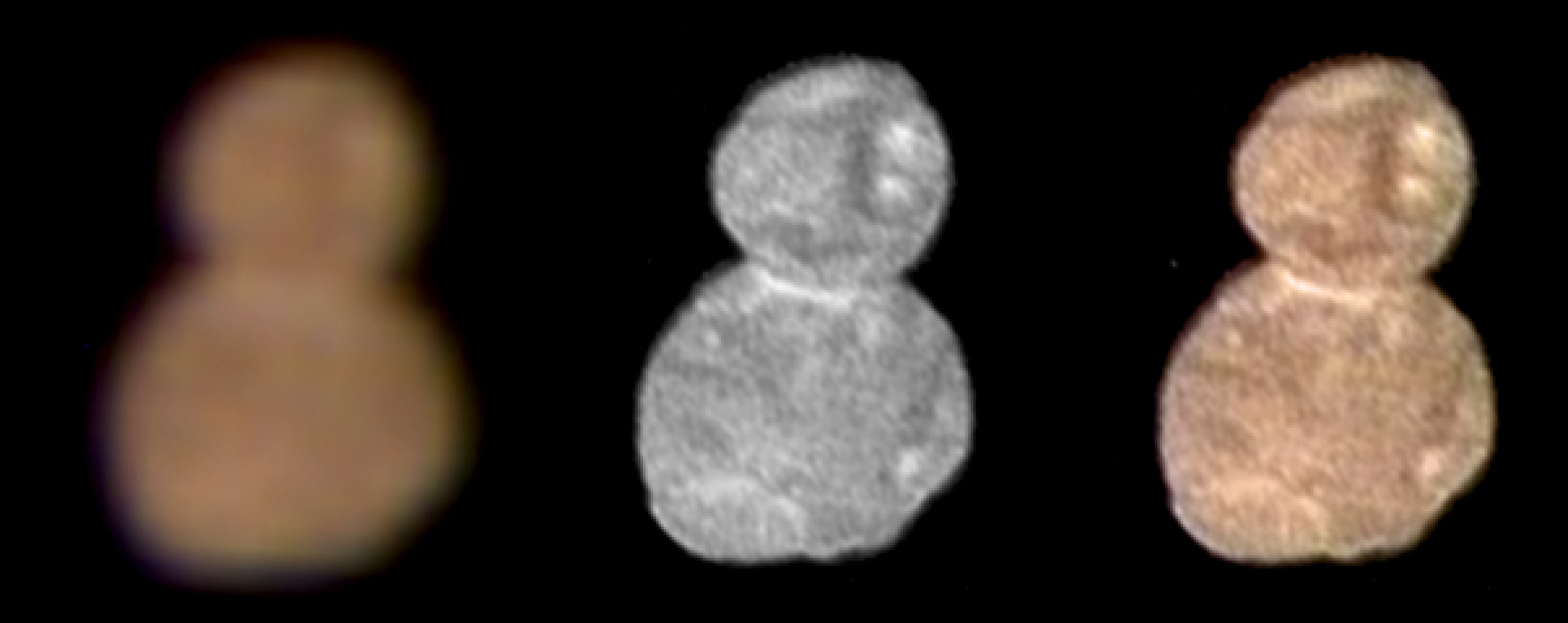
“New Horizons is like a time machine, taking us back to the birth of the solar system. We are seeing a physical representation of the beginning of planetary formation, frozen in time,” said Jeff Moore, New Horizons Geology and Geophysics team lead. “Studying Ultima Thule is helping us understand how planets form — both those in our own solar system and those orbiting other stars in our galaxy.”
Since determining the true shape of Ultima Thule, researchers have split the original name and designated the lobes Thule (the smaller lobe) and Ultima (the larger lobe). The latest photographs have enabled researchers to calculate that Ultima is almost exactly three times larger than Thule.
“New Horizons holds a dear place in our hearts as an intrepid and persistent little explorer, as well as a great photographer,” says Johns Hopkins Applied Physics Laboratory Director Ralph Semmel. “This flyby marks a first for all of us – APL, NASA, the nation, and the world – and it is a great credit to the bold team of scientists and engineers who brought us to this point.”
“Reaching Ultima Thule from four billion miles away is an incredible achievement. This is exploration at its finest,” said Adam L. Hamilton, president and CEO of the Southwest Research Institute in San Antonio. “Kudos to the science team and mission partners for starting the textbooks on Pluto and the Kuiper Belt. We're looking forward to seeing the next chapter.”
The New Horizons spacecraft will continue downloading images and other data in the days and months ahead, completing the return of all science data over the next 20 months.
When 465-kilogram New Horizons spacecraft launched atop a United Launch Alliance (ULA) Atlas V rocket in January 2006, it was bristling with an extensive suite of scientific equipment:
- Ralph: Visible and infrared imager/spectrometer; provides color, composition and thermal maps
- Alice: Ultraviolet imaging spectrometer; analyzes composition and structure of Pluto’s atmosphere and looks for atmospheres around Charon and Kuiper Belt Objects (KBOs)
- REX (Radio Science EXperiment): Measures atmospheric composition and temperature; passive radiometer
- LORRI (LOng Range Reconnaissance Imager): Telescopic camera; obtains encounter data at long distances, maps Pluto’s far side and provides high resolution geologic data
- SWAP (Solar Wind Around Pluto): Solar wind and plasma spectrometer; measures atmospheric “escape rate” and observes Pluto’s interaction with solar wind
- PEPSSI (Pluto Energetic Particle Spectrometer Science Investigation): Energetic particle spectrometer; measures the composition and density of plasma (ions) escaping from Pluto’s atmosphere
- VBSDC (Venetia Burney Student Dust Counter): Built and operated by students at University of Colorado; measures the space dust peppering New Horizons during its voyage across the solar system
New Horizons is the fastest spacecraft ever launched. It uses a hydrazine monopropellant fuel for its stabilization and trajectory correction thrusters and a plutonium-238-fueled radioisotope thermoelectric generator (RTG) for onboard power.
The New Horizon mission was authorized after being ranked at the top of the 2003 National Academies planetary decadal survey queue for medium-scale missions. Nine years into its journey, the spacecraft began its exploration of the Kuiper Belt with a flyby of Pluto and its moons. Almost 13 years after the launch, the spacecraft will continue its exploration of the Kuiper Belt until at least 2021. Team members plan to propose more Kuiper Belt exploration.
The Johns Hopkins Applied Physics Laboratory in Laurel, Maryland, designed, built, and operates the New Horizons spacecraft and manages the mission for NASA's Science Mission Directorate. The Southwest Research Institute, based in San Antonio, leads the science team, payload operations, and encounter science planning. New Horizons is part of the New Frontiers Program managed by NASA's Marshall Space Flight Center in Huntsville, Alabama.
William Kucinski is content editor at SAE International, Aerospace Products Group in Warrendale, Pa. Previously, he worked as a writer at the NASA Safety Center in Cleveland, Ohio and was responsible for writing the agency’s System Failure Case Studies. His interests include literally anything that has to do with space, past and present military aircraft, and propulsion technology.
Contact him regarding any article or collaboration ideas by e-mail at
More From SAE Media Group
Aerospace & Defense Tech Briefs
Live Footage of NASA’s First Mars Landing in Six Years
Aerospace & Defense Tech Briefs
Dragonfly Will Be NASA’s Next Solar System Explorer
Aerospace & Defense Tech Briefs
NASA InSight Landing a Success
Aerospace & Defense Tech Briefs
JAXA MINERVA-II1 Rovers Achieve Asteroid Landing, Autonomy, Image and Data Capture
Aerospace & Defense Tech Briefs
NASA Invests in Aerospace Start-Up, University Projects on CubeSat Platform
Aerospace & Defense Tech Briefs
Made in Space Is Set to Make in Space
Aerospace & Defense Tech Briefs
NASA Budget Amendment to Help Send Americans to Moon by 2024, Then Mars
Aerospace & Defense Tech Briefs
A New Expanding NASA Aeroshell Could Mean Larger Planetary Payloads
Aerospace & Defense Tech Briefs
FADA-CATEC Uses 3D Printing to Slim down the CHEOPS Satellite
Aerospace & Defense Tech Briefs
What Does NASA Do with a Space Station Originally Developed for a Now-Cancelled Mission?
Aerospace & Defense Tech Briefs
Lockheed Martin Validates Heatshield for the Mars 2020 Rover Mission
Aerospace & Defense Tech Briefs
NASA's Orion Spacecraft Is Complete, Assembled, and Ready for Integration Ahead of Final Testing
Aerospace & Defense Tech Briefs
“The Eagle Has Landed”
Aerospace & Defense Tech Briefs
U.S., India to Collaborate on Mars Exploration, Earth-Observing Mission
Aerospace & Defense Tech Briefs
Ultraviolet Spacecraft Camera
Aerospace & Defense Tech Briefs
New Zealand and LeoLabs Establish the First Low-Earth Orbit Regulatory Platform
Aerospace & Defense Tech Briefs
NASA Selects Power and Propulsion Module for Upcoming Lunar Gateway
Aerospace & Defense Tech Briefs
Northrop Grumman Tests, Qualifies Orion Launch Abort Motor for Flight in Cold Conditions
Aerospace & Defense Tech Briefs
Space Tango Takes Its Next Steps in Orbital Manufacturing
Aerospace & Defense Tech Briefs
First Orion European Space Module Delivered
Aerospace & Defense Tech Briefs
ISS Launches Largest Satellite to Date to Test Active Debris Removal
Aerospace & Defense Tech Briefs
New Horizons Spacecraft to Reach Ultima Thule
Aerospace & Defense Tech Briefs
Firefly Aerospace Is the Latest Addition to Florida’s “Space Coast”
Aerospace & Defense Tech Briefs
Lockheed Martin’s “Non-Operational” Space Fence Detects Indian Anti-Satellite Operations While Still in Test Mode
Aerospace & Defense Tech Briefs
Jeff Bezos Lays out Blue Origin’s Moon Shot, Debuts Lunar Lander
Aerospace & Defense Tech Briefs
Apollo Fusion Will Supply NASA JPL with MaSMi Hall Thrusters as Sole Licensed Manufacturer

Aerospace & Defense Tech Briefs
NASA Selects Frontier Aerospace to Continue Development of New Deep Space Thruster
Top Stories
NewsRF & Microwave Electronics
 Microvision Aquires Luminar, Plans Relationship Restoration, Multi-industry Push
INSIDERAerospace
 A Next Generation Helmet System for Navy Pilots
INSIDERDesign
 New Raytheon and Lockheed Martin Agreements Expand Missile Defense Production
INSIDERMaterials
 How Airbus is Using w-DED to 3D Print Larger Titanium Airplane Parts
NewsPower
 Ford Announces 48-Volt Architecture for Future Electric Truck
ArticlesAR/AI

Webcasts
Electronics & Computers
 Cooling a New Generation of Aerospace and Defense Embedded...
Automotive
 Battery Abuse Testing: Pushing to Failure
Power
 A FREE Two-Day Event Dedicated to Connected Mobility
Unmanned Systems
 Quiet, Please: NVH Improvement Opportunities in the Early Design Cycle
Automotive
 Advantages of Smart Power Distribution Unit Design for Automotive &...
Energy
 Sesame Solar's Nanogrid Tech Promises Major Gains in Drone Endurance