




Lockheed Martin Validates Heatshield for the Mars 2020 Rover Mission
The 15-foot wide heatshield, one half of the rover’s aeroshell, is the largest that Lockheed Martin has ever produced.
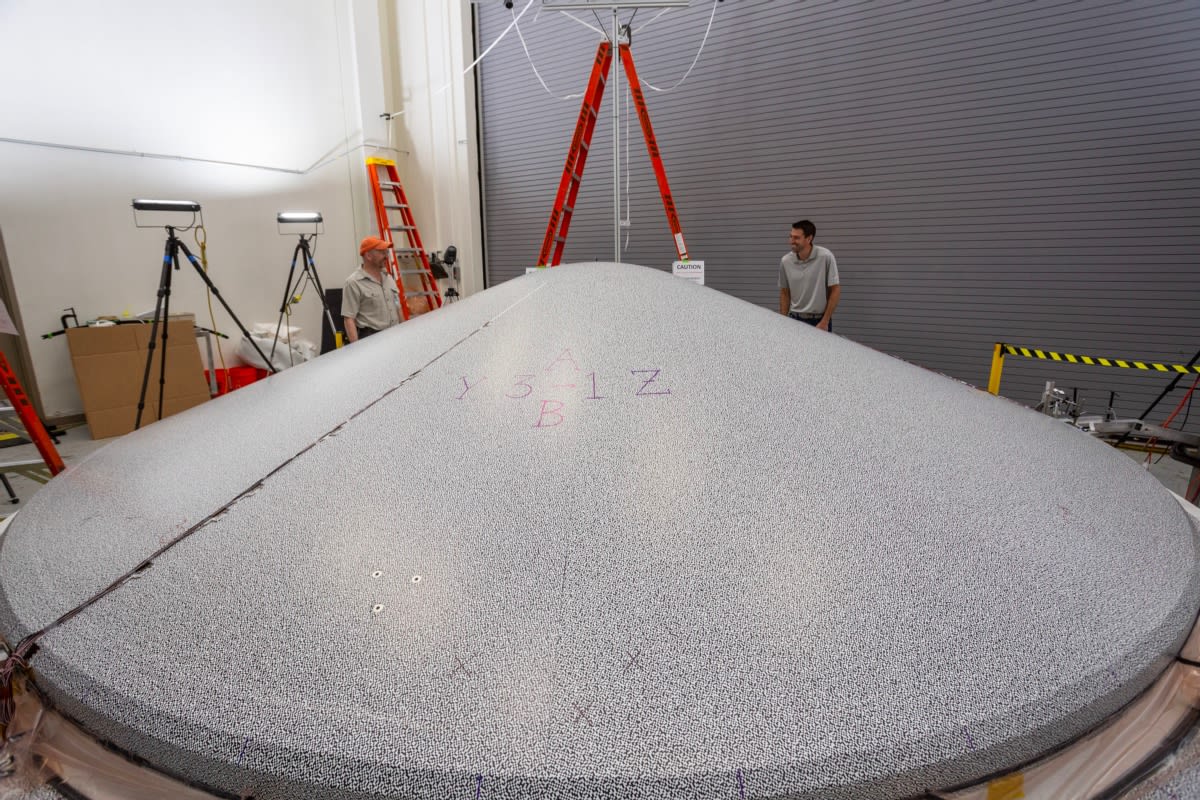
Lockheed Martin Corporation (Lockheed Martin) successfully completed development and testing for the heatshield that will protect NASA Jet Propulsion Laboratory (JPL) Mars 2020 rover during its descent to the Martian surface. After completing the flight hardware structure, Lockheed Martin tested the heatshield’s physical integrity by exposing it to ‘flight-like’ thermal conditions.
The heatshield serves as one half of the rover’s large, sophisticated, two-part aeroshell. Beyond protecting the rover from the extreme friction and heat that occurs during entry into the Martial atmosphere, the heatshield’s aerodynamics will act as a descent ‘brake’ to decelerate the spacecraft from approximately 12,000 miles per hour (19,300 kilometers per hour).
To validate the heatshield’s structure, engineers used vacuum pumps to simulate the load that the heat shield will experience during entry. The heatshield withstood approximately 140,000 pounds on pressure – 20 percent beyond of the expected flight load.
William Kucinski is content editor at SAE International, Aerospace Products Group in Warrendale, Pa. Previously, he worked as a writer at the NASA Safety Center in Cleveland, Ohio and was responsible for writing the agency’s System Failure Case Studies. His interests include literally anything that has to do with space, past and present military aircraft, and propulsion technology.
Contact him regarding any article or collaboration ideas by e-mail at
More From SAE Media Group
Aerospace & Defense Tech Briefs
Final Orion Capsule Parachute System Test Successful
Aerospace & Defense Tech Briefs
A New Expanding NASA Aeroshell Could Mean Larger Planetary Payloads
Tech Briefs
Flexible, Spinning Heat Shield for Spacecraft
Aerospace & Defense Tech Briefs
Northrop Grumman Tests, Qualifies Orion Launch Abort Motor for Flight in Cold Conditions
Aerospace & Defense Tech Briefs
Live Footage of NASA’s First Mars Landing in Six Years
Aerospace & Defense Tech Briefs
Made in Space Is Set to Make in Space
Aerospace & Defense Tech Briefs
Dragonfly Will Be NASA’s Next Solar System Explorer
Aerospace & Defense Tech Briefs
NASA's Orion Spacecraft Is Complete, Assembled, and Ready for Integration Ahead of Final Testing
Motion Design
Component Helps Perseverance Sample Mars
Aerospace & Defense Tech Briefs
Lockheed Martin’s “Non-Operational” Space Fence Detects Indian Anti-Satellite Operations While Still in Test Mode
Aerospace & Defense Tech Briefs
NASA Budget Amendment to Help Send Americans to Moon by 2024, Then Mars
Aerospace & Defense Tech Briefs
NASA and AeroVironment Are Building a Helicopter for Mars

Aerospace & Defense Tech Briefs
Mars Rover Electric Motors

Aerospace & Defense Tech Briefs
NASA Invests in Aerospace Start-Up, University Projects on CubeSat Platform
Aerospace & Defense Tech Briefs
Blue Origin Mission 9 a Success
Aerospace & Defense Tech Briefs
NASA Selects Power and Propulsion Module for Upcoming Lunar Gateway
Aerospace & Defense Tech Briefs
First Orion European Space Module Delivered
Aerospace & Defense Tech Briefs
Apollo Fusion Will Supply NASA JPL with MaSMi Hall Thrusters as Sole Licensed Manufacturer
Aerospace & Defense Tech Briefs
3D Printed Spacecraft Parts
Tech Briefs
Mars 2020 – Getting to Mars
Aerospace & Defense Tech Briefs
New Zealand and LeoLabs Establish the First Low-Earth Orbit Regulatory Platform
Aerospace & Defense Tech Briefs
JAXA MINERVA-II1 Rovers Achieve Asteroid Landing, Autonomy, Image and Data Capture

Test & Measurement INSIDER
NASA Completes Heat Shield Test for Future Mars Vehicles
Aerospace & Defense Tech Briefs
NASA InSight Landing a Success
Aerospace & Defense Tech Briefs
“The Eagle Has Landed”
Aerospace & Defense Tech Briefs
Astronaut Garbage Is a Serious Operational Concern When Travelling to the Moon and Mars
Top Stories
NewsRF & Microwave Electronics
 Microvision Aquires Luminar, Plans Relationship Restoration, Multi-industry Push
INSIDERAerospace
 A Next Generation Helmet System for Navy Pilots
INSIDERDesign
 New Raytheon and Lockheed Martin Agreements Expand Missile Defense Production
INSIDERMaterials
 How Airbus is Using w-DED to 3D Print Larger Titanium Airplane Parts
NewsPower
 Ford Announces 48-Volt Architecture for Future Electric Truck
ArticlesAR/AI

Webcasts
Electronics & Computers
 Cooling a New Generation of Aerospace and Defense Embedded...
Automotive
 Battery Abuse Testing: Pushing to Failure
Power
 A FREE Two-Day Event Dedicated to Connected Mobility
Unmanned Systems
 Quiet, Please: NVH Improvement Opportunities in the Early Design Cycle
Automotive
 Advantages of Smart Power Distribution Unit Design for Automotive &...
Energy
 Sesame Solar's Nanogrid Tech Promises Major Gains in Drone Endurance