




Tekscan Goes Fast-Track with Its High-Speed Tire Scanning

A new electronic testing method lets engineers analyze the impact of speed, motion, and inertial forces that high-speed tires experience, a vast departure from what was previously possible with sensor systems.
While Tekscan has a track record with tire-footprint analysis with as many as 250,000 sensing points, the length of time needed to scan that vast data array essentially meant that tire speeds could be no faster than 10 mph (16 km/h).

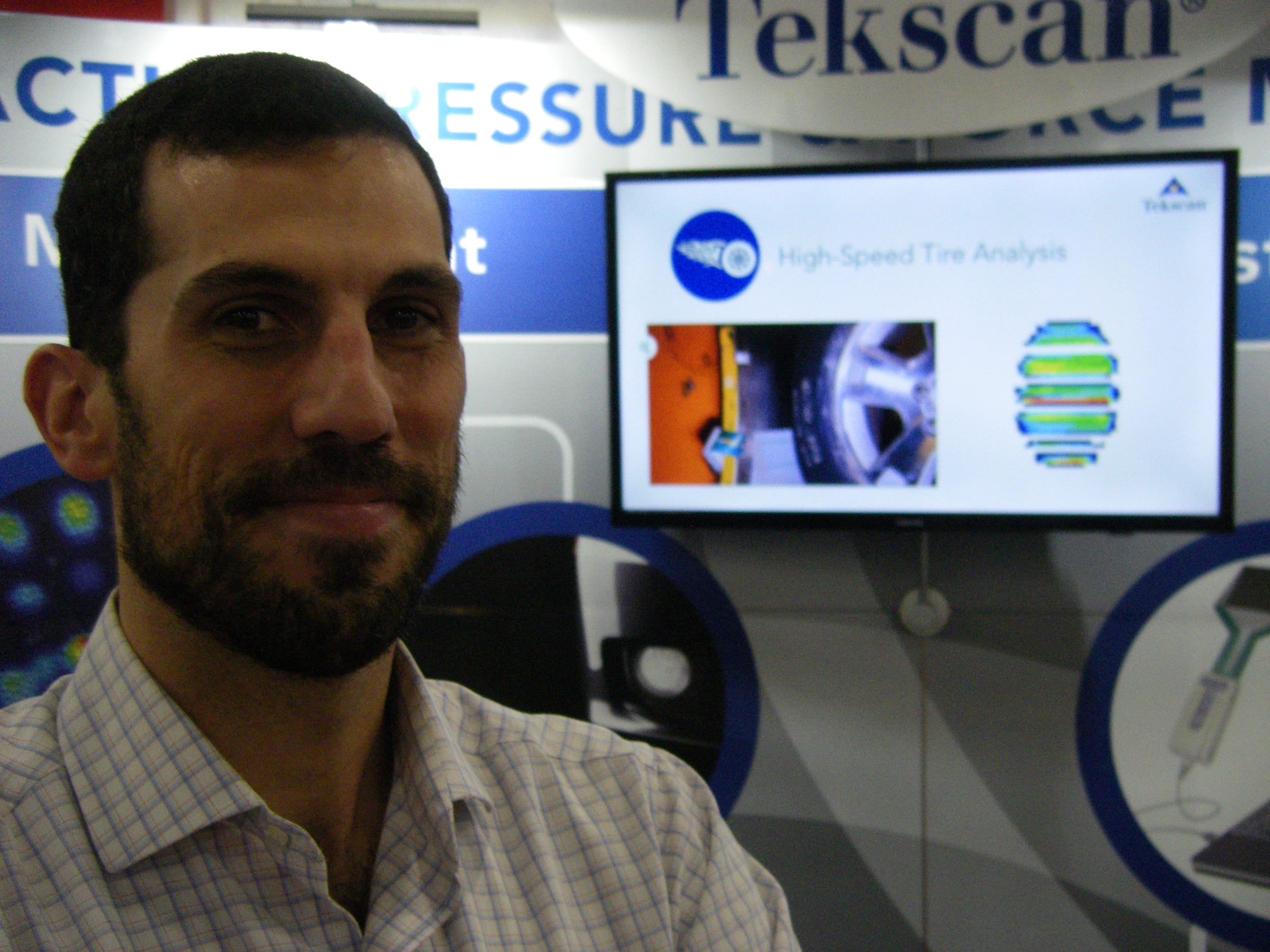
“But people studying tires also want to understand the impact of centrifugal forces at high-speeds, especially with handling being so important at highway speeds,” Camilo Aladro, Product Manager of Pressure Mapping for Tekscan Inc., said during a recent interview with Automotive Engineering.
Passenger-vehicle, commercial-truck, motorcycle, racecar and other types of tires can be tested with Tekscan’s High Speed TireScan™ via either a tethered or datalogger configuration. For the latter testing method, scanning electronics are affixed to a testing drum’s interior, a datalogger is fastened to the drum’s interior, a thin polyester-film sensor is affixed to the drum and a radio-transmitted signal triggers the recording of data.
Tire evaluators can use the high-speed scanning method to compare inflation pressures, different loads and different velocities.
“We know drivers don’t always operate their vehicles with standard tire-inflation pressures. That’s why it’s important for a tire manufacturer or an OEM to understand how a tire is going to perform for customers who are not giving all the tender loving care that tires need,” Aladro said.
In a recent test case, Tekscan’s High Speed TireScan was used on a specific tire model at a fixed load and inflation pressure. The test was repeated at double the velocity of the original test.
“As that tire was spinning faster, that speed was expanding the tire’s shoulder length. That’s obviously going to change the performance and handling of a vehicle, since at a higher speed there’s now a different contact area with the road,” said Aladro.
Tekscan’s high-speed testing system is capable of scanning multiple linear arrays across the tire’s width as the tire rolls across a single-sensing column at 20 kHz. While the tire is in motion, Tekscan software shows the tire’s shape and its pressure mapping.
“Being able to scan that column at 20kHz gives us the ability to recognize the tested tire’s footprint while it’s moving at speeds up to 165 mph (265 km/h). We can evaluate tire performance — even cornering performance — and identify failure modes,” said Aladro, adding, “Before this sensing system, you could get the dynamic movement of the tire. But what we were missing was the ability to capture and analyze the impact of centrifugal forces at higher speeds,” he explained.
More From SAE Media Group
Automotive Engineering
Discount Tire Tests So You Don’t Have To
Automotive Engineering
Deep Breathing for EV Batteries
Automotive Engineering
Leading Vehicle Prognostics Toward the AV Future
Motion Design
Making the Jump to Electric
Sensor Technology
Measurement Technology Drives Vehicle Development Forward

Off-Highway Engineering
Advances in Virtual Powertrain Development

Off-Highway Engineering
Daimler Truck and Torc Intensify Pursuit of Autonomous Trucks
Automotive Engineering
China Aims New EV Coolant Regulation at Battery Safety
Automotive Engineering
Unreliable Electronics Are the New Prince of Darkness
Automotive Engineering
Balancing the ‘Dominos’ in EV Thermal Management
Automotive Engineering
WCX 2024: Traditional OEMs Vs. Startups: Report to Cite Strengths, Weaknesses
Automotive Engineering
Soft Tests for Autonomous Vehicles
Autonomous Vehicle Engineering
'Road Race' for AV Testing May Be Slowing
Aerospace & Defense Tech Briefs
Sensuron Enables Real-Time Structural Health Monitoring Onboard NASA’s X-56 UAV
Automotive Engineering
ZF’s Latest Safety Advances Open Up, Tighten up and Double Down
Aerospace & Defense Tech Briefs
Laboratory Test Requirements for Marine Shock Isolation Seats
Automotive Engineering
Autonomous Transit Bus Nears Its First Year of Operation
Automotive Engineering
Hydrogen Storage Tank Options: Not Everything Need Look like a Sausage
Off-Highway Engineering
Transmission Talk: Eaton Discusses Its Portfolio of Commercial Gearboxes
Automotive Engineering
Data Analysis Companies Collaborate to Slash EV Battery Production Time
Automotive Engineering
Steering Toward Lower NVH
Automotive Engineering
Provizio Eyes Safety with Radar, Not LiDAR
Automotive Engineering
SAE Launches New Standards Document to Rate Power of Electrified Vehicles
Off-Highway Engineering
Advanced Simulation Techniques Drive Powertrain Design
Automotive Engineering
Tuning the 2024 Corvette E-Ray for Exceptional Drivability
Autonomous Vehicle Engineering
Making the Strategic Move into AV Testing
Autonomous Vehicle Engineering
'Level 2+': Making Automated Driving Profitable, Mainstream
Top Stories
INSIDERManufacturing & Prototyping
 How Airbus is Using w-DED to 3D Print Larger Titanium Airplane Parts
NewsAutomotive
 Microvision Aquires Luminar, Plans Relationship Restoration, Multi-industry Push
INSIDERAerospace
 A Next Generation Helmet System for Navy Pilots
INSIDERDesign
 New Raytheon and Lockheed Martin Agreements Expand Missile Defense Production
ArticlesAR/AI
 CES 2026: Bosch is Ready to Bring AI to Your (Likely ICE-powered) Vehicle
Road ReadyDesign

Webcasts
Semiconductors & ICs
 Advantages of Smart Power Distribution Unit Design for Automotive...
Unmanned Systems
 Quiet, Please: NVH Improvement Opportunities in the Early Design...
Electronics & Computers
 Cooling a New Generation of Aerospace and Defense Embedded...
Power
 Battery Abuse Testing: Pushing to Failure
AR/AI
 A FREE Two-Day Event Dedicated to Connected Mobility
