




Steering Toward Lower NVH
Systems-based analysis at Saint-Gobain shows how a small part can make a big difference to steering and to overall vehicle quality.

As regulations on automotive noise have become more stringent over the years, engine noise has been reduced significantly. This trend has increased with the rise of EVs and hybrid vehicles, modern quiet ICEs and stop-start systems. The overall impact has been positive for the environment on and around roads, as high levels of noise can cause human stress and other disruptions. This is also good news for drivers who want the solace of a quiet cabin. However, one problem with increasingly quiet vehicle propulsion systems is that the small noises—the little rattles and squeaks—become more obvious.
Improvements in road conditions and tire and suspension technology has meant that the driving experience has become smoother. This means that automotive systems that have a small effect on the comfort of a drive now become more obvious. This puts further demand on automotive parts to ensure a high-quality brand perception. Vehicle manufacturers need confidence that the components they purchase are going to deliver.
As Automotive Engineering readers know, only when engineers fully understand the challenges their customers face can they then provide effective solutions. Such is the case with evaluating the customer’s steering system with thorough testing and detailed investigation. Saint-Gobain engineers have found that that two important features of a steering system that can affect quality are noise and steering feel. And often the solution is a systems-based, rather than a component-based, approach.
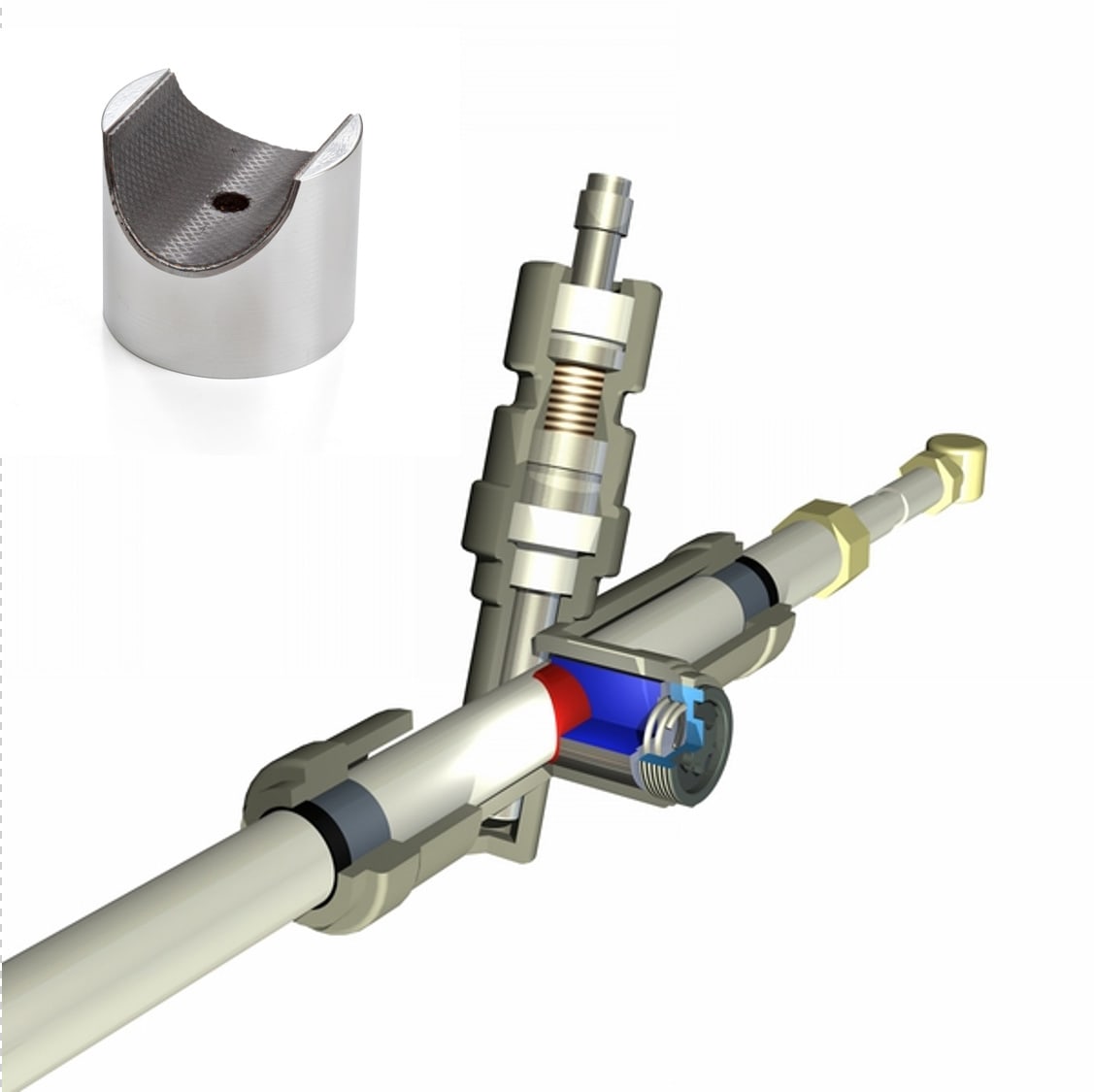
The steering yoke bearing (also known as the steering rack guide bearing) as seen in the Figure 1 illustration, performs a critical function in the steering system. The yoke bearing is used to ensure constant meshing between the rack and pinion gear teeth. If the gear teeth were to disengage, then the entire steering system would fail. The steering yoke bearing has to be pushed against the steering rack by a spring with typically 300 N (67.4 lb) of spring force (see https://www.bearings.saint-gobain.com/your-industry/automotive/chassis/steering-yoke-guide-bearing ).
The force applied to the steering yoke generates friction on the steering rack, which affects steering “feel.” Therefore, it is necessary to ensure that the yoke bearing’s sliding layer is well designed. Generally, yoke bearings will comprise a PTFE layer with a metal backing. The yoke bearing shape is typically designed so that there is line contact between the yoke bearing sliding layer and the steering rack. This creates a high pressure on the sliding surface which increases wear.
As the material is worn away, clearance can be produced between the rack and pinion’s gear teeth. Clearance here can cause “teeth chatter” or rattle.
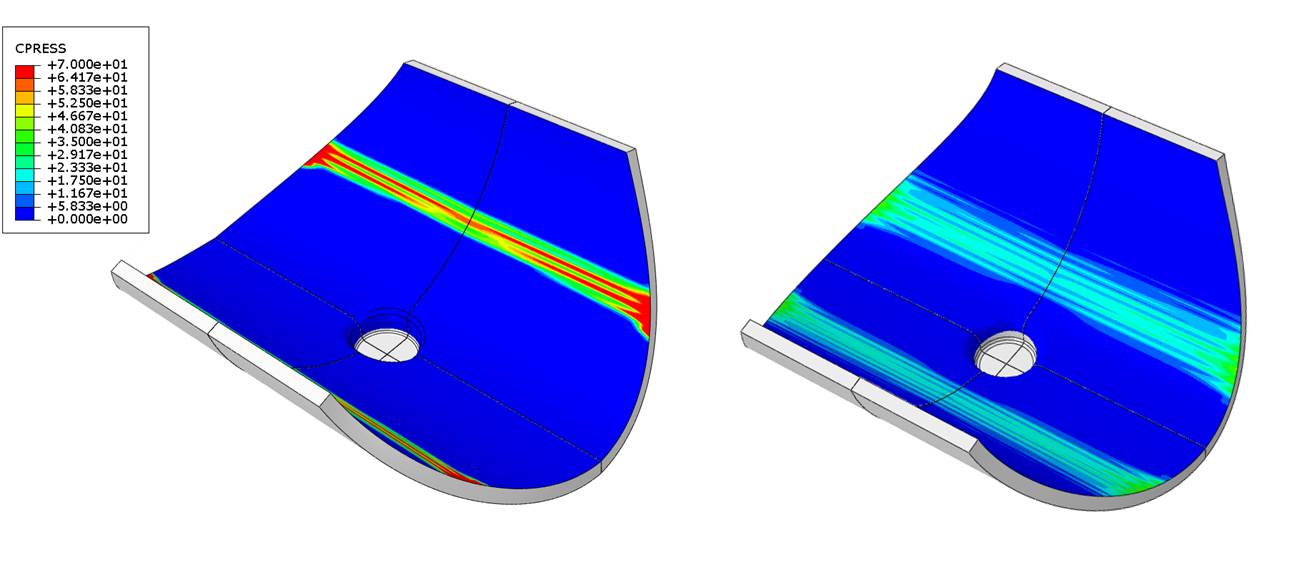
Steering yoke bearings that are tailored to individual customer needs and specifications are more likely to ensure a high-quality product throughout the lifetime of the vehicle. As an example, Figure 2 shows the finite element analysis (FEA) of the bearing pressure generated by two yoke bearing shapes—one shape with poor conformity to the rack that gives line contact, and one shape with higher rack conformity giving greater contact.
Steering rack yokes with greater contact shapes reduce the pressure and, therefore, the wear on the part. This results in less rattle in the steering system.

Another problem with a high wear rate is that the friction will increase over time. Analyses have determined that bearings that are made with sintered bronze and PTFE often have a thin PTFE layer, which when worn, exposes the bronze layer to the steering rack. This, in turn, increases the friction in the system.
The greater contact bearings that have a lower wear rate ensure that the metal part of the structure is not exposed. The effect of a durability test on the friction and stick-slip of a sintered bronze and PTFE product designed with line contact and two Norglide yoke bearings designed with greater contact, is shown in Figure 3.
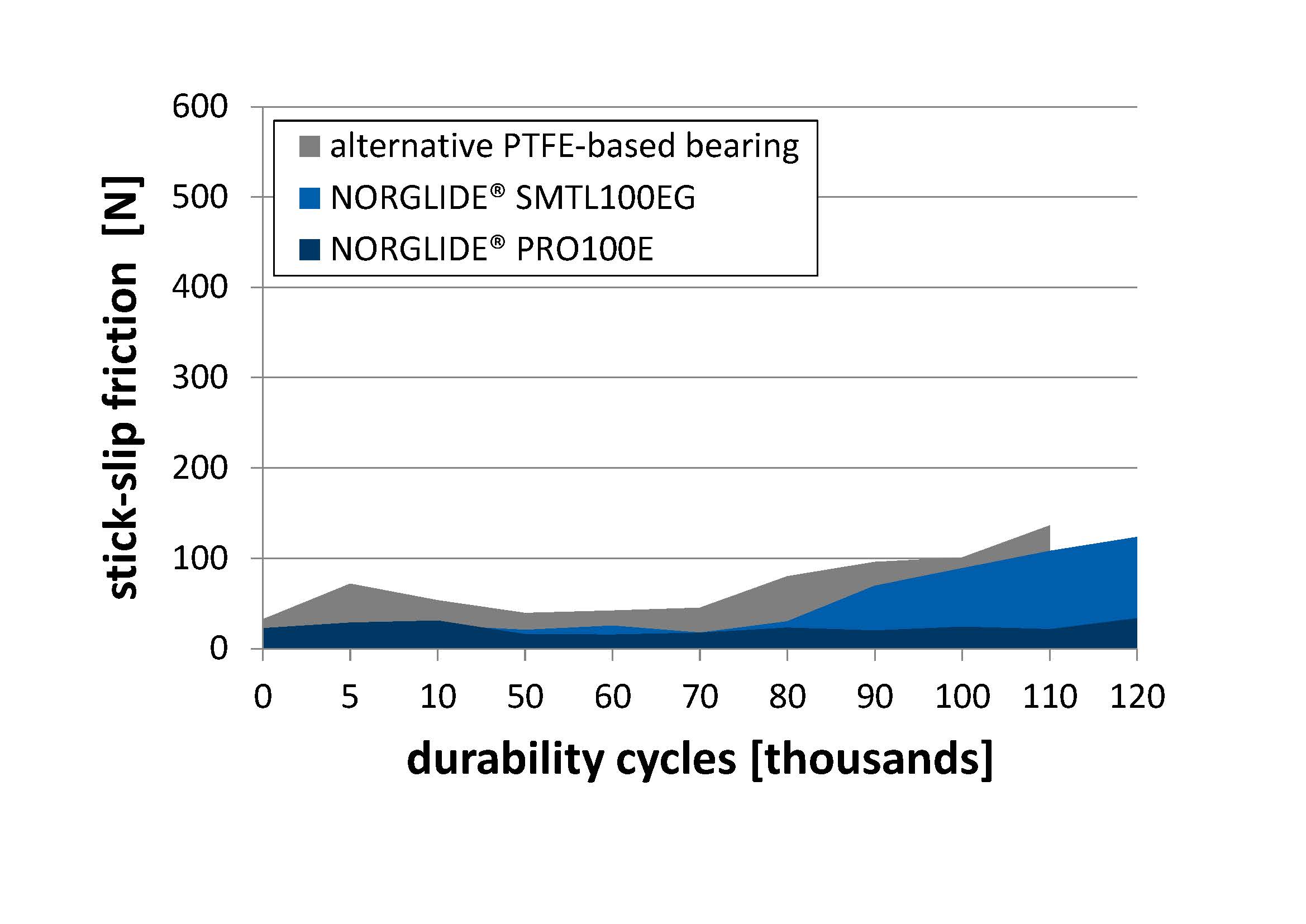
The sintered bronze and PTFE-based bearing has a significantly increasing friction value throughout the lifetime of the part, but the Norglide solutions maintain a consistent friction and stick-slip value.
By working in close collaboration with customers, engineers taking a systems approach can help to solve the problems that customers have with custom made solutions. Thorough testing gives confidence to the customers in the parts they buy.
About the author: Dr. Lethbridge is an NVH Engineer responsible for Norglide bearings and Rencol tolerance rings at Saint-Gobain. He is based in Bristol, U.K. He earned his Ph.D in Physics from the University of Exeter where he specialized in optical waves and oscillations in resonant systems.
More From SAE Media Group
Aerospace & Defense Tech Briefs
Testing Military Vehicle Steering Systems
Automotive Engineering
Latest NVH Simulation Tools Are Ultimate EV Buzz Killers
Off-Highway Engineering
Modern Approaches to Electric Vehicle Noise and Vibration
Automotive Engineering
EVs Drive NVH Material Innovations
Automotive Engineering
Engineering at the New NVH Frontier
Automotive Engineering
Metamaterials R&D Targets NVH Abatement
Motion Design
Built-In Vibration Control to Soundproof Spaces
Automotive Engineering
All-New Wind Tunnel Lets Honda Air It Out
Automotive Engineering
ZF’s Latest Safety Advances Open Up, Tighten up and Double Down
Automotive Engineering
2020 Explorer Will Be First Product to Emerge – More Quietly – from Ford’s Newest NVH Lab.
Automotive Engineering
GKN Spreads Premium Propshaft Tech to Quiet Pickup Cabins
Off-Highway Engineering
JLG Develops Self-Leveling Boom Lift
Off-Highway Engineering
Daimler Truck and Torc Intensify Pursuit of Autonomous Trucks
Battery Technology
An Immersive Solution for Thermally Safer EV Batteries
Tech Briefs
Meringue-Like Material Reduces Aircraft Noise
Tech Briefs
Compact, Lightweight, CMC-Based Acoustic Liner
Automotive Engineering
China Aims New EV Coolant Regulation at Battery Safety
Tech Briefs
Force Testing Profile Stings
Automotive Engineering
Vinfast Needs to Stop Digging
Automotive Engineering
Turning the Vehicle into a Giant Microphone
Off-Highway Engineering
Tekscan Goes Fast-Track with Its High-Speed Tire Scanning
Aerospace & Defense Tech Briefs
Confidence Through Testing: How to Design a Practical Structural Test Program
Tech Briefs
Analyzing Wear and Tear of Metal
Sensor Technology
Measurement Technology Drives Vehicle Development Forward

Tech Briefs
Flow-Through Transducer for Wind Tunnel Analysis
Automotive Engineering
Deep Breathing for EV Batteries
Automotive Engineering
Expanding the ‘Bubble’ of Cabin Acoustics
Automotive Engineering
A View Inside Volkswagen's Silicon Valley Lab
Automotive Engineering
AB Dynamics Provides New Drive-By-CAN Testing System
Top Stories
INSIDERManufacturing & Prototyping
 How Airbus is Using w-DED to 3D Print Larger Titanium Airplane Parts
NewsAutomotive
 Microvision Aquires Luminar, Plans Relationship Restoration, Multi-industry Push
INSIDERAerospace
 A Next Generation Helmet System for Navy Pilots
INSIDERDesign
 New Raytheon and Lockheed Martin Agreements Expand Missile Defense Production
ArticlesAR/AI
 CES 2026: Bosch is Ready to Bring AI to Your (Likely ICE-powered) Vehicle
Road ReadyDesign

Webcasts
Semiconductors & ICs
 Advantages of Smart Power Distribution Unit Design for Automotive...
Unmanned Systems
 Quiet, Please: NVH Improvement Opportunities in the Early Design...
Electronics & Computers
 Cooling a New Generation of Aerospace and Defense Embedded...
Power
 Battery Abuse Testing: Pushing to Failure
AR/AI
 A FREE Two-Day Event Dedicated to Connected Mobility
