




Stratasys LPM Technology Marries Additive Manufacturing, Short-Run Metal Parts Production
Stratasys seeks to help industry pioneer new era in 3D-printed production metal parts with proprietary Layered Powder Metallurgy (LPM) technology, aimed at production-grade metal parts for low-to-mid volumes.

Stratasys (Nasdaq:SSYS) in Eden Prairie, Minnesota, is developing a new additive manufacturing (AM) platform for short-run metal applications based on Stratasys’ Layered Powder Metallurgy (LPM) technology, designed to make production of metal parts faster, easier, and more cost-effective, with the goal of helping customers pioneer a new era in additive manufacturing for production-grade metal parts, officials say.
The advanced platform combines the value of additive manufacturing with short-run metal parts production, and is intended to disrupt conventional manufacturing approaches – driving improved efficiency and cost savings using standard powder metallurgy (PM) alloys, mechanical properties with high accuracy and controlled shrinkage, and fast throughput.
“Current approaches to 3D printing metal parts leave a lot to be desired – including slow postprocessing, painstakingly intricate support removal, and hours of matching and grinding,” Rafie Grinvald, director of product marketing and management at Stratasys. Combined with the high cost of AM powders, this means each part is expensive, with a total cost of ownership that is too hard to justify.
“Our new platform is being designed to transform the current metals additive manufacturing landscape – presenting a viable alternative to typical production methods – and helping customers dramatically reduce the costs of creating reliable, consistent production-grade, metal parts for short-run applications,” Grinvald adds.
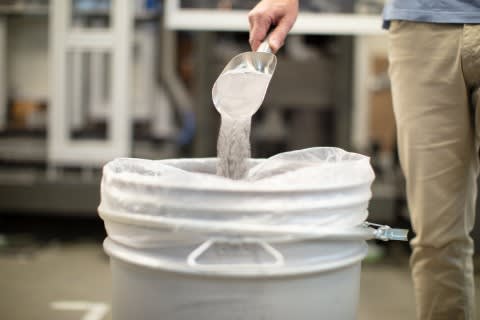
Stratasys’ LPM solution includes a three-step, additive manufacturing process combining traditional powder metallurgy, including aluminum powders, with Stratasys’ PolyJet inkjet technology. The process includes printing of boundaries with proprietary thermal ink, powder dispensing and spreading, and then compaction of the powder layer to achieve high-density and controllable shrinkage.
The system aims to directly address needs of aerospace, defense, and automotive customers who require production of pilot-series parts, small-batch manufacturing during product ramp-up and end-of-life, and customized, lightweight, complex parts.
Stratasys is a global provider of additive manufacturing/3D printing technology, and is the manufacturer of FDM and PolyJet 3D printers. The company’s technologies are used to create prototypes, manufacturing tools, and production parts for aerospace, automotive, healthcare, consumer products, and education industries. For 30 years, Stratasys products have helped manufacturers reduce product-development time, cost and time-to-market, as well as reduce or eliminate tooling costs and improve product quality, officials say. The Stratasys 3D printing ecosystem of solutions includes: 3D printers, materials, software, services, and on-demand parts production.
Working on aerospace systems and platforms? Wrestling with challenges? Have aerospace wisdom to share for the greater good of the industry? You're invited to get involved with SAE International -- contact
Courtney E. Howard is editorial director and content strategist at SAE International, Aerospace Products Group. Contact her by e-mail at
More From SAE Media Group
Aerospace & Defense Tech Briefs
Low Distortion Titanium in Laser Powder Bed Fusion Systems
Aerospace & Defense Tech Briefs
Evaluation of Additively Manufactured Ultrahard Steels
Automotive Engineering
Directing GM’s 3D-Printed Future
Tech Briefs
Sustainable 3D-Printed Magnets
Aerospace & Defense Tech Briefs
3D Printable Superalloy
Off-Highway Engineering
EOS Releases Four New Metal Materials for Series Additive Manufacturing
Tech Briefs
Using 3D Printing to Strengthen Jet Engines
Off-Highway Engineering
MELD Exploits Plastic Deformation of Metals with Non-Melt Additive Manufacturing
Aerospace & Defense Tech Briefs
Portable 3D Printing Factory
Tech Briefs
Executive Roundtable: 3D Printing
Automotive Engineering
3D Printing Scales-Up
Aerospace & Defense Tech Briefs
SAE International Issues First Technical Standards for Aerospace Additive Manufacturing
Medical Design Briefs
As 3D Printing Grows, Compounders Become Production Partners
Aerospace & Defense Tech Briefs
Metal-Plated, High-Temperature Plastics
Off-Highway Engineering
John Deere 3D-Prints Production Fuel Valves for Tractors
Off-Highway Engineering
Moving Metal AM Forward


Off-Highway Engineering
Bosch Invested in Large-Scale Metal 3D Printing
Aerospace Manufacturing and Machining
Getting the Most Out of Laser Wire Additive Manufacturing
Off-Highway Engineering
Additive Manufacturing Is Transforming Mobility Engineering, Driving the Factory of the Future
Aerospace & Defense Tech Briefs
Unlocking the Potential of 3D-Printed Polymers in Aerospace and Defense
Aerospace & Defense Tech Briefs
Physics-Guided Neural Network for Regularization and Learning Unbalanced Data Sets
Off-Highway Engineering
Mahle Advances 3D Printing Capabilities
Aerospace & Defense Tech Briefs
Equispheres Accelerates Additive Manufacturing Innovation with $5M from Lockheed Martin
Tech Briefs
Liquid Metal Lattice
Off-Highway Engineering
3DEO Launches New Metal 3D-Printing Platform
Automotive Engineering
Casting Around for Lightweighting Solutions
Aerospace & Defense Tech Briefs
Finding the Perfect Aluminum for Additive Manufacturing
Top Stories
NewsRF & Microwave Electronics
 Microvision Aquires Luminar, Plans Relationship Restoration, Multi-industry Push
INSIDERAerospace
 A Next Generation Helmet System for Navy Pilots
INSIDERDesign
 New Raytheon and Lockheed Martin Agreements Expand Missile Defense Production
INSIDERMaterials
 How Airbus is Using w-DED to 3D Print Larger Titanium Airplane Parts
NewsPower
 Ford Announces 48-Volt Architecture for Future Electric Truck
ArticlesAR/AI

Webcasts
Electronics & Computers
 Cooling a New Generation of Aerospace and Defense Embedded...
Automotive
 Battery Abuse Testing: Pushing to Failure
Power
 A FREE Two-Day Event Dedicated to Connected Mobility
Unmanned Systems
 Quiet, Please: NVH Improvement Opportunities in the Early Design Cycle
Automotive
 Advantages of Smart Power Distribution Unit Design for Automotive &...
Energy
 Sesame Solar's Nanogrid Tech Promises Major Gains in Drone Endurance