




Hardide Coatings Awarded Two Major UK Aerospace Funding Grants
The projects involve the development of a grinding and super-finish technology for the Hardide coating and development of ultra-low temperature coating that will increase the range of aerospace substrate materials suitable for Hardide coating.
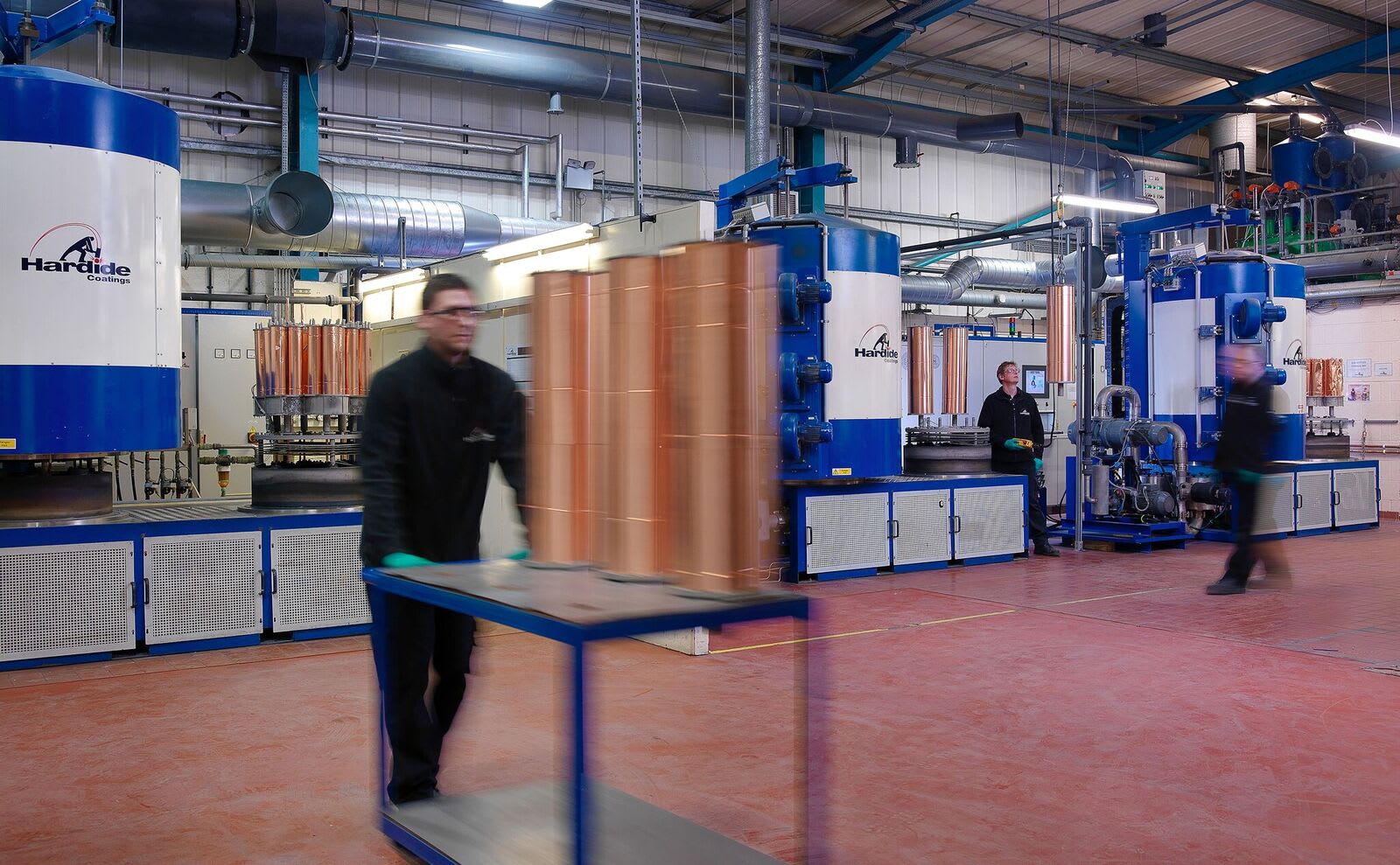
Today, Oxfordshire-based Hardide Coatings of Hardide plc in the United Kingdom (UK) was awarded funding from the National Aerospace Technology Exploitation Programme (NATEP) aerospace initiative. Hardide Coatings – which develops, manufactures and applies its proprietary Hardide-A coating – will use the funding to further develop two projects related to coating technology for aircraft components.
The first project –– is to develop a grinding and super-finish technology for the Hardide-A coating (“A” for “aerospace”). Hardide Coatings developed Hardide-A – a low-temprature chemical vapor deposition tungsten carbide coating – for the aerospace and defense industry as a replacement for toxic hard-chrome plating (HCP).
HCP has been a mainstay of industrial coating in aerospace, heavy equipment, automotive, and various other industries where extreme operating environments require corrosion- and wear-resistant coatings. An example of this would be in hydraulic aircraft landing gear or wing flap actuators where leak-tight seals are present. Corroded metal finishes can accelerate seal degradation and affect reliability, downtime, and maintenance costs.
HCP was banned in 2017 under European Union ’s Registration, Evaluation, Authorization, and Restriction of Chemicals (REACH) regulations because the hexavalent chrome salts used to produce HCP pose extreme health and environmental hazards. The substance is also highly regulated by the United States Occupational Safety and Health Administration (OSHA).
Hardide-A has less environmental impact, possesses versatile geometric compatibility, corrosion and fatigue resistance. These are big advantages over alternatives like high-velocity oxygen fuel (HVOF) coating, cadmium plating, and other coating processes where spray coatings cannot be used. Additionally, Hardide-A can be used to accurately coat interior surfaces and complex geometries. This enabling technology is proven to offer dramatic improvements in component life, particularly when applied to components that operate in very aggressive environments, like actuators, pistons, bushes, bearings, turbine blades, valves, landing gear, pins, hooks, and latches. The result saves airline operators cost through reduced downtime and increased operational efficiency.
Hardide Coatings’ project to develop grinding and super-finish technology is supported by Airbus of Toulouse, France; Perfect Bore Manufacturing Ltd of Andover, UK; and Engis (UK) Ltd. of Oxfordshire.
The second project is to develop the processing of an ultra-low temperature coating that will increase the range of aerospace substrate materials suitable for the Hardide coating process. Airbus, Leonardo Helicopters of Farnborough, UK are end-users and Perfect Bore Manufacturing and Westmoreland Mechanical Testing and Research Ltd. of Banbury, UK are support partners in this project.
“These grant awards were made after a rigorous application process and we will be working closely on the projects with our end-user customers. Both projects have the potential to expand significantly Hardide Coatings’ aerospace business, widening the range of aircraft components and substrate materials suitable for our coating technology,” says Philip Kirkham, CEO of Hardide Coatings.
Aerospace customers include Airbus, BAE Systems of Farnborough, UK, and Leonardo. Customers in other sectors include leading blue chip companies operating in oil and gas exploration and production, valve and pump manufacturing and precision engineering industries.
Both projects are commencing on September 1, 2018 and will each take 18 months to complete.
NATEP is a UK-wide, £14.4 ($18.6) million program established to mature 40 wide-ranging aerospace technologies in the UK aerospace supply chain. NATEP’s technology development list includes focuses like composites, design and modeling solutions, software, electronics, unmanned aerial vehicles (UAVs), big data, ground support, and maintenance, repair, and overhaul (MRO).
William Kucinski is content editor at SAE International, Aerospace Products Group in Warrendale, Pa. Previously, he worked as a writer at the NASA Safety Center in Cleveland, Ohio and was responsible for writing the agency’s System Failure Case Studies. His interests include 'literally anything that has to do with space,' past and present military aircraft, and propulsion technology. And also sportscars.
Contact him regarding any article or collaboration ideas by e-mail at
More From SAE Media Group
Aerospace & Defense Tech Briefs
Boeing Reports on Its Environmental Efforts
Aerospace & Defense Tech Briefs
Hardide Coatings to Construct Two Additional U.S.-Based Reactors
Aerospace & Defense Tech Briefs
SAE International Extends Call for Abstracts, Seeks Submissions for AeroTech Conference
Aerospace & Defense Tech Briefs
SAE International Issues, Revises Technical Reports for Aerospace Engineering
Aerospace & Defense Tech Briefs
Industry Invited to Participate in AeroTech Aerospace and Defense Technical Program
Automotive Engineering
Bye Aerospace’s Solar-Electric Prototype Completes First Flight
Aerospace & Defense Tech Briefs
Additive Manufacturing Adoption Up, Growing Rapidly in Aerospace
Aerospace & Defense Tech Briefs
The Challenge of Replacing Hard Chrome
Aerospace Manufacturing and Machining
Does Your Coating Thickness Meet Spec?
Aerospace & Defense Tech Briefs
SAE International Issues First Technical Standards for Aerospace Additive Manufacturing
Automotive Engineering
SAE International Releases New Process for Measuring Aerosols in Aircraft Exhaust

Automotive Engineering
Demand up for Composite-Grade, High-Performance Plastics Across Aerospace, Automotive
Aerospace & Defense Tech Briefs
Novel Chromium–Molybdenum Metal Alloy Withstands Extreme Conditions
Aerospace & Defense Tech Briefs
The Next Material Disruption
Aerospace & Defense Tech Briefs
NASA Invests in Aerospace Start-Up, University Projects on CubeSat Platform
Tech Briefs
Aluminum Electroplating Using Bromide Salts
Aerospace & Defense Tech Briefs
Cold Spray Technology
Aerospace & Defense Tech Briefs
Novel Whisker Mitigating Composite Conformal Coat Assessment


Off-Highway Engineering
Moving Metal AM Forward
Aerospace & Defense Tech Briefs
Advances in Adhesive Joining of Structural Components Focus of New Book from SAE International
Automotive Engineering
Unzipping the Future of Sustainable Electronics
Photonics & Imaging Technology
Bats Inspire Detectors to Help Prevent Oil and Gas Pipe Leaks
Automotive Engineering
Virtual and Physical Testing of Third-Generation High Strength Steel
Aerospace & Defense Tech Briefs
PPG Primes Second Location for New Aerospace E-Coat Pilot System
Aerospace & Defense Tech Briefs
Rolls-Royce Starts Lean-Burn Combustion Engine Icing Tests
Aerospace & Defense Tech Briefs
SAE International Launches Aerospace Technology Symposium at Japan Aerospace 2018
Top Stories
INSIDERManufacturing & Prototyping
 How Airbus is Using w-DED to 3D Print Larger Titanium Airplane Parts
INSIDERManned Systems
 FAA to Replace Aging Network of Ground-Based Radars
NewsTransportation
 CES 2026: Bosch is Ready to Bring AI to Your (Likely ICE-powered) Vehicle
NewsSoftware
 Accelerating Down the Road to Autonomy
EditorialDesign
 DarkSky One Wants to Make the World a Darker Place
INSIDERMaterials
 Can This Self-Healing Composite Make Airplane and Spacecraft Components Last...
Webcasts
Defense
 How Sift's Unified Observability Platform Accelerates Drone Innovation
Automotive
 E/E Architecture Redefined: Building Smarter, Safer, and Scalable...
Power
 Hydrogen Engines Are Heating Up for Heavy Duty
Electronics & Computers
 Advantages of Smart Power Distribution Unit Design for Automotive...
Unmanned Systems
 Quiet, Please: NVH Improvement Opportunities in the Early Design...
